
The Low-Energy Effective Action
A string amplitude contains both propagation over long spacetime distances and interactions localized on the scale of the string. A low-energy effective action must reproduce both. Its massless fields are the metric, the two-form, and the dilaton; their leading interactions give gravity coupled to matter. Higher powers of momentum reveal corrections to that description.
We will calculate two cubic amplitudes, explain how exchange subtraction determines local vertices, and derive the passage from the string metric to the Einstein metric. The global conventions, sphere prescription, and massless vertex analysis supply the normalizations and prerequisites. The physical flat-space bosonic theory here has . General will be useful for the frame algebra, with noncritical dynamics explicitly distinguished below.
The bosonic vacuum contains a tachyon. These calculations describe formal perturbative amplitudes about that unstable background; they do not construct a stable vacuum by treating the tachyon as an ordinary heavy particle.
A massless field coupled to two tachyons
Section titled “A massless field coupled to two tachyons”Write the massless matter vertex as
The oscillator-normalized matter operator from the state–operator map is . This minus sign is the product of the two factors associated with the left and right oscillators. Let shorten the following calculation.
Insert the massless operator at and tachyon operators at and , initially with real . All momenta are incoming. The tachyon mass shell and momentum conservation give
Separate the target-space momentum delta function. The exponential correlator is then . The derivative at the first insertion contracts with the two other exponentials:
Normal ordering excludes a contraction with its own exponential. Transversality allows us to replace the vector in parentheses by when contracted with . The antiholomorphic contraction has the same factor ; it is a second chiral calculation, not complex conjugation of the external momentum or polarization.
The grouped holomorphic and antiholomorphic ghost correlators give . Consequently the finite-position result for is
Every insertion-position factor has canceled before taking . For , the reduced kinematic factor is therefore
Here , so the result is invariant under the on-shell longitudinal shifts of . Its symmetric momentum tensor couples to the graviton and the physical scalar polarization, while its contraction with an antisymmetric polarization vanishes. The graviton part has the form expected from a metric coupled to scalar stress. The scalar part also involves the dilaton–metric mixture explained on the previous page.
The stripped amplitude is a common sphere normalization times . As in the sphere prescription, the sign from grouping interleaved odd ghosts is included once in that common normalization. The explicit operator phases and the relative signs inside the matter calculation have been retained. This calculation alone does not determine the numerical relation between the sphere normalization and .
Since the tachyons obey , this example is not a small-momentum expansion in all external momenta. It identifies a coupling using exact on-shell vertex operators.
Three massless vertices from Gaussian contractions
Section titled “Three massless vertices from Gaussian contractions”A general polarization tensor is a sum of factorized tensors. It therefore suffices to calculate with
These equations imply for every pair. Nontrivial three-point kinematics requires complex momenta, or the analytic continuation of an amplitude: real Lorentzian null momenta satisfying these conditions are collinear. Complex momenta are paired bilinearly with the continued Minkowski metric, without complex conjugation.
The one-pair and three-singleton terms
Section titled “The one-pair and three-singleton terms”Keep the positions . Define three momentum contractions
and the polynomials
has one power of momentum and has three. The letter in this polynomial denotes this product, not a new target coordinate.
For the three currents , contractions with the exponentials produce the means
The current–current covariances are
There are precisely four allowed Gaussian partitions of three currents: three singletons, or one pair and one singleton. The exponential correlator is one because all pairwise momentum products vanish. Wick’s theorem gives
The plus sign and the coefficient follow from the contractions. Gauge invariance alone cannot determine them: and separately vanish upon replacing any one by .
The holomorphic ghost correlator in the order is . Thus the ghost-dressed raw chiral factor is . Multiplying by the three oscillator factors gives
The right sector gives by the same calculation. Up to the common sphere normalization, the closed result is
This exhibits left–right factorization without assuming that the right polarization is the complex conjugate of the left one. Summing factorized tensors recovers arbitrary graviton, two-form, and scalar polarizations.
What the momentum orders tell us
Section titled “What the momentum orders tell us”The three terms in the product are
After the overall normalization is matched to gravity, the relative corrections have orders and . For pure metric states they are associated with curvature-squared and curvature-cubed interactions, accompanied by dilaton and two-form terms in a complete action. An on-shell cubic polynomial does not specify a unique nonlinear curvature invariant. In particular, terms that vanish by the leading equations and terms first visible at four points require additional care.
The leading has the graviton, scalar, and two-form couplings of the two-derivative action below. A complete matching also compares amplitudes with different external species and multiplicities. We have derived its cubic momentum structures, not all coefficients of an arbitrary off-shell higher-derivative action.
Local interactions after exchange subtraction
Section titled “Local interactions after exchange subtraction”A local four-point vertex is polynomial in external momenta. An exchange diagram is not: an internal massless line contributes an inverse kinetic operator and hence a pole. In a physical-state basis its residue is sewn using the inverse two-point pairing, as developed on the factorization page. Equivalently, one can calculate with gauge-fixed propagators and all diagrams required by the spacetime gauge symmetry.
At each derivative order, first use the already matched lower-point vertices to construct the complete exchange contribution. Then match
where labels the chosen momentum order and the common momentum delta function is stripped. Expanding only the pole residue is not enough to fix this difference: a choice of local fields also specifies the off-shell continuation of the exchange vertices. Changing that choice can transfer polynomial pieces between exchange and contact terms without changing the total amplitude.
Einstein gravity already contains a quartic local interaction with two derivatives. Conversely, a higher-derivative cubic interaction can occur at one end of an exchange diagram and change its residue. Thus “pole” and “contact” are not synonyms for “two derivatives” and “higher derivatives.”
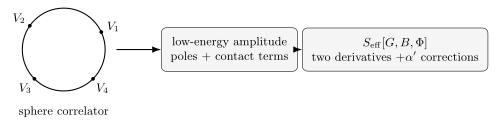
At a fixed derivative order, construct the , , and exchange diagrams from the action already matched at lower multiplicity, then determine the remaining local four-point vertex. Both kinds of diagram can contain higher-derivative interactions. The graph shapes are schematic and carry no spacetime length scale.
This procedure determines an equivalence class of actions. Perturbatively invertible local field redefinitions, integration by parts, and terms proportional to lower-order equations of motion leave the on-shell scattering data unchanged when applied consistently. Exercise 4 gives an explicit curvature-squared example. Polchinski’s discussion of sewing and background fields in §§2.8–3.1 provides the connection between these two descriptions of string interactions.
The leading action and the dilaton genus weight
Section titled “The leading action and the dilaton genus weight”The leading massless action, in string variables, is
All contractions in this expression use . The factor is the kinetic normalization for the three-form field strength. This action is the two-derivative result of amplitude/background matching; the full bosonic theory also contains the tachyon, higher-derivative terms, and string-loop corrections. Tong §§7.2.3–7.3 discusses its relation to the worldsheet background equations.
The overall dilaton dependence has a topological explanation. On a closed oriented Euclidean worldsheet, the curvature coupling and Gauss–Bonnet theorem give, for constant ,
Its contribution to is . With canonically normalized closed external states, the additional external factors give
In particular, a three-point sphere amplitude is proportional to , while a four-point sphere amplitude is proportional to . The sphere vacuum weight is not the power in either scattering amplitude.
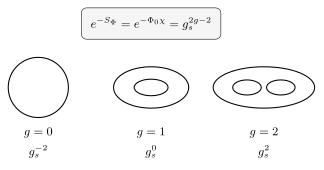
The edge identifications close the surfaces; handles are not boundary holes. Their Euler characteristics are , , and , giving topology weights , , and . The separately indicated normalized external insertions change the exponent to . Cell shapes and perspective are schematic rather than metric geometry.
A constant shift determines these powers but does not, by itself, derive all couplings of a varying dilaton. The local prefactor and the relative derivative terms also require matching in a slowly varying background. Expanding such a tree action about fixed gives the equivalent prefactor
This retains the constant background dependence in the physical gravitational coupling. It must not be dropped while keeping the same coupling symbol on both sides.
The tachyon example can be expressed by choosing a scalar field normalized at infinity:
Its overall field normalization has been absorbed into ; no absolute tachyon self-coupling is inferred here. To see the scalar coupling more precisely, write the dimensionless string-metric perturbation as . For the transverse physical massless representative on the preceding page, . Thus
At linear order only the inverse metric in the kinetic term varies, leaving . This explains the derivative momentum tensor found in the vertex calculation, including its physical scalar component. The dimensionless here is distinct from the canonically scaled Einstein-metric perturbation used below.
Coupled metric, two-form, and dilaton equations
Section titled “Coupled metric, two-form, and dilaton equations”It is useful to keep a constant inside the string-frame bracket as while doing the variation. Set for the critical action just displayed. Define
Here and in this section the metric is the string metric. With compactly supported variations, the bulk first variation is
The derivatives acting on are essential. For example, the curvature variation contains , and the variation of must be integrated by parts with the same weight. Exercise 2 derives all these terms.
The simultaneous equations are therefore
The simplified metric equation uses the dilaton equation. It is not the raw inverse-metric Euler derivative on an arbitrary off-shell background. Around flat space with constant dilaton and , its linearization is , in agreement with the scalar–metric relation on the preceding page.
For the noncritical extension, use the leading worldsheet result in these equations. A constant dilaton and flat metric do not solve these equations when . This is a route toward nonconstant backgrounds, not a prescription for an arbitrary-dimensional flat critical string. The next page explains the beta functions and the linear dilaton; Tong §7.4.4 discusses this extension.
Deriving the Einstein metric
Section titled “Deriving the Einstein metric”The coefficient of the string-frame curvature depends on the dilaton. Removing that dependence requires a field redefinition, not a spacetime coordinate transformation. Set and use the overview’s Einstein metric, so that
The connection difference is
Substituting it into the curvature definition and contracting gives
The measure contributes . Together with the curvature and total dilaton factor, its exponent is
Thus the Einstein–Hilbert coefficient is constant, with precisely the conversion from to . The Laplacian is now a total divergence with constant coefficient. We discard it under the stated bulk/boundary assumptions; an action principle with arbitrary boundary data would also require appropriate boundary terms.
The remaining scalar kinetic terms combine as
This is why the positive string-frame coefficient does not describe a negative-norm physical scalar: the metric and dilaton mix before this redefinition. There are three inverse metrics in . Relative to the Einstein curvature density they leave . A string-frame constant term has no inverse metric and leaves . The result, including the optional term, is
For the scalar coefficient is , the weight is , and . The canonical spacetime scalar in the overview then gives , including the overall gravitational prefactor. A scalar normalized only inside the square brackets would not yet have this canonical normalization.
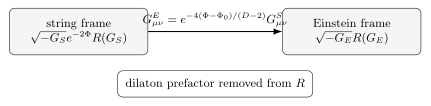
The asymptotic constant enters . After this conversion, the Einstein curvature weight is one. The plotted weights and are dimensionless relative coefficients on . The second is the transformation weight of a possible string-frame potential; the critical central-charge-deficit coefficient itself is zero. These curves are not background solutions.
For example, let . To first order, the three-form density has the expansion
The three inverse metrics account for the factor six. This identifies the and interactions, with still in the normalization of the displayed action. It also shows why reading only a pure-graviton amplitude cannot determine every massless coupling. Tong §7.3.1 develops the string/Einstein frame relation; the calculation above keeps its general-dimensional factors explicit.
Two independent small parameters
Section titled “Two independent small parameters”The derivative expansion requires small invariants such as and, in a background, small curvature and gradients in string units. A massless leg obeys identically, so cannot diagnose whether a scattering process has low energy. Near a massless pole, the propagating massless field must remain explicit rather than be expanded into a local interaction.
The genus expansion instead requires weak local coupling . Small curvature does not guarantee small coupling, and weak coupling does not guarantee small curvature. Worldsheet sigma-model loops organize the expansion; additional worldsheet handles organize spacetime string loops. They are distinct approximations.
Finally, the bosonic tachyon limits the physical interpretation of the flat-space expansion even when both parameters are small. The omitted tachyon problem is discussed in Tong §7.4.5. Neither a change of frame nor the removal of redundant higher-derivative terms resolves that instability.
Exercises
Section titled “Exercises”1. Ward identities and a nonzero complex three-point example
Section titled “1. Ward identities and a nonzero complex three-point example”Prove separately that and vanish when any one polarization is replaced by its momentum. Then evaluate them for the four-dimensional complex vectors
The momentum components are given in units of a fixed momentum ; the polarization components are dimensionless. Extra components vanish when embedding into . Explain why the Ward test cannot replace the Wick calculation of the relative coefficient. Also check the antisymmetric two-tachyon coupling.
Solution
Replacing by gives , hence . Momentum conservation and transversality give and , so
The other replacements follow by cyclic permutation. The same proof works in the right sector. Therefore any linear combination has this on-shell Ward property, whatever is. Wick contractions, not this test alone, fixed .
For the displayed example, each and each is zero; the momentum sum and pairwise momentum products also vanish. Explicitly,
Thus and . Both structures are nonzero, so this kinematics can test their relative coefficient. For identical left and right choices, the closed polynomial is . The special choice would make that example vanish accidentally; it is not a general identity.
For real nonzero momenta, two orthogonal Lorentzian null vectors are parallel. Three-point conservation therefore forces the real on-shell configuration to be collinear, and transverse polarizations make the cubic structures vanish. Complex continuation avoids that degeneracy.
Finally, . The two-tachyon source is symmetric and has no coupling to the antisymmetric massless polarization.
2. Weighted variation of all three massless fields
Section titled “2. Weighted variation of all three massless fields”Derive the bulk first variation in the text, including , with respect to , , and . Use compactly supported variations. Explain why the simplified metric equation requires the dilaton equation, and recover the flat-background linearized equations.
Solution
Set and temporarily suppress the common factor . The curvature variation is
The derivatives of the weight are
The explicit metric variation of contributes , canceling the nontrace gradient term from . Three inverse metrics in give
The determinant variation contributes minus one-half the entire bracket times . Combining the trace terms gives , while the other terms give .
For the dilaton, varying gives minus twice the original bracket. The kinetic variation contributes
The sum is . For the two-form, antisymmetry gives , so
These reproduce the displayed first variation. First impose ; only then does the metric equation reduce to .
In the critical flat background, all products of fluctuations drop out. The three equations become
Taking the trace of the first and comparing with the second gives and . This is consistent with a massless scalar that mixes with the string-frame metric, rather than an independent pure metric trace.
3. Potential weights and the canonical scalar
Section titled “3. Potential weights and the canonical scalar”Transform the supplied tachyon action and the string-frame constant term to Einstein variables. Derive the canonical dilaton normalization including , specialize it to and , and determine whether the constant-deficit potential has a finite dilaton extremum when .
Solution
The shifted scalar kinetic density transforms with exponent . A mass term has no inverse metric, so its exponent is . Hence
The Einstein tachyon kinetic term is canonical in the stated normalization at infinity, but its mass coefficient is dilaton dependent. Since the exponential is positive for real , the sign persists.
The gravitationally normalized dilaton kinetic term is . Matching it to gives
Since is dimensionless and , the scalar has the canonical dimension . Normalizing only inside the gravitational bracket would miss this factor of .
The constant-deficit contribution is , with
For nonzero there is no finite stationary point of this potential alone. For , its supplied central-deficit value is zero, so it produces no potential. Other fields, fluxes, or corrections can change an extremum problem; none are included in this calculation.
4. Removing Ricci terms by a field redefinition
Section titled “4. Removing Ricci terms by a field redefinition”In pure gravity with constant dilaton and vanishing , consider
Substitute for the covariant metric in this action. Determine that remove the two displayed curvature-squared terms through first order in , modulo a boundary term. State the limitations of the conclusion.
Solution
The first variation of Einstein–Hilbert with a covariant metric displacement is
The minus sign follows from . Substitution gives the change of the bracket
The change of the already order- terms is higher order. Thus choose
The redefinition is perturbatively invertible when curvatures are small in string units. With the same physical asymptotic states, it changes no on-shell amplitude; it changes the description of off-shell vertices and their contact pieces.
This does not remove every curvature-squared invariant. In , a Riemann-squared term is not a linear combination of the two terms eliminated by this calculation. Nor can one apply this pure-gravity substitution to the full dilaton/two-form theory while holding its other interactions fixed: their metric variations generate additional terms. The statement is an equivalence of consistently transformed actions, not a deletion rule for selected pieces.
5. Genus counting from spacetime graphs
Section titled “5. Genus counting from spacetime graphs”Expand fields with canonical kinetic terms so that an -field tree vertex carries . For a connected graph with external lines, internal lines, and vertices, derive its coupling power in terms of the loop number . Compare four-point cubic trees and one-loop cubic graphs with the string genus expansion.
Solution
Let count the vertices of valence . Each internal line supplies two ends and each external line one, so
The coupling exponent is
Thus the graph carries . At fixed string scale and fixed compactification data, , giving precisely when .
A cubic four-point tree has , , , and power . A cubic four-point one-loop graph has , , , and power . A quartic contact tree also has power , so a local contact is not necessarily suppressed relative to exchange at the same derivative order.
This counting concerns spacetime perturbative loops. A sigma-model loop can correct a coupling by an additional power of without adding a handle to the string worldsheet. The two loop expansions must not be identified.
6. A local expansion after subtracting massless poles
Section titled “6. A local expansion after subtracting massless poles”Consider the illustrative stripped scalar amplitude
The symbols here are toy-model couplings, unrelated to the metric or string coupling; has the same dimension as and . Subtract the massless exchange, find the local expansion through cubic order in , and specify its convergence domain. Explain what fails without the subtraction.
Solution
After removing the displayed massless term, expand each heavy denominator by a geometric series. For ,
The linear term vanishes. The identity gives
Each polynomial corresponds to a local interaction, subject to crossing and field-redefinition relations. The absence of the linear term is an on-shell relation, not the absence of every possible two-derivative off-shell scalar operator.
The original amplitude has singular divisors , , and through the origin. It therefore has no ordinary Taylor series there. Subtracting its massless exchanges leaves an analytic function whose nearest singularities are the heavy poles; this is the reason the massless fields are retained in the effective theory.
This is a stable-heavy-exchange toy model, not a formula for the full bosonic-string amplitude and not a treatment of tachyon condensation.
References
Section titled “References”- Polchinski, Joseph. “What Is String Theory?” Lectures at the 1994 Les Houches Summer School, NSF-ITP-94-97 (1994), §§2.8–3.1. arXiv:hep-th/9411028.
- Tong, David. Lectures on String Theory. University of Cambridge Part III lecture notes (2009; arXiv version 3, 2012), §§7.2.3–7.3.2, 7.4.4–7.4.5. arXiv:0908.0333.