
Holographic Correlators and the Breitenlohner–Freedman Bound
A holographic correlation function is a response to a boundary source. To calculate it, one solves a bulk field equation, imposes an interior condition, and differentiates a renormalized action. The normalization of that action matters as much as the two near-boundary powers. This page carries those steps through for a scalar field and then explains how changing its boundary condition changes the dual operator.
The central results are the scalar relation , the normalized two-point function, and the Breitenlohner–Freedman (BF) bound . The last statement concerns linear scalar dynamics on fixed AdS with suitable boundary conditions. Within a limited negative-mass range, two ordinary boundary quantizations are possible; at the endpoints, logarithms require separate treatment. A cubic interaction will finally produce a three-point function.
The calculations use the shared Fourier and source definitions and build on the boundary-source prescription on page 31. We work in boundary dimension , with flat boundary metric and a free bulk scalar except when explicitly adding the leading cubic interaction.
Scalar fields and their boundary powers
Section titled “Scalar fields and their boundary powers”Consider the positive Euclidean kinetic action
in the Poincaré metric
Here and have dimensions of length. We take dimensionless, so has dimensions . A negative does not change the sign of the kinetic term; whether it causes an instability is a question about the radial gradient energy and the boundary condition.
Since , the equation becomes
Near , a power obeys the indicial equation
Define its two roots by
For now take real and avoid integer . The expansion has the form
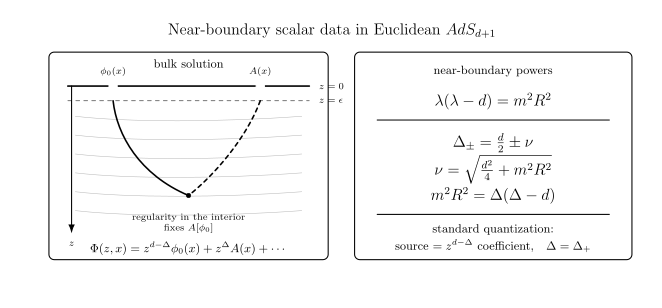
In standard quantization, is the source for an operator of dimension . Its dimensions are , making dimensionless. The coefficient has dimensions and will determine the expectation value. The intermediate coefficients are local derivatives of the source; they are not independent responses.
For a Euclidean Fourier mode of magnitude , substitution gives
This recurrence explains both an important subtraction and an exception. If , the source term occurs before the response. If is a positive integer, the recurrence becomes singular at , signaling a logarithm rather than a failure of the bulk solution.
Interior regularity fixes the response
Section titled “Interior regularity fixes the response”Writing turns the radial equation into the modified Bessel equation. The two independent solutions are and . At positive Euclidean momentum, grows exponentially toward , while decays. Interior regularity therefore selects
The prefactor makes the coefficient of exactly . For noninteger , the small-argument expansion is
It follows that
The two boundary coefficients are thus independent local data for the differential equation, but they are related once the interior condition is imposed. Different states or interior geometries generally change that relation.
Extracting a response after the source terms
Section titled “Extracting a response after the source terms”An exact example makes the subtraction visible. In with , equivalently ,
The expansion contains an analytic source descendant before the nonanalytic response. Thus
For the regular mode, the plotted residual isolates the coefficient of the faster boundary power. Both axes are dimensionless, with and . The boundary lies at ; the limit gives . The curve is calculated from the exact Bessel solution, not from a truncated power series.
Prescribing a source at a finite cutoff
Section titled “Prescribing a source at a finite cutoff”If the boundary value is imposed at , the exact solution instead reads
The denominator ensures . It must be retained while varying the cutoff action. Its subleading terms can contribute when the radial derivative is evaluated at the same cutoff. Taking the boundary limit prematurely gives an incorrect two-point normalization, as the appendix of Freedman, Mathur, Matusis, and Rastelli explains.
The rescaled cutoff source approaches . One may use either as the independent source, provided the relation between them is kept through the calculation and the limit is taken consistently.
Renormalized action and the two-point function
Section titled “Renormalized action and the two-point function”On a solution, integration by parts reduces the action to a surface term. At the lower boundary of the region , the outward normal points toward decreasing :
Consequently,
It is useful to denote the dimensionless coefficient produced by this reduction as
The factor of comes from the induced measure and the unit normal. It is part of the physical normalization of every response below.
Subtract divergences before differentiating
Section titled “Subtract divergences before differentiating”For , the leading local counterterm is sufficient:
To see its finite effect, keep the cross term between and . The boundary action contributes , while the counterterm contributes . Their sum is
For , divergent source descendants require derivative counterterms as well. Away from , the next term is
Here is the Laplacian of the induced metric. Higher descendants require further local terms; at integer one of the subtractions is logarithmic. The nonlocal cross term above survives this procedure, while the finite local terms depend on the subtraction scheme. This is the scalar holographic-renormalization construction developed in de Haro, Solodukhin, and Skenderis, section 5.1.
With , variation gives
The factor of two is essential: is itself a linear functional of . Equivalently, write the quadratic functional as , with the shared Fourier measure. Then
This expression applies to noninteger . A finite local counterterm changes a polynomial in , hence a delta function or its derivatives in position space. It does not change the answer at distinct insertion points.
Position-space normalization
Section titled “Position-space normalization”The Fourier transform must be understood as a distribution with local subtractions. Analytic continuation of the power-law transform gives, away from ,
Combining the two coefficients yields
The coefficient is positive for and . A negative coefficient of a nonlocal momentum-space expression, such as the result on page 31, does not imply a negative separated-point norm: the distributional Fourier transform also has a sign.
Integer indices and the massless AdS5 scalar
Section titled “Integer indices and the massless AdS5 scalar”When is a positive integer, the pole of multiplies a local polynomial. Subtracting that pole leaves a logarithm. Its nonlocal coefficient is
For example, put and expand . The product of this logarithm with the Gamma-function residue gives the stated coefficient. The scale makes the logarithm dimensionless; changing it adds a local term.
A massless scalar in has , , and regular profile . Thus
Exercise 2 restores the ten-dimensional dilaton normalization and connects this result to the absorption spectral density on page 30. The coincident-root case requires a different source expansion and is treated below.
The bulk-to-boundary kernel
Section titled “The bulk-to-boundary kernel”The same linear solution can be written directly in position space:
where
Substitution verifies the scalar equation with . The coefficient is fixed by the source, not by the bulk kinetic coefficient. To check it, set in the convolution:
For a smooth bounded source, the integrable weight at permits the limit inside the integral. Using radial coordinates and a beta integral gives
so . In this sense, approaches a boundary delta function. At a fixed separated point , however,
This tail determines the response to a localized source. Multiplying it by reproduces the separated-point correlator. The delta-function limit and the separated-point tail are two different statements about the same kernel, not competing boundary conditions.
The BF bound and the allowed boundary quantizations
Section titled “The BF bound and the allowed boundary quantizations”The roots become complex if . A radial-energy calculation explains why this threshold is the stability bound, and why its use requires a boundary condition.
In Lorentzian AdS, separate a mode as
The Klein–Gordon equation becomes a one-dimensional spectral problem:
The radial part of the Klein–Gordon norm is proportional to
This is the norm relevant to Lorentzian scalar modes. It is not the Euclidean spacetime integral .
Gradient energy can support a negative mass squared
Section titled “Gradient energy can support a negative mass squared”For a smooth function of compact support in , integration by parts gives the Hardy identity
It follows that the quadratic form of is nonnegative when . Closing this form gives the standard positive, or Friedrichs, realization of the radial operator. Below the bound, the extra negative inverse-square potential makes the form unbounded below; Exercise 3 constructs explicit trial functions.
The conclusion is that
allows stable free scalar dynamics with an appropriate boundary condition. It does not assert that every boundary condition is positive, nor does it prove nonlinear stability of the coupled gravitational theory. The relation between AdS boundary conditions and positive self-adjoint extensions is analyzed systematically by Ishibashi and Wald.
When both powers have finite norm
Section titled “When both powers have finite norm”Near the boundary, the two radial behaviors are
The faster behavior has finite boundary norm for . The slower one requires
Thus two distinct, ordinary power-law quantizations are available in the strict window
In standard quantization, the slower coefficient is the source and the operator has dimension . In alternate quantization, the faster coefficient is the source and the operator has dimension . This is a change in the boundary condition defining the theory. Both choices have to be distinguished from turning on a source within one fixed theory. Their relation is developed by Klebanov and Witten, section 2.
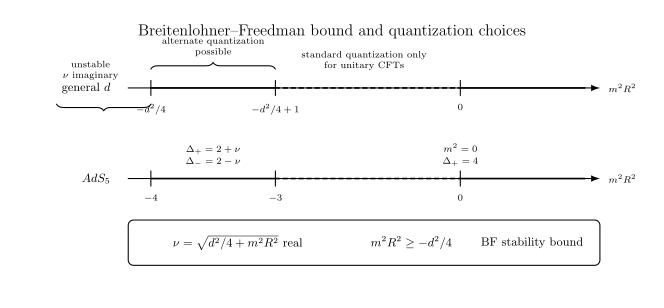
For , . The ordinary alternate branch is available only for . At the roots coincide and a logarithmic mode appears. At , the slower mode reaches and its ordinary Klein–Gordon norm diverges logarithmically. The diagram shows the mass and dimension conditions; positivity also depends on the chosen boundary condition.
For , the scalar unitarity bound is , apart from the identity operator. The upper endpoint saturates this bound for . It is not part of the ordinary finite-norm alternate window: obtaining a free-field or singleton limit there requires an additional limiting construction. At the lower endpoint , both logarithmic and nonlogarithmic radial behaviors have finite boundary norm, but the two power-law dimensions have coalesced. That case also needs separate treatment.
These statements describe allowed free bulk boundary quantizations. Embedding an arbitrary chosen scalar mass in a complete interacting AdS/CFT pair is an additional physical requirement.
Alternate quantization and mixed boundary conditions
Section titled “Alternate quantization and mixed boundary conditions”The change of quantization has a useful functional description. In this calculation, choose the subtraction scheme with finite local quadratic source terms removed, so the standard response is exactly . Such terms would otherwise also change the conjugate variable in the Legendre transform. For , let
Choose the alternate source to be the faster coefficient itself. The appropriate Legendre transformation is
Stationarity says , precisely the standard response relation. Differentiating the transformed functional with respect to its independent source gives
For a quadratic functional, and direct elimination of gives
The square of records the chosen source normalization. If the independent source were instead , the corresponding kernel would be . A Legendre transform without a specified source variable leaves precisely this ambiguity.
As a check, at the regular solution has . Hence
In four boundary dimensions, the latter transforms to , the positive two-point function of an operator with .
A double-trace deformation changes the boundary condition
Section titled “A double-trace deformation changes the boundary condition”Add to the Euclidean action and couple an external source through . At the Gaussian level, or at leading large when the relevant correlators factorize, the expectation value responds to the effective source :
Since , the bulk source relation is
This is a mixed boundary condition relating the two asymptotic coefficients. The coupling has mass dimension , so it is relevant in the alternate theory. This relation between multi-trace interactions and boundary conditions was formulated by Witten.
The sign of matters. For ,
A negative produces a pole at positive Euclidean . Exercise 4 identifies the corresponding negative radial eigenvalue and growing Lorentzian mode. The mass is above the BF bound, but this boundary condition is unstable. For positive , the same formula illustrates the flow toward standard-quantization scaling after its local term is removed.
At the BF bound: a logarithmic source
Section titled “At the BF bound: a logarithmic source”At , the two powers merge. Use the independent asymptotic data
Here the source is explicitly the coefficient of the logarithm. The scale only specifies how the nonlogarithmic coefficient is separated from it. Interior regularity at gives
This follows from . The sign in the solution is fixed by the chosen positive coefficient of .
The required leading counterterm is now
Combining it with the oriented boundary action gives
Consequently the logarithmic-source normalization yields
Exercise 5 derives the finite term explicitly. Simply putting into the standard prefactor would miss this result, because the basis of boundary modes and the normalization of the source have changed.
Under , the same bulk field has . This changes the response by a local multiple of the source. In particular, the source-free condition , which excludes the logarithmic branch, is scale invariant. A condition with unrestricted is not invariant under this change. There is therefore one scale-invariant source-free choice at this coalescing-root point, rather than two ordinary quantizations with different dimensions; more general mixed conditions introduce scale dependence.
A cubic interaction gives a three-point function
Section titled “A cubic interaction gives a three-point function”Now consider three distinct scalar fields with standard dimensions and the interaction
For dimensionless fields, has dimensions . There is no for three distinct fields with this definition of the coupling. For an identical field, writing instead is convenient because three source derivatives then supply .
At first order in , insert the three free solutions into . Corrections to the solutions do not contribute through the quadratic action at this order: its first variation vanishes on the free solution with the renormalized sources held fixed. Using , three source derivatives therefore give the connected tree-level result
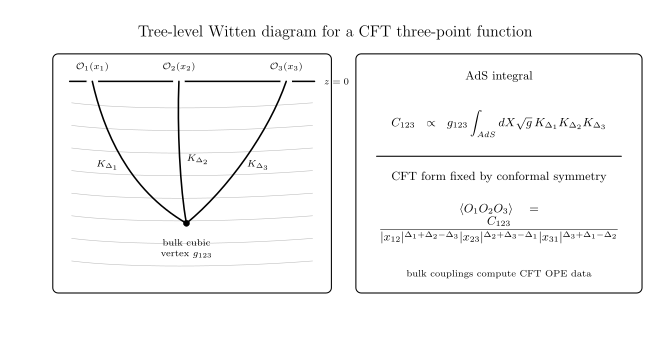
The leading contact Witten diagram for three distinct scalar fields integrates one cubic vertex over AdS. Each line represents a source-normalized kernel . The overall sign follows from . The drawing is schematic: the lines are kernel connections, not particle trajectories, and the vertex can lie anywhere in the integration region.
Conformal powers and the contact integral
Section titled “Conformal powers and the contact integral”Translation and rotation invariance restrict the answer to functions of the three separations. Under inversion, transforms to . Scalar-primary covariance then requires that the powers attached to point add to . Define
where is the remaining index. The answer has the form
The integral determines , which conformal symmetry alone does not fix. One efficient calculation uses an inversion to send to infinity and rescales the correlator by . The remaining integral, before the kernel prefactors, is
Combine the two denominators with a Feynman parameter . Completing the square in introduces . The integral and the radial integral use
The final parameter integral is . Combining these beta functions gives
The factor is the volume factor of the dimensionful AdS metric. This calculation, including derivative vertices, is developed in Freedman, Mathur, Matusis, and Rastelli.
The displayed integral is directly convergent for separated insertions when and every , in addition to the standard kernel conditions . At an extremal relation such as , a Gamma function has a pole. The unregulated formula then cannot be used as a finite answer. Couplings, boundary terms, and the limiting prescription must be examined in the particular bulk theory.
Common pitfalls
Section titled “Common pitfalls”Reading the response before subtracting descendants. When , local source terms can precede the faster independent power. The response coefficient is what remains after those determined terms are removed.
Dropping the bulk normalization or the sign of the boundary. The product and the outward normal both enter the action. Once the source and are fixed, the nonlocal sign is fixed too.
Using the BF inequality without a boundary condition. The inequality permits a positive realization of the free radial operator. A mixed condition can still introduce a negative eigenvalue, as Exercise 4 shows.
Treating an endpoint as an interior point of the mass window. At the source is logarithmic; at the ordinary slow-mode norm diverges. Neither endpoint is obtained by copying the two-power discussion unchanged.
Exercises
Section titled “Exercises”1. A response hidden behind a derivative counterterm
Section titled “1. A response hidden behind a derivative counterterm”For , , verify the exact solution
Compute the regulated action and both displayed counterterms. Obtain the nonlocal two-point coefficient and its position-space normalization. Show what divergence remains if the derivative counterterm is omitted.
Solution
Here . Direct differentiation gives
For one real Fourier amplitude, with the product denoted by , the three action terms are
All fields and derivatives on the right are evaluated at . The negative sign of the last term follows from .
Writing , the first two terms combine exactly to
where is the derivative with respect to . Adding the derivative counterterm gives
Therefore
The general position-space coefficient with becomes
Thus the separated-point correlator is . Omitting leaves : identifying the finite response in the field does not by itself renormalize its action.
2. Dilaton normalization and a local scale dependence
Section titled “2. Dilaton normalization and a local scale dependence”Use the dimensionless ten-dimensional dilaton action
on with common radius . For an -independent fluctuation, determine , the position-space correlator, and the positive-frequency spectral density. Show that changing the subtraction scale changes only a local term. Finally, track the correlator under a constant source change , .
Solution
The sphere volume is . Comparing the reduced action with gives
The last step uses the shared D3 charge and gravitational normalization, equivalently . The sphere integral supplies length to the fifth power; has length to the eighth power, so has length dimension and is dimensionless.
The massless result becomes
Using the shared continuation at , put . For , the logarithm becomes , so
This is the normalization measured by absorption on page 30. Classical supergravity gives the leading large- coefficient; it does not distinguish the exact finite- interacting-sector factor from the free center-of-mass contribution.
The scale derivative is
Its inverse Fourier transform is proportional to . Hence a scale change leaves both separated-point correlators and the positive timelike spectral density unchanged.
Finally, preserving requires . Therefore . A source rescaling changes the normalization explicitly; it cannot be used to change the sign of a real operator’s two-point norm.
3. Constructing a negative-energy trial mode below BF
Section titled “3. Constructing a negative-energy trial mode below BF”Let . For the radial operator , use , where is a fixed reference length, to construct a compactly supported trial function with negative quadratic form. Explain how a dilation makes the form unbounded below at fixed norm, and why the argument extends from a piecewise smooth trial function to smooth compactly supported functions.
Solution
For real , the pointwise identity underlying Hardy’s inequality is
The last term integrates to zero for compact support away from the endpoints. Let . Then , and the quadratic form is
Choose on and zero elsewhere. This continuous function has a square-integrable weak derivative. Its support corresponds to , so its radial norm is finite. Direct integration gives
For instance, gives . Although the derivative jumps at the endpoints, the trial function can be approximated in the first-derivative norm by smooth functions supported in a slightly enlarged finite interval. On this interval stays away from zero, so the potential is bounded and the quadratic form converges. A sufficiently close smooth approximation still has negative .
Normalize such a smooth to unit radial norm and define
A change of variable gives and . Taking makes arbitrarily negative. Each individual function still has compact support strictly inside . Thus the radial form is unbounded below already on the common compact-support domain; choosing a boundary extension cannot repair this below-BF defect.
This is a statement about the free linear scalar operator. It does not analyze nonlinear scalar potentials or gravitational backreaction.
4. An instability produced by a mixed boundary condition
Section titled “4. An instability produced by a mixed boundary condition”Take , and alternate quantization. Starting with , add to the Euclidean action. Derive the response kernel and the source-free bulk boundary condition. Find a negative radial eigenvalue when . For , identify the nonlocal infrared scaling after removing the leading contact term.
Solution
The linear response equation gives
At , the field expansion is , so and . Since , the source-free condition becomes
The radial potential vanishes for , hence . A square-integrable bound mode has
Its boundary condition requires . Such a mode exists precisely when , and its eigenvalue is . At zero spatial momentum, equals that negative eigenvalue, giving an exponentially growing solution. The same is the positive Euclidean pole of .
For the denominator has no pole at positive . At ,
The first term is local. The leading nonlocal term is proportional to , the standard-quantization kernel for , with a source normalization depending on . This is the leading-large- double-trace flow. The sign and the pole calculation rely on the stated deformation of the Euclidean action; they would change if the sign of that deformation were changed.
5. Renormalizing the logarithmic BF source
Section titled “5. Renormalizing the logarithmic BF source”At , hold the logarithmic coefficient fixed as the cutoff is removed. Derive the finite action from the stated BF counterterm, calculate its two-point kernel, and show how the scale change acts on . Explain why the two-point formula cannot simply be evaluated at zero.
Solution
Set and . Up to terms vanishing with the cutoff, and
The two surface contributions are therefore
Their sum simplifies before the limit:
For a general source, restore the boundary integral. Interior regularity gives . Taking source derivatives of with as the independent source yields
The constant is a contact term. Differentiate the analytically continued Fourier power at to obtain, away from the origin,
The product gives the positive coefficient quoted in the text. Keeping the field fixed under requires
Hence changes by , and changes by the local constant .
The regular standard solution at small positive has normalization . To keep a finite logarithmic source, its source must be rescaled according to . The correlator must then be divided by before taking the limit, and a local pole must be subtracted. That procedure recovers ; setting with the old source held fixed instead gives a degenerate normalization.
6. A normalized cubic contact diagram
Section titled “6. A normalized cubic contact diagram”For three distinct scalars with in , compute the complete coefficient of the contact three-point function for the coupling used above. Derive its distance powers from inversion covariance. Explain what changes for one identical scalar with interaction , and why an extremal relation cannot be substituted into the convergent integral without further analysis.
Solution
Let the distance powers be , , on , , . Inversion covariance at the three insertions requires
Thus . These equations come from the factors of acquired under inversion, not from independently rescaling the neighborhood of only one point.
To evaluate the coefficient, send to infinity. The Feynman-parameter representation combines the two remaining denominators of power three. Integrating over the four boundary coordinates supplies
With , the integral is
The remaining integral is . Therefore the scalar integral before the three kernel constants is
Each source-normalized kernel has . Restoring the other separations by covariance, the AdS measure , and the interaction sign gives
The dimensionless product multiplies length to the power , as required for three operators of dimension three.
For an identical field, the three source derivatives of give six identical terms. The factorial cancels, leaving the same integral with in place of . Inserting an uncanceled for three distinct fields would instead change the definition of the coupling and the answer by a factor of six.
At an extremal relation , one has . The radial beta function develops a pole, expressing a genuine failure of the stated convergence domain. A finite extremal correlator in a specific theory may involve a vanishing cubic coupling, boundary contributions, or a regulated limit; none follows by assigning an arbitrary finite value to that Gamma function.
References
Section titled “References”- de Haro, Sebastian, Sergey N. Solodukhin, and Kostas Skenderis. “Holographic Reconstruction of Spacetime and Renormalization in the AdS/CFT Correspondence.” Communications in Mathematical Physics 217 (2001), 595–622. arXiv:hep-th/0002230.
- Freedman, Daniel Z., Samir D. Mathur, Alec Matusis, and Leonardo Rastelli. “Correlation Functions in the CFT(d)/AdS(d+1) Correspondence.” Nuclear Physics B 546 (1999), 96–118. arXiv:hep-th/9804058.
- Ishibashi, Akihiro, and Robert M. Wald. “Dynamics in Non-Globally-Hyperbolic Static Spacetimes III: Anti-de Sitter Spacetime.” Classical and Quantum Gravity 21 (2004), 2981–3014. arXiv:hep-th/0402184.
- Klebanov, Igor R., and Edward Witten. “AdS/CFT Correspondence and Symmetry Breaking.” Nuclear Physics B 556 (1999), 89–114. arXiv:hep-th/9905104.
- Witten, Edward. “Multi-Trace Operators, Boundary Conditions, and AdS/CFT Correspondence.” Preprint (2001), revised 2002. arXiv:hep-th/0112258.