
Mode Expansions, Regge Trajectories, and Bosonic String Quantization
A rotating string turns tension into a relation between mass and angular momentum. Quantizing its vibrations turns the same scale into a ladder of particle masses. The leading trajectories of the critical bosonic string are
We will derive their classical slopes, normalize the oscillators, and identify the physical states that produce the quantum intercepts. The calculation concerns free strings in flat, noncompact target spacetime, with Neumann conditions in every target direction for the open string. Classical results can keep general; the quantum spectrum below assumes the critical bosonic theory, . Compactification and strings stretched between D-branes modify the mass formulae on later pages. Massless polarization counts refer to nonzero null momentum; Chan–Paton endpoint multiplicities are not included.
The previous page derived the wave equation and metric constraints. We use its chiral assignments and the shared notation and stress-tensor normalizations, writing . In particular, are the classical constraint components, while will denote their canonically normalized modes.
A rotating open string
Section titled “A rotating open string”Consider
with all other coordinates constant. The open interval is . Each component obeys , and the spatial derivatives vanish at both endpoints. To check the constraints, calculate
Therefore and , or equivalently . The induced metric is : it is timelike in the interior and degenerates at the massless endpoints.
At fixed target time , the string is a straight segment of length . Its physical angular velocity and the speed of a point on the segment are
Both endpoints move at unit speed; interior points move more slowly. The frequency appearing in is a frequency with respect to the dimensionless worldsheet time, not the physical angular velocity.
The conserved target-space charges give
The spatial momentum vanishes because the integral of is zero. Thus this is the center-of-mass frame, , and eliminating gives
This is the classical open-string Regge slope. Notice that is greater than the static energy : the rotating string carries kinetic energy. Exercise 5 derives the local energy density and explains why its endpoint divergence is integrable.
The folded closed string
Section titled “The folded closed string”The same embedding also solves the closed-string equations if runs over . At a fixed time it now traces the segment twice. The interval runs from one end of the segment to the other, and returns along it.
There are no string endpoints. The points are folds, where the embedding doubles back and the induced metric degenerates. The Polyakov embedding remains smooth and satisfies the wave equation and constraints; the nondegenerate Nambu–Goto elimination argument must be used away from the folds.
Each coincident strand contributes to the charges:
Consequently
At fixed , both charges are twice their open-string values. At fixed energy, the closed string instead has half the maximal angular momentum. This gives a classical explanation of the factor of two between the Regge slopes.
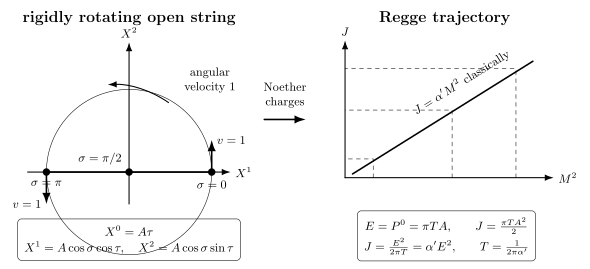
At target time , both solutions span and rotate counterclockwise with physical angular velocity . The closed embedding covers the segment twice; any separation drawn between its strands is schematic. Open endpoints and closed fold points move at unit speed. The displayed charge relations and slopes are classical and exact for these embeddings.
The corresponding quantum relations will have intercepts. For large , an order-one intercept is a small relative correction, which is the regime in which comparison with a classical rotating string is most direct.
Neumann modes and canonical normalization
Section titled “Neumann modes and canonical normalization”Separating the wave equation on the open interval gives spatial functions satisfying . Neumann conditions at and select , with integer . The zero-frequency solution is linear in . Packaging the nonzero modes into complex amplitudes gives
The factor in the zero mode is fixed by the total momentum:
The oscillator integrals vanish. Hermiticity requires , with Hermitian.
The canonical momentum is . On the Neumann interval the equal-time commutator uses the delta distribution represented in the cosine basis,
It reproduces a function on when integrated against its cosine expansion. This form also handles the reflected endpoint conditions.
To derive the oscillator normalization rather than assume it, at introduce the Fourier coordinates and their conjugate momenta for :
Cosine orthogonality gives . The mode expansion implies
Here the index on is raised with the target metric. Inverting,
The canonical brackets therefore give
All mixed zero-mode/oscillator commutators vanish. The coefficients in the expansion and the factor in this algebra belong together.
For , define . Then
The positive modes annihilate the oscillator vacuum . Because , a timelike excitation has negative norm in this covariant Fock space. The physical space is obtained only after the constraints and the null-state quotient described below.
From chiral constraints to quantum Virasoro modes
Section titled “From chiral constraints to quantum Virasoro modes”For the open string, let . Differentiating the mode expansion gives the useful single-sum expression
Thus the canonically normalized constraint densities are
The open-string boundaries relate the two chiral functions. Their combined conserved Fourier mode is
Indeed, the two exponentials combine into a cosine, and . This is the boundary-doubling factor that would be missed by using only one chiral integral over half a circle.
In the quantum theory, move positive modes to the right:
In particular,
The symbol is a level operator, not the unweighted number of quanta. On the transverse physical oscillators,
An excitation at frequency costs units of level. The covariant expression for has the same grading, although its Fock space has an indefinite norm.
Commuting an oscillator through the quadratic expression gives
Both terms in contribute half of the result. A second commutator gives
The first term is the quantized version of the classical algebra. The second is the central term, generated by normal ordering. Its coefficient is the matter central charge , including the timelike boson. Exercise 3 derives it from a finite sum of oscillator contractions; a negative target-space norm does not reverse this boson’s central charge.
Criticality and the intercept
Section titled “Criticality and the intercept”For the ordinary flat bosonic string, the diffeomorphism ghosts contribute . Quantum Weyl invariance then requires
The ghost system and this contribution are developed on the ghost and BRST page. Here we use this consistency condition rather than attempt to establish quantum gauge invariance from the classical equations. The light-cone approach reaches the same critical dimension by requiring closure of the target-space Lorentz algebra, as in Goddard, Goldstone, Rebbi, and Thorn.
There is also a constant in the mass-shell condition. Each transverse boson contributes the finite zero-point energy . For example, the exponential regulator used for the long-string Casimir energy gives
After removing the divergent term, the light-cone oscillator Hamiltonian contains , with
This calculation fixes the intercept in the critical theory. A regulated sum by itself does not prove Lorentz invariance or authorize the same pure bosonic theory in arbitrary . Noncritical strings require additional structure.
Physical open-string states
Section titled “Physical open-string states”In covariant quantization the physical-state conditions are
followed by quotienting out physical null states. Requiring every , positive and negative, to annihilate a state would conflict with the central extension. The positive-mode conditions ensure the corresponding negative-mode matrix elements vanish between physical states, since .
The quotient is also essential: imposing equations alone does not identify gauge-equivalent vectors in the Fock space. In the critical theory the resulting nonzero-momentum physical spectrum agrees with the transverse-oscillator spectrum. This positivity statement is the content of the no-ghost result, not a consequence of merely counting the classical constraints; the covariant and transverse constructions are discussed in the original quantum-string analysis.
With , the zero-mode condition gives
Thus the critical open string has the following first levels.
| Level | Representative transverse states | Physical content | |
|---|---|---|---|
| Scalar tachyon | |||
| 24 vector polarizations | |||
| , | 324 polarizations of a massive spin-two particle |
The negative mass squared of the ground state indicates instability of this bosonic vacuum. The level-two statement refers to the physical states: the 24 one-oscillator states and 300 symmetric two-oscillator states combine into one massive little-group representation. Exercise 4 checks the count.
The massless vector and its null polarization
Section titled “The massless vector and its null polarization”In the covariant description, a level-one state is
The equation gives . The commutator derived above gives
Therefore . The higher positive modes annihilate this state automatically.
There remains a special state,
At it satisfies the level-one physical conditions and has zero norm:
The vacuum used to construct this descendant has ; it is not itself an on-shell open-string tachyon with the same momentum. Its level-one descendant is the physical null vector. It is orthogonal to every physical vector because . Quotienting it out gives
For nonzero null , the transverse condition removes one of the components and this equivalence removes one more, leaving positive-norm polarizations. This is the momentum-space gauge freedom of a massless vector. Chan–Paton endpoint labels will later turn such vectors into nonabelian gauge fields.
Closed-string modes and level matching
Section titled “Closed-string modes and level matching”A closed string is periodic in . We assign the untilded oscillators to , consistently with the untilded Virasoro modes on the previous page:
Each chiral set obeys the same oscillator algebra, and the two sets commute. The zero-mode coefficient is half its open-string value because the coordinate interval is twice as long:
Consequently
Both chiral sectors obey the positive-mode constraints and the shifted zero-mode condition. Subtracting the two zero-mode equations gives level matching,
It expresses the vanishing of the generator of translations around the worldsheet spatial circle, as Exercise 2 shows. Using either zero-mode equation then gives
For , the state has ; the level is massless. These formulae assume no winding and no compact momentum lattice.
The physical graviton, two-form, and dilaton
Section titled “The physical graviton, two-form, and dilaton”The covariant massless state has the form
The two positive-mode conditions impose transversality in both indices, and the two null-state families generate longitudinal gauge equivalences:
For nonzero null momentum, the quotient leaves a tensor in the dimensional physical transverse space. Decompose this tensor:
The three pieces are the polarizations of the graviton, the antisymmetric two-form, and the dilaton. Their dimensions are
At , this is . The little group of a massless particle is what organizes these polarizations; they are not unconstrained symmetric, antisymmetric, and trace tensors in all spacetime directions. In particular, subtracting would not give a spacetime-traceless or transverse graviton polarization. Exercise 6 constructs a covariant transverse projector and the normalized dilaton polarization.
A massless spin-two state is therefore present in the closed-string spectrum. Identifying its interactions with gravity requires the consistency of its couplings, beyond this free-spectrum calculation. Tong’s lectures develop the little-group decomposition and the connection to gravitational interactions.
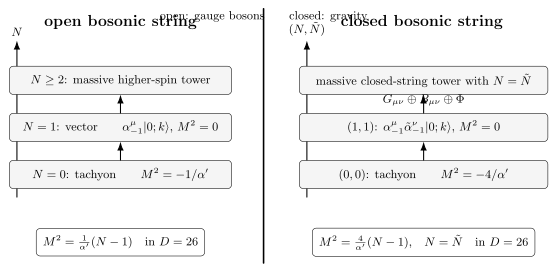
For free strings in flat noncompact spacetime with and , the first excited open level has 24 vector polarizations. The first excited closed level has polarizations, decomposing into 299 graviton, 276 two-form, and one dilaton polarization. The displayed masses are exact free-string values in units of ; the layout is schematic.
Angular momentum and the leading quantum trajectories
Section titled “Angular momentum and the leading quantum trajectories”The oscillator form of target-space angular momentum explains which states reach the largest . Substituting the open-string expansion into the Noether charge and using cosine orthogonality gives
Only pairs of opposite oscillator frequencies survive the spatial integral after antisymmetrizing . The zero modes give the orbital term; the sum is the intrinsic contribution. A closed string has an identical contribution from each of its two oscillator sets.
Choose a transverse rotation plane and define a circularly polarized creation operator
The spin part of the charge obeys
so , whereas . Each such quantum supplies one unit of angular momentum but costs units of level. The maximal spin projection at level therefore uses and aligned polarizations:
Here labels rotation in the chosen plane and hence the leading symmetric-tensor trajectory; it is not an additional light-cone index. The intrinsic particle spin is being counted, not orbital angular momentum of a center-of-mass wave packet.
Combining this count with the open mass formula gives
For the closed string, align the polarizations in both sectors. Level matching gives equal levels, so
The slopes agree with the classical rotating solutions. The intercepts arise from the zero-point contribution to the mass-shell equation; they are not obtained by adding an arbitrary constant to the classical angular momentum.
The picture also motivates the older association of open flux tubes with mesons and closed flux loops with glueballs. This is an organizing analogy for a confining gauge theory, not an identification of its physical spectrum with the critical bosonic string. The tachyon and the need for a consistent quantum spectrum lead us next to worldsheet supersymmetry.
Exercises
Section titled “Exercises”Exercise 1: Higher harmonics of a rotating string
Section titled “Exercise 1: Higher harmonics of a rotating string”Let be a positive integer and consider
Verify the equations, constraints, and open-string boundary conditions. Compute and on , and then for the closed solution on . Why do solutions fail to maximize at fixed ?
Solution
The two spatial components have equal temporal and spatial frequency , so the wave equation holds. Their spatial derivatives contain and vanish at both open endpoints. The relevant contractions are
The constraints therefore hold, including for the periodic closed embedding. The open charges are
The closed integration doubles each charge:
Eliminating gives
The higher harmonic covers the same geometric segment more times. This costs energy without increasing the geometric radius at a fixed , and at fixed energy it reduces the radius. Its physical angular speed remains . The leading classical trajectory is . This mirrors the quantum statement that an oscillator at mode number costs units of level but can contribute only one unit of spin in a chosen transverse plane.
Exercise 2: Level matching as a spatial constraint
Section titled “Exercise 2: Level matching as a spatial constraint”For the closed-string expansion above, show that the generator of translations around the spatial circle is
Explain its action on the embedding and derive level matching. Also check that the displayed zero-mode coefficient and the two chiral oscillator algebras reproduce the periodic equal-time canonical delta function.
Solution
Use and . The cross terms cancel:
The zero Fourier mode of each density gives the corresponding . The normal-ordering shifts of the two sectors are equal and cancel in the difference, so
The canonical commutator gives . Thus generates shifts of the coordinate around the circle. Such shifts are gauge transformations, so physical states must have , yielding . Periodicity of the embedding alone permits arbitrary periodic traveling waves; the constraint additionally selects the allowed physical combinations.
For the normalization check, the zero modes contribute
With the oscillator commutators, the two chiral contributions sum to
Together they give , where
There is no extra open-string factor of two: each independent chiral sector supplies half of the nonzero-mode contribution.
Exercise 3: Deriving the central term from a finite contraction
Section titled “Exercise 3: Deriving the central term from a finite contraction”Let be the matter oscillator vacuum with zero target momentum, used as an algebraic test state rather than an on-shell string state. For an integer , calculate and use it to determine the central term. Explain why the timelike oscillator contributes with the same sign as a spacelike one.
Solution
The only terms in that survive on this vacuum have two negative-index oscillators:
There are two contractions with the annihilators in the bra. Including the factors of in each Virasoro operator gives
A double contraction contains the target-metric contraction . In particular, the timelike contribution contains two negative signs and is positive.
The finite sum is
Since and , the commutator expectation is purely central:
The noncentral term is already fixed to by its action on the oscillators. The central term can occur only when , since it must commute with the level grading. The result therefore fixes . At the answer is , a useful quick normalization check. This calculation concerns the matter algebra; it does not include the ghost contribution or impose criticality by itself.
Exercise 4: The first massive little-group representation
Section titled “Exercise 4: The first massive little-group representation”Count the physical level-two open-string states in . Explain how the answer is compatible with the little group of a massive particle, although light-cone oscillators have only 24 transverse indices. Decompose that massive representation under the manifest .
Solution
Two types of transverse states have total level two:
The first type has 24 states. The second is symmetric in because the creation operators commute, so it has states. Their total is 324.
In a massive rest frame, the little group acts on 25 spatial directions. A symmetric traceless rank-two tensor in that space has
components. To see the match under , split . The components are the traceless part of , the vector , and one scalar. The equation
ties the two potential trace scalars together. The dimensions are therefore
On the oscillator side, the 300 symmetric states split into , and the states supply the vector 24. This verifies the branching and count. It does not by itself prove closure of every Lorentz generator; that is a separate consistency condition of the critical quantum theory.
Exercise 5: The endpoint energy density
Section titled “Exercise 5: The endpoint energy density”For the rotating open string, at a fixed time use the signed coordinate along the segment, with . Derive the energy and angular-momentum densities with respect to , integrate them, and explain the endpoint singularity. How do they change for the folded closed string at the same ?
Solution
Choose the snapshot , so and
The worldsheet charge density is . Converting the integration variable gives
This also has the expected local Lorentz factor for a piece of string moving perpendicular to its length. Its momentum is tangential, so . Hence
The substitution evaluates both integrals:
Near , the energy density behaves as . The local Lorentz factor diverges as the endpoint speed approaches one, but is finite. There is no separate endpoint mass in this solution. The folded closed embedding has two coincident contributions at each interior , so both densities and both integrated charges are twice as large at fixed .
Exercise 6: A covariant dilaton polarization
Section titled “Exercise 6: A covariant dilaton polarization”Let be a nonzero null momentum and choose a null vector with . Define
Show that it is a transverse projector of rank , and normalize the scalar polarization. Explain how this repairs a decomposition using , and why changing the auxiliary vector does not change the physical scalar state.
Solution
Using and gives
The trace and squared norm are
The two null directions span a Lorentzian plane; its orthogonal complement is a positive-definite transverse space. The unit scalar polarization is therefore
After using gauge equivalences to choose a polarization transverse to both and , its symmetric trace is removed by subtracting . This leaves a transverse traceless graviton polarization. The antisymmetric part gives the two-form, and the projected trace gives the scalar.
Replacing by would fail: , and the full metric has trace , not . Using instead would fix the spacetime trace of a purely algebraic tensor split but would still violate the physical transversality requirement.
Finally, if is another allowed choice, then and
This is exactly a longitudinal null-state shift. Thus selects a convenient covariant representative of the scalar polarization; its choice does not change the physical state.
References
Section titled “References”- Goddard, Peter, Jeffrey Goldstone, Claudio Rebbi, and Charles B. Thorn. “Quantum dynamics of a massless relativistic string.” Nuclear Physics B 56, no. 1 (1973): 109–135. doi:10.1016/0550-3213(73)90223-X. The original treatment relates transverse quantization, Lorentz consistency, and the covariant physical spectrum.
- Tong, David. String Theory. University of Cambridge Part III Mathematical Tripos lecture notes (2009), sections 1.4, 2.1–2.4, 3.1, and 4.5. arXiv:0908.0333. A complementary development of oscillator quantization, the physical spectrum, and the Virasoro algebra.