
Supergravity p-Branes, NS5-Branes, and Throat Geometries
A D-brane sources the metric, dilaton and Ramond–Ramond fields simultaneously. Their nonlinear equations have a special family of extremal solutions: several warp factors are determined by one harmonic function in the transverse space. Charge quantization fixes its coefficient. For D3-branes the near region becomes ; for NS5-branes it becomes a constant-radius three-sphere and a linear-dilaton direction. These geometries provide two different connections between branes and spacetime physics.
We will derive the exterior fields and their normalization, then separate a near-region approximation from the conditions under which supergravity or string perturbation theory is reliable. The shared frames and couplings, RR field basis and brane couplings, and orientation and Hodge star are used throughout. The source signs follow D-brane charges and BPS bounds.
Extremal D-branes and transverse harmonic functions
Section titled “Extremal D-branes and transverse harmonic functions”Consider a static stack of equally oriented D-branes in noncompact ten-dimensional spacetime. Here , with even in IIA and odd in IIB. Let , , run along the brane, and let denote the transverse coordinates. Put and .
The exterior solution in string frame is
The potential vanishes at infinity. Its sign is the one appropriate to a positive WZ coupling . For D3-branes, the derivative of this potential is the electric part of the five-form; its magnetic completion will be essential below. For , the displayed electric potential is a dual description of the usual lower-degree RR field, not an additional independent propagating field.
The flat transverse Laplacian determines :
Indeed, rotational symmetry gives . The constant is fixed by the asymptotic metric and dilaton; the remaining coefficient is fixed by charge. The positive, aligned multi-center generalization is
The metric itself is not a linear superposition. The special relation among its warp factors allows the harmonic function to superpose. Negative terms in this sum do not describe arbitrary antibranes in equilibrium: an antibrane changes the charge relative to the tension and generally breaks this construction.
D7-branes have a logarithmic transverse Green function, D8-branes require the massive-IIA domain-wall treatment, and D9 charge involves a nondynamical top form. They are outside this asymptotically flat radial family. The explicit D backgrounds and their radial regimes are also developed by Itzhaki, Maldacena, Sonnenschein and Yankielowicz, section 2; their gauge-field normalization must be translated before comparing gauge couplings.
Warped Gauss law fixes the charge radius
Section titled “Warped Gauss law fixes the charge radius”It is tempting to integrate the electric field as if the metric were flat. The Hodge star contains exactly the warp factors needed to simplify the answer. Write
In Cartesian coordinates . Raising the parallel indices and one transverse index contributes , including the Lorentzian sign. The total power is , which cancels . Keeping the order of the forms gives
The transverse orientation is induced by ; the sphere has its outward orientation. Consequently,
A negative signed integral for odd is consistent with positive brane charge in the shared orientation. The source equation, including that sign, is
For D3 this equation uses the self-dual/string source normalization explained on page 21, rather than a second unconstrained five-form action. The electric Gauss law and the magnetic Bianchi identity encode the same charge.
Combining the two equations gives the distributional harmonic equation and its coefficient:
Both sides have length dimension . Three useful special cases are
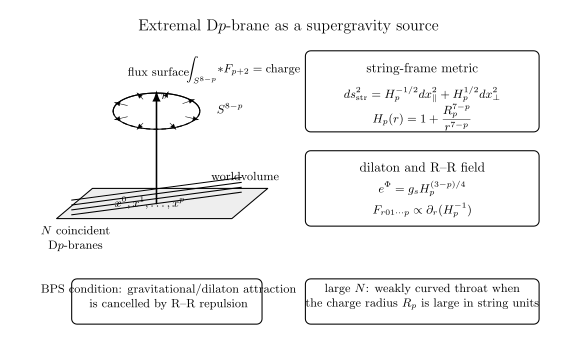
A schematic two-dimensional section of the six-dimensional normal fiber of a D3 stack. The linking surfaces are five-spheres, not brane worldvolumes. Their outward flux is in the fixed spacetime orientation, independent of the radius. The full field is self-dual; the signed flux does not indicate an antibrane.
Checking all the coupled field equations
Section titled “Checking all the coupled field equations”A harmonic function alone is not a proof that the spacetime solves supergravity. We now check the form, scalar and Einstein equations. In the asymptotically matched Einstein metric the fields become
For this calculation abbreviate the rescaled electric form by , with . For , the appropriate ordinary electric action is
This is a consistent single-charge truncation; for the high-degree electric fields it follows after dualization. It must not be read as an action for every democratic RR field independently. Bergshoeff and collaborators, section 2.1, explain the doubled-field pseudo-action and the constraints imposed after variation. The present signs and field basis are those of the shared overview.
Variation gives
The factor comes from trace reversal in ten dimensions. The electric form has a negative scalar square because one index is timelike.
The cancellation of the nonlinear terms
Section titled “The cancellation of the nonlinear terms”Let , and . Use , , and write the metric as , where
All derivatives in the following formulas are flat transverse derivatives. Direct contraction of the Christoffel symbols gives
The relation cancels both the quadratic bracket in and the uncontracted Hessian in . If , then , so
These are nonzero curvature components. They must equal the scalar and form sources. For , the second identity gives
Substitution reproduces both Ricci blocks: the transverse coefficient is . Meanwhile,
The last expression proves that the form equation is precisely . This calculation works for a nonspherical harmonic function as well, so it establishes the multi-center exterior equations. It does not replace the source matching at the singular centers. Exercise 2 derives the exponents rather than starting with their values.
The D3 five-form and the AdS limit
Section titled “The D3 five-form and the AdS limit”For D3-branes the dilaton is constant and the matched Einstein metric equals the string metric. The unshifted invariant metric differs by its prescribed constant factor; these distinctions matter under the S-duality transformation of the asymptotic coupling on page 25.
The full D3 field is
The five-form term in the IIB pseudo-action is , inside the overall factor . Vary first and impose self-duality afterwards. With , its Einstein equation is
Although , its tensor contraction is nonzero. A vanishing scalar Lagrangian after imposing a constraint does not imply vanishing stress. Exercise 4 checks both curvature blocks and explains how the factor avoids double counting.
For , neglecting the constant in gives
With , this is the Poincaré metric on times a round , both of radius . The asymptotically flat exterior has been removed by the approximation; the full solution still connects it to the near region.
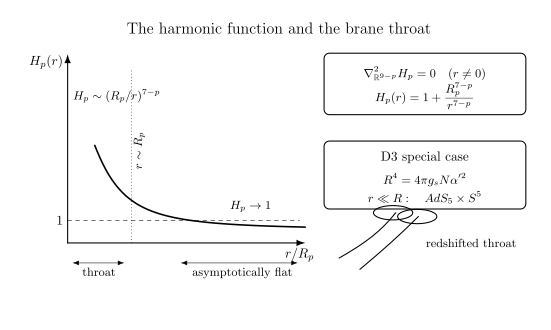
For , the exact function is and the near expression is . The relative error from dropping 1 is . The logarithmic axes cover . This measures approximation error; it does not by itself test curvature or string loops.
There are two independent expansion parameters. String-scale curvature is small when , or ; string loops are suppressed when . Large allows both. “Curvature” here means a scale extracted from Riemann components or invariants, not just the Ricci scalar: the latter vanishes on , whereas .
Fundamental strings and NS5-branes
Section titled “Fundamental strings and NS5-branes”The S-duality discussion becomes quantitative once the harmonic coefficients are fixed. The NSNS string-frame action needed for these backgrounds is
Here is distinguished by its form degree from the scalar harmonic functions. Its exterior equations are
The electric fundamental string
Section titled “The electric fundamental string”For positive fundamental strings along ,
To recover the coefficient, compute the weighted electric flux:
Thus , giving the displayed . The factor is different from the D1 coefficient : the NSNS kinetic term carries .
One can also check the metric equation directly. With , its parallel block reduces to ; the transverse block and dilaton equation vanish identically for this ansatz. The weighted form equation supplies the remaining condition. This verifies the coupled equations, rather than only their asymptotic flux.
The magnetic NS5-brane
Section titled “The magnetic NS5-brane”For a positive magnetic charge in the outward transverse orientation,
The last equality is for a spherical center, with the volume form of the unit three-sphere. It holds throughout the exterior. In particular,
The same coefficient follows from the positive D5 solution by the properly oriented S-duality transformation and coordinate rescaling in Exercise 3.
The NS5 field equations make the role of the flat star precise. Set . The nontrivial transverse metric equation reduces to
and the scalar equation is . The weighted form equation is automatic away from sources; its magnetic Bianchi identity fixes the localized charge. These statements can hold for a multi-center harmonic function. They do not assign a weakly coupled description to every center.
The NS5 throat and its worldsheet theory
Section titled “The NS5 throat and its worldsheet theory”Put and define a logarithmic radial coordinate
In the near region ,
The three-sphere has constant radius, while is an infinite proper-distance end. The additive dilaton constant shown here follows from the chosen origin of . Shifting that origin changes the constant as well.
The worldsheet description is six free coordinate supermultiplets, a supersymmetric Wess–Zumino–Witten model and a radial linear-dilaton supermultiplet. Its normalization is particularly instructive. The supersymmetric level is ; separating three adjoint fermions leaves a bosonic level . Therefore
The radial field has improvement coefficient in
Its central charge, including its fermion, is
The transverse theory has , and the six flat supermultiplets add , giving the critical matter value . Exercise 5 derives the central pole and the fermionic level shift. This ordinary unitary construction uses ; at the bosonic level is zero and a large-radius geometric interpretation is unavailable. A negative bosonic level at is not a justification for extending this description unchanged. The level shift and linear-dilaton construction are explained by Callan, Harvey and Strominger, section 8.
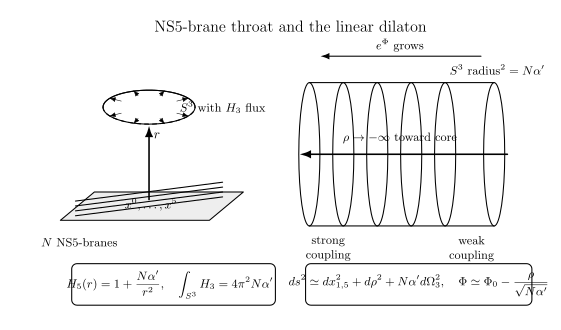
The cylinder is schematic, and is a proper radial coordinate only in the throat approximation. The full-profile comparison uses the same logarithmic coordinate. The graph uses , and , with exact coupling and throat estimate . The latter reaches unity at ; the exact crossing is , too close to separate at this scale. Small curvature at large does not prevent strong string coupling toward the left.
Independent limits of the description
Section titled “Independent limits of the description”For large , the throat curvature is of order , so the derivative expansion is useful. The exact worldsheet construction supplies more information about effects, but it does not suppress higher genera where is large. A simple simultaneous supergravity window is
The two inequalities have different meanings: the right one selects the throat; the left one suppresses string loops. The asymptotic coupling can be weak while the far end of the throat is strongly coupled.
The conventional little-string decoupling limit takes at fixed and focuses on the fivebrane sector. It is more than the replacement . Aharony’s review, sections 1 and 3, explains this limit and the resulting nongravitational theory. IIB S-duality and the IIA eleven-dimensional description provide other regimes, but simply lifting a smeared solution does not prove a localized, resolved core. The latter issue leads to M-branes and the eleven-dimensional limit.
Exercises
Section titled “Exercises”Exercise 1: Local charges and a moving probe
Section titled “Exercise 1: Local charges and a moving probe”Take two positive D centers with . Compute the signed flux around either center and around both. Then evaluate the full DBI plus WZ Lagrangian of a parallel probe moving with transverse coordinate velocity . Derive its static energy and quadratic kinetic term, and compare with an antibrane. Explain the obstruction to the same asymptotic harmonic boundary condition for .
Solution
The distributional identity in transverse dimensions is
The smooth contribution of the other center has zero flux through a small sphere. The warped Hodge identity therefore gives around center and the same coefficient times around both. The charges add even though the metric components do not.
In static gauge the induced time component is and each parallel spatial component is . Hence
For a positively oriented probe, , so
Its static energy is constant, and its leading translational kinetic coefficient is independent of position. The expansion requires , not merely a small coordinate velocity in arbitrary units. This probe result is consistent with, but does not replace, the coupled field-equation calculation.
The antibrane has the same DBI term and opposite WZ term. In the gauge where the potential vanishes at infinity,
The force points toward a positive center. A constant shift of the potential changes the reference energy, not this force. Backreaction, open-string instabilities at short separation and a final annihilation state are outside this probe calculation.
For a nonzero point source in two dimensions gives . It cannot both carry that charge and approach a finite constant at arbitrarily large in the same noncompact ansatz. Global sevenbrane constructions require additional information.
Exercise 2: Determine the warp exponents
Section titled “Exercise 2: Determine the warp exponents”For the ordinary electric action, keep , and a general coupling . Seek a branch with harmonic , metric exponents , , scalar and . Require the equations to hold for a generic multi-center harmonic function. Determine , and specialize to D-branes.
Solution
For a generic harmonic function, and are independent tensors. The form stress has no uncontracted Hessian, so its coefficient in the Ricci tensor must vanish:
Matching the powers of in the gradient stress and curvature requires . With these conditions, the scalar equation and the parallel Einstein equation respectively give
The transverse coefficient is a further check:
Define . Combining the preceding relations yields
The sign of selects the charge orientation; its square enters the metric equations. The Maxwell density is proportional to because its remaining power is
For , one finds for every D in the stated range. Choosing positive gives precisely the main-text exponents. Both the scalar and transverse Einstein equations would detect an arbitrary change of one exponent; solving only Maxwell’s equation would not fix them.
For this derivation uses the dualized ordinary electric action. At it algebraically produces the correct metric exponents, but does not establish the physical IIB field content. The full constrained five-form must still be supplied, as in Exercise 4.
Exercise 3: Duality, coordinates and absolute NS charges
Section titled “Exercise 3: Duality, coordinates and absolute NS charges”Apply the positive-to-positive transformation to a D1 and a D5 at zero axion. Restore a unit asymptotic string metric without changing . Derive the F1 and NS5 harmonic coefficients and their fluxes. Track which Einstein metric is invariant.
Solution
Initially , so gives and . At infinity . The physical coordinates with a unit asymptotic metric are therefore , including the transverse radius , and .
For D1, . Multiplication of the string metric by gives, after the coordinate rescaling,
Consequently . In the shared WZ doublet, maps the positive D1 potential to . Its original factor is canceled by , giving . The weighted flux is .
For D5, and . The transformed metric becomes
The shared democratic relation is . The warped star calculation gives . The map sends this magnetic RR flux to , and the constant coordinate rescaling gives
The displayed matrix on page 25 gives the opposite NS charge orientations; its metric and dilaton profiles are the same. A profile alone cannot settle the charge sign.
Finally as a tensor under the duality, whereas changes to . A coordinate rescaling is then used to express each asymptotic string metric in its own normalized coordinates. Holding both numerical coordinates and the normalized metric fixed would lose the required powers of in the charge radius.
Exercise 4: A vanishing Ricci scalar in a curved geometry
Section titled “Exercise 4: A vanishing Ricci scalar in a curved geometry”Construct the near-region D3 five-form in an orthonormal frame, compute its two Einstein-source blocks, and evaluate the Ricci and Kretschmann scalars. Recover the charge radius. Compare the complete IIB calculation with omitting the magnetic field while retaining the pseudo-action coefficient.
Solution
Let and , with their product the ten-dimensional orientation. Lorentzian signature gives and . The positive electric potential yields
The parallel and spherical contractions are respectively and . Dividing by gives
For a constant-curvature space of dimension , . Each five-dimensional factor contributes , so the product has . It is curved despite its vanishing Ricci scalar. Similarly, does not make either source block vanish.
The magnetic flux is , with . Equating it to gives . Electric and magnetic integrals describe the same charge; they are not added to double .
There is a useful diagnostic subtlety. Before self-duality, an ordinary electric five-form with kinetic coefficient has trace-reversed stress
For this ansatz it reproduces the same metric source as the complete self-dual IIB field: its trace term supplies the spherical block. Thus agreement of a metric calculation alone does not establish the IIB field content. If instead the IIB pseudo-action’s half coefficient is kept and the magnetic completion is omitted, this entire source is halved and fails the Einstein equation. Conversely, inserting both halves into the ordinary full-coefficient action doubles the correct source. The physical IIB prescription is variation of the half-coefficient pseudo-action followed by the self-duality constraint.
Exercise 5: Compute the throat central charge
Section titled “Exercise 5: Compute the throat central charge”Derive the central pole of the radial stress tensor without fixing . Show that three adjoint Majorana fermions supply level 2 to an current, and use the Sugawara central charge of the residual bosonic algebra to recover the critical NS5 worldsheet theory. Explain what this says about , and string loops.
Solution
The elementary derivative contractions are
Double contraction of the two quadratic terms in contributes . The two improvement terms add . A mixed contraction leaves an uncontracted field and cannot add a central constant. Since the central coefficient is , the boson gives ; its fermion adds .
For , define the adjoint bilinear . For example , whose double contraction is . Thus
In the convention with central term , these fermions carry level 2. Subtracting their current from the supersymmetric total leaves a commuting bosonic current of level . Its Sugawara stress has . Adding the three fermions and the radial supermultiplet gives
The cancellation uses both the level shift and the dimensional improvement coefficient. Omitting the shift would give a different central charge. The usual nonnegative-level bosonic construction allows ; the model has a trivial level-zero bosonic factor and is not a weakly curved sphere. Naively setting would require a negative bosonic level. None of this controls the genus weight , which diverges at the strong-coupling end of the throat.
Exercise 6: Proper distances and radial control
Section titled “Exercise 6: Proper distances and radial control”Determine which D near regions are at infinite string-frame proper radial distance. Compare the local sphere radius and coupling for , and . For NS5-branes derive an exact weak-coupling bound and the relative errors of the throat metric and coupling, then distinguish that approximation from the little-string decoupling limit.
Solution
In the D near region, the radial proper-distance element is
Its integral to diverges for , logarithmically at , and converges for . Finite distance does not imply a regular endpoint. The transverse sphere radius is
For the sphere grows toward the core while also grows, eventually invalidating weakly coupled string perturbation theory. At both scales are constant in the near region. For the sphere shrinks and curvature corrections eventually become important even though the local coupling decreases. Dimensionless coefficients in actual Riemann components matter; a radius estimate is a scaling test, not a complete invariant calculation. At the asymptotically flat end , the coupling approaches and the curvature vanishes.
For NS5-branes, put . The exact transverse metric in these coordinates is
The error of replacing the metric coefficient by 1, relative to the exact coefficient, is . The ratio of throat to exact coupling is . Both are controlled by .
If , the exact condition is
Strong separation from this lower bound and from the near-region upper bound gives the window in the main text. At and it spans approximately , with strict inequalities interpreted parametrically rather than as sharp reliability thresholds.
Finally, a near-region approximation holds the theory’s parameters fixed and drops the constant in a spatial profile. The little-string limit changes while holding fixed and isolates a sector of the theory. Weak curvature, weak coupling and decoupling are distinct questions. An exact worldsheet throat treats effects even when geometric curvature is not small. It neither ensures weak string loops nor establishes decoupling.
References
Section titled “References”- Aharony, Ofer. “A Brief Review of ‘Little String Theories’.” Classical and Quantum Gravity 17 (2000), 929–938. arXiv:hep-th/9911147; doi:10.1088/0264-9381/17/5/302. Sections 1 and 3 discuss decoupling and the throat description.
- Bergshoeff, Eric, Renata Kallosh, Tomás Ortín, Diederik Roest, and Antoine Van Proeyen. “New Formulations of D=10 Supersymmetry and D8–O8 Domain Walls.” Classical and Quantum Gravity 18 (2001), 3359–3382. arXiv:hep-th/0103233; doi:10.1088/0264-9381/18/17/303. Section 2.1 gives the democratic pseudo-action and the constraints imposed after variation.
- Callan, Curtis G., Jr., Jeffrey A. Harvey, and Andrew Strominger. “Supersymmetric String Solitons.” Lectures at the 1991 Trieste Spring School on String Theory and Quantum Gravity. arXiv:hep-th/9112030. Section 8 develops the supersymmetric WZW and linear-dilaton description.
- Itzhaki, Nissan, Juan M. Maldacena, Jacob Sonnenschein, and Shimon Yankielowicz. “Supergravity and the Large N Limit of Theories With Sixteen Supercharges.” Physical Review D 58 (1998), 046004. arXiv:hep-th/9802042; doi:10.1103/PhysRevD.58.046004. Sections 2 and 7 discuss D-brane geometries, dual regimes and fivebranes.