
Type II T-Duality, RR Fields, and Preserved Supersymmetry
T-duality changes more than the geometry of an open-string endpoint. It reverses one Ramond chirality, exchanges type IIA with type IIB, and changes the degree of the Ramond–Ramond potential to which a D-brane couples. These transformations must agree quantitatively: a wrapped brane and its dual must have the same energy and the same coupling to a transformed RR field.
We will derive this agreement for a flat spatial circle, constant dilaton, vanishing -field, and fields independent of the circle coordinate. We then determine the supersymmetry preserved by an unfluxed brane. The extension to curved backgrounds requires an isometry and additional field transformations; top-form sources require separate global conditions.
Use the overview’s spacetime and spinor conventions, RR bulk and brane-coupling basis, and tensions and couplings. The relevant prerequisites are Ramond spin fields, RR vertices, and open-string T-duality.
A spatial reflection on one worldsheet sector
Section titled “A spatial reflection on one worldsheet sector”Let have period , and write . The dual coordinate is . Worldsheet supersymmetry requires the right-moving fermion to reverse sign too:
Other fermions and the left-moving sector are unchanged. The circle transformation derived on page 15 is
A Ramond fermion zero mode acts as a gamma matrix. Therefore its spinor transformation must reverse while leaving the other nine gamma matrices fixed under ordinary conjugation. Define the reflection lift
Since anticommutes with each gamma matrix,
The last identity proves that the Ramond chirality changes. Multiplication by also changes chirality, but by itself its ordinary conjugation fixes and reverses the other gamma matrices. On an input of definite chirality , reduces to ; this restricted statement does not remove the need to track after duality. This is the spin lift used in Polchinski, section 3.3.
The inverse transformation includes a lift sign
Section titled “The inverse transformation includes a lift sign”Write the right-spinor map as , with . The sign is part of the identification between the two theories. Because , choosing the opposite sign for the reverse map makes it the inverse. Applying the same lift twice would instead give a minus sign on that Ramond sector. Hassan, equations (9)–(11), distinguishes these two choices explicitly.
The shared spinor and orientation choices take , with in IIA and in IIB. Their inverse-lift signs satisfy . We will now show how those choices give the normalized RR component map and the self-dual IIB five-form. The chirality labels select representations without changing their dimensions.
From a spinor matrix to a normalized RR field
Section titled “From a spinor matrix to a normalized RR field”The RR vertex has two spinor-coordinate indices. As on pages 9 and 12, convert its polarization matrix into a Clifford endomorphism using charge conjugation:
Changing the right state gives . Since
we obtain, without suppressing the index conversion,
Thus right multiplication by one gamma matrix is the result for these calibrated Clifford coefficients. It is not the ordinary-conjugation spin lift itself.
Matching the coefficients to the brane-coupling basis
Section titled “Matching the coefficients to the brane-coupling basis”The linearized polarization forms used in the vertex analysis specify representations and constraints. To compare their amplitudes with spacetime actions, we must also fix their field normalization and relative degree signs. At , let
These are the field strengths in the overview’s brane-coupling basis. In particular, and in IIA, while in IIB
The minus sign in follows from the fixed global relation , where the latter is the bulk-action potential. It is a field-basis sign, not a negative norm or a negative charge magnitude.
For one independent RR form with a conventional kinetic term, the constant-background action can be written
The self-dual five-form uses its pseudoaction with the usual additional factor of one half. Its duality condition is imposed after variation. The equality above explains the relative coupling normalization appropriate to vertex states measured in gravitational units. The shared calibration of their Clifford coefficients is therefore
with a common external-vertex normalization suppressed. This calibration applies to linearized fields about the constant background. It does not replace nonlinear supergravity by a vertex-operator identity. The brane-coupling RR basis is also the one used in Myers, equations (3)–(5); his coupling normalization must be translated along with his fields.
Right multiplication adds or removes the last index
Section titled “Right multiplication adds or removes the last index”Place the compact index last. For an ordered product with all ,
There is no factorial left over: the in the full antisymmetric expansion precisely converts it to a sum over ordered independent components. The normalized strengths therefore satisfy
Here are physical flat coordinates; the other coordinates are unchanged. Both branches acquire the magnitude . The fields are independent of , so the operation commutes with exterior differentiation on the nine-dimensional base. The same component rule consequently holds for potentials, after matching their gauge choices and constant modes by the brane coupling.
Ordered potentials and the physical circle radius
Section titled “Ordered potentials and the physical circle radius”Introduce angles , of period , and define the degree-rescaled forms
Use dimensionless base coordinates when writing components of . A component containing has an additional factor relative to its physical-coordinate component. That factor converts the preceding physical dictionary into
An equivalent form statement, with the compact leg last, is
The two terms on the right have degrees and . If the compact differential is instead put first, the signs change: the degree-raising term is , and removing a first leg from an -form introduces . A formula containing a bare wedge plus contraction cannot be used without specifying this ordering and potential basis.
For example, directly in physical components and the overview’s bulk potentials, the IIA-to-IIB map gives
The primes on the two-form denote the IIB bulk . The two minus signs disappear when it is replaced by . This example is why an RR dictionary must name its potentials.
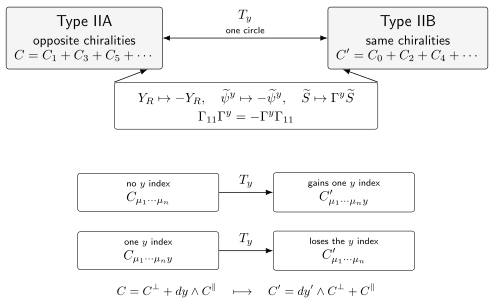
The exchange is for the dimensionless WZ-basis forms in angular coordinates, with the compact differential last, flat , and a circle isometry. Physical-coordinate components acquire . Bulk IIB potentials require the global basis translation, including the minus sign of . The diagram describes an exterior-algebra operation; the reflection lift and the resulting Clifford component map play different roles.
The brane integrals fix the radius factor
Section titled “The brane integrals fix the radius factor”An unfluxed brane has WZ coupling . A brane wrapped once on reduces to a D-brane. With the circle last in the oriented worldvolume,
Since , this is exactly the factor . Conversely, an unwrapped D becomes a D wrapped on the dual circle:
Now , giving the same factor. The DBI energies agree as well:
These equalities compare energy per common noncompact spatial volume. Leaving unchanged would spoil them away from the self-dual radius.
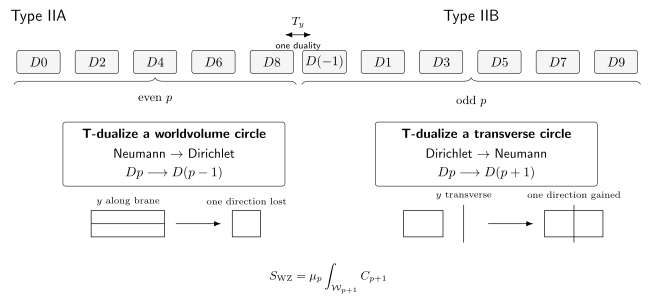
The circle radii are and . Spectator directions are suppressed. A wrapped circle disappears from the brane worldvolume; a localized point becomes a wrapped dual direction. The displayed energy equalities include the transformed coupling and apply to one wrapping, no flux, and the same oriented brane charge.
Radiative RR fields and their dual partners
Section titled “Radiative RR fields and their dual partners”At nonzero null momentum, the two Dirac constraints on imply
These are linearized Bianchi identities and field equations. Their independent physical content is
| Theory | Independent radiative strengths | Transverse potential polarizations |
|---|---|---|
| IIA | ||
| IIB | with self-duality |
Higher magnetic partners can be retained in a democratic description, provided a duality constraint removes the doubling. The sign of that constraint follows from the same orientation and Hodge star as the kinetic action, not only from requiring to be correct.
To see the sign explicitly, let be an -form and denote its Clifford image by . With the oriented volume , direct reordering of gamma matrices gives
This star satisfies . For instance, , because the norm of is negative. Combining the identity with gives
Consequently in IIB. For the even IIA forms,
These are relations in the calibrated WZ-strength basis. Applying them twice uses and returns the original form. Switching the orientation or chirality labels requires translating the relation too. Exercise 2 checks the kinetic-action sign as well as this double-star check.
Why the zero- and top-forms are different
Section titled “Why the zero- and top-forms are different”For a nonzero plane-wave momentum, forces . The ten-form is its constrained dual and also has no radiative polarization. A constant is instead the Romans parameter of massive IIA. A D8 is a domain wall sourcing its jump; its nine-form potential is useful even though it adds no local propagating mode.
An IIB D9 requires a ten-form potential . In ten dimensions there is no eleven-form kinetic field strength. Varying this nondynamical potential imposes a charge constraint on space-filling sources. This is the relevant distinction between a local D9 boundary condition and a globally consistent vacuum; the type I orientifold includes the compensating source and projection, as explained on page 13. A D-instanton instead has a Euclidean worldvolume and must not be treated as an ordinary Lorentzian particle multiplet.
The flat boundary-CFT operation taking D9 to D8 is well defined. A transformation between their fully sourced supergravity backgrounds is a stronger statement: ordinary Buscher rules require an isometry, localized sources may require a smeared description, and nonzero Romans mass involves the corresponding IIB axion dependence. Hassan, section 4, treats that massive extension. We are not deriving a global backreacted D8 or D9 solution from the flat-circle calculation.
A brane preserves a graph of supersymmetry parameters
Section titled “A brane preserves a graph of supersymmetry parameters”The Ramond spin fields also supply the BRST-closed contour currents whose integrals are the spacetime supercharges. Schematically,
Here denotes the bosonized superghost, not the spacetime dilaton. Their picture, locality and BRST qualifications were established on page 7. A boundary relates the two currents, so only a diagonal set of their transformations survives.
Parameters and charge columns are paired, not identified
Section titled “Parameters and charge columns are paired, not identified”On page 7, labels the linear combination of basis currents, just as labels a Ramond vertex. Thus has the same chirality as that Ramond polarization. To express the generator with the shared invariant pairing, collect the basis currents into a column and define its covariant charge column by . Then
The basis-current index satisfies . Since pairs opposite Weyl representations, . The Ramond polarization and parameter have chirality ; the covariant charge column has the opposite chirality. This is an index conversion, with sixteen real components throughout. It preserves the page-7 result , where the gaugino and parameter have the same chirality.
The lift obeys , so its full matrix preserves this pairing. Its restriction to the opposite Weyl spaces is different. With , the parameter effectively transforms by , while the covariant charge column transforms by . The formulas for a basis current and for a covariant charge column must therefore not be interchanged.
Start with a positively oriented D9 boundary condition . Dualize successively in directions . The parameter relation becomes
Each of the inverse parameter maps contributes a minus sign. For the second equality, use and . The compact index is removed last in each WZ coupling, preserving the positive source orientation throughout this sequence. This fixes the parameter sign together with that charge convention. For an antibrane the RR source orientation reverses. Both cases are described by
This construction is for flat unfluxed Lorentzian D-branes, . The chirality change of is , giving even in IIA and odd in IIB.
The sign also agrees directly with the positive WZ charge map. For a compact coordinate ordered last, removing a wrapped direction or adding a transverse one gives, respectively,
The first identity applies for , the second for . The factor is the inverse parameter map as well as the forward one on the relevant Weyl spaces. Thus both operations keep for the positive source orientations used in the WZ integrals above.
Constructing the actual projector
Section titled “Constructing the actual projector”The matrix is invertible, but
need not equal one. It is therefore unsafe to call the brane projector. On the pair , define instead
Then , and is exactly the graph relation. The parameter is arbitrary in its allowed real Weyl space, so the graph has dimension sixteen. The opposite graph has dimension sixteen too. Thus an isolated flat brane boundary condition preserves half of the thirty-two bulk supersymmetries.
The preserved charge combination follows by substitution into the bilinear:
This derives the transpose and charge-conjugation factors. It avoids equating a parameter relation with an unsupported matrix formula for charge components.
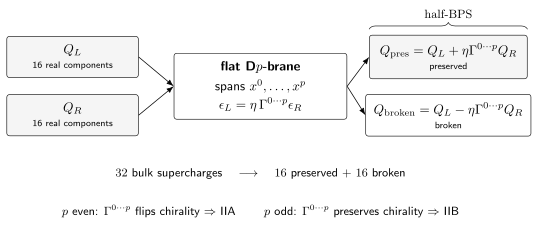
For a flat unfluxed brane, selects the positive eigenspace of , whose lower off-diagonal block contains . The drawing is a schematic slice of the parameter spaces, with no norm or angle implied. Charge components are obtained through the invariant pairing in the text; they are not automatically related by the same displayed graph matrix.
The massless worldvolume multiplet
Section titled “The massless worldvolume multiplet”The supersymmetric GSO projection keeps the open NS states and the corresponding Ramond ground states. Splitting into Neumann directions and Dirichlet directions gives a gauge field and transverse scalar fields . Their interactions are the dimensional reduction of ten-dimensional super Yang–Mills at leading derivative order, with the matrix and Abelian normalizations already derived.
For and a nonzero null worldvolume momentum, the vector has physical polarizations and the embedding contributes scalars. The total is eight bosonic polarizations, paired with eight fermionic polarizations. D0-brane dynamics is quantum mechanics, with nine coordinate matrices and a nondynamical time component of the gauge field; the same nonzero-null-momentum count is not applicable there. The D-instanton requires its Euclidean continuation.
For coincident parallel branes, Chan–Paton labels promote these fields to adjoint matrices. The diagonal scalar entries describe positions, and off-diagonal strings become massive when branes separate. This is the Higgs mechanism developed on page 17, now placed in a multiplet with sixteen supersymmetries. Fluxes, intersections and brane–antibrane systems can preserve fewer or no common supersymmetries.
Gauge covariance beyond the flat component map
Section titled “Gauge covariance beyond the flat component map”The RR potential entering the D-brane action is the WZ-basis polyform, not an unspecified sum of bulk potentials. At fixed , its infinitesimal gauge transformation is
Graded differentiation gives
The product changes by an exact form; it is not itself gauge invariant. Including the worldvolume field, the action contains . Under an NSNS gauge transformation the boundary coupling requires , so is invariant. Exercise 6 checks both statements in components of fixed degree.
For nonzero or off-diagonal metric components, the potential transformations involve additional terms and the isometry-adapted frame. The curved-space rules and their potential basis are given by Hassan, equations (34)–(38). To compare his minus- differential with our WZ basis, the degree signs give : since , the corresponding curvature becomes . His sector and duality-lift choices must also be translated. This identifies a precise comparison; the elementary flat-circle calculation above does not claim to derive the full nonlinear rules.
Common pitfalls
Section titled “Common pitfalls”A chirality flip does not by itself fix a reflection lift. Check the conjugation of every gamma matrix and specify the inverse transformation. The restricted action on a Weyl spinor can conceal a sign that matters on the next duality.
Form degree does not fix normalization or potential basis. Angular and physical-coordinate components differ, the coupling changes, and the bulk IIB two-form differs in sign from its WZ counterpart. All three enter the charge comparison.
Democratic fields are not extra particles. Dual strengths obey constraints. Romans mass is a background parameter; a D9 ten-form is nondynamical. Neither supplies an extra massless RR polarization.
Exercises
Section titled “Exercises”Exercise 1: two reflection lifts and their inverses
Section titled “Exercise 1: two reflection lifts and their inverses”Derive the conjugations by for a spatial direction. Show that lifts for distinct spatial directions anticommute. Compare using the same lift twice with using the inverse theory identification. Explain why replacing the lift by before this calculation is insufficient.
Solution
Because and , we have and . For the reflected direction, anticommutation gives ; for , the two minus signs from passing through and cancel. Hence ordinary conjugation gives precisely the desired one-coordinate reflection.
For ,
The vector reflections commute, but their spin lifts can differ by the central minus sign when their order is interchanged. A sign on spinors is invisible in the vector representation. Likewise, the same lift twice gives . With and , their product is .
On a Weyl spinor of chirality , acts as . After the first action, the chirality is , so the next restricted action carries the other sign. Dropping those factors prematurely would give the wrong lift composition. Conversely, ordinary conjugation by fixes and changes the sign of all with ; it does not realize the specified reflection on the full Clifford algebra.
Exercise 2: an ordered form map and the Hodge sign
Section titled “Exercise 2: an ordered form map and the Hodge sign”Use and independent potential components , , , in IIA. Derive their IIB bulk images, including signs and the radius factor. Verify the round trip in the angular WZ basis. Then check the democratic constraint on a timelike one-form and on a zero-/ten-form pair, using the kinetic-action definition of the Hodge star.
Solution
Right multiplication of the normalized Clifford coefficient by appends the last index when absent and removes it when present. Since the base exterior derivative commutes with this operation, its WZ-potential version has the same index rule. Dividing by the transformed coupling gives . The global relations and at then give
for the corresponding coefficients: explicitly , , and similarly for the last two entries. In angular WZ variables, write . Its image is , and applying the inverse gives . In physical components the two factors multiply to .
For the Hodge check, , so
The democratic relation for is . Taking gives , and the relation returns because on one-forms. For the even pair, take and . Then and . Checking only the square of the star would not detect an erroneous overall sign of the star on all odd degrees; the wedge-norm test does.
Exercise 3: a wrapped and an unwrapped D2
Section titled “Exercise 3: a wrapped and an unwrapped D2”Compute the DBI energies and WZ couplings of a D2 that either wraps the circle once or lies transverse to it. Match them to a D1 and a wrapped D3. Why do the RR component factors remain even though the angular dictionary has unit coefficients?
Solution
For the wrapped D2,
For the transverse D2,
The first equality of WZ integrals requires , hence . The second requires , hence . Integrating a nonconstant base profile gives the same equalities point by point on the common base.
The angular variable satisfies , while the dual satisfies . These Jacobians, together with the degree-rescaling by , are exactly what removes the component factors from the angular dictionary. It does not remove them from a formula written in physical coordinates. Holding fixed would also miss the DBI energy match, showing that the radius change alone is insufficient.
Exercise 4: half supersymmetry and an intersection
Section titled “Exercise 4: half supersymmetry and an intersection”Construct the brane projector on the allowed pair of Weyl-parameter spaces. Derive the preserved charge combination from the bilinear. Determine the common supersymmetry of a parallel brane–antibrane pair and of a D1 along within a D5 along , with compatible orientations.
Solution
The two parameter spaces each have real dimension sixteen. The map is an invertible map from the right one to the left one. Thus
Every vector in the positive eigenspace has the form , with arbitrary allowed , giving rank sixteen. The negative eigenspace is . This works also when .
Substitution into the generator gives
If , reversing the ordered product of gamma matrices after transposition gives
This factor and the chosen order of are determined by the pairing, not by the parameter graph alone.
A parallel brane and antibrane require both and . Invertibility forces both parameters to vanish. For a D1 inside a D5, the two positive graph conditions instead give
This matrix squares to one and preserves the right Weyl space. Its two eigenspaces there have equal dimension: an invertible even gamma product such as preserves Weyl chirality and anticommutes with , pairing the eigenvectors. Therefore precisely eight real right parameters satisfy the condition, and the left parameter is fixed by either graph. The pair preserves eight of the thirty-two bulk supersymmetries.
Exercise 5: a top-form jump and a space-filling constraint
Section titled “Exercise 5: a top-form jump and a space-filling constraint”Consider in a flat region with and a prescribed D8 source. Starting from
derive the jump of across . Compare with the variation of a nondynamical IIB ten-form coupled to space-filling charges. Does either field add a radiative state?
Solution
A nine-form has odd degree, so after discarding the boundary term,
Varying the action therefore gives
In the democratic relation derived in the text, , so . Integrating over a small positively oriented interval transverse to the wall yields
The last equality uses the global values of and . Away from the wall is constant. There is no wave equation with an additional local scalar polarization. On a compact transverse circle, integrating the same equation requires the total oriented wall charge to vanish, unless the setup is modified by additional sources or global data.
For an IIB ten-form there is no eleven-form kinetic term. A coupling gives upon variation. Uniform space-filling charges must therefore cancel, with orientifold and brane contributions included where applicable. This is a constraint on sources, not the propagation of another RR field. The calculation is a local source equation with fixed metric; it does not determine the dilaton, metric profile, or global boundary conditions of a D8 solution.
Exercise 6: exact shifts of the WZ density
Section titled “Exercise 6: exact shifts of the WZ density”At fixed , prove from . Work out the degree-four expression explicitly. Then include the NSNS transformation of the worldvolume gauge field. Explain the difference between a gauge-invariant action and a gauge-invariant local potential density.
Solution
For a homogeneous component ,
The second equality uses the degree-three sign when moving past . Summing degrees proves the identity. The degree-four WZ density at zero worldvolume flux is
For ordinary RR gauge parameters , , , and . Thus
The global IIB translation writes the same density in bulk variables as
This is generally not the bare bulk or a degree-four term built by putting unspecified bulk potentials into the exponential.
For , the open-string boundary transformation is . Hence . Under RR transformations, multiplication by preserves the exact-shift calculation because in this Abelian source-free patch. Integrating on a closed worldvolume gives zero variation. A worldvolume boundary or nontrivial global patching requires the corresponding boundary/overlap data; the local density itself need not be invariant. This argument establishes gauge covariance of the coupling, not the full curved-background T-duality transformation.
References
Section titled “References”- S. F. Hassan, “T-Duality, Space-time Spinors and R-R Fields in Curved Backgrounds,” Nuclear Physics B 568 (2000), 145–161, doi:10.1016/S0550-3213(99)00684-7; arXiv:hep-th/9907152. Sections 2 and 4 treat the spin lift, inverse-duality choices, and isometric RR transformations; the potential and orientation conventions require the translations described above.
- Robert C. Myers, “Dielectric-Branes,” Journal of High Energy Physics 1999, no. 12, 022, doi:10.1088/1126-6708/1999/12/022; arXiv:hep-th/9910053. Equations (3)–(7) specify the brane-coupling RR basis, its action, and the radius/coupling transformation.
- Joseph Polchinski, “TASI Lectures on D-Branes,” in Fields, Strings and Duality, edited by Costas Efthimiou and Brian Greene, World Scientific, Singapore (1997), pp. 293–356; arXiv:hep-th/9611050, revised 23 April 1997. Sections 3.3–3.5 derive the type II spinor and brane interpretation; section 4.2 discusses common supersymmetries of intersecting branes.