
String Theory II Introduction
These pages develop the material of Professor Igor R. Klebanov’s one-semester course, “Strings, Black Holes and Gauge Theories,” taught in Spring 2011. The initial drafts were prepared with the assistance of AI and have since been reviewed and edited by me. The site is still under construction; although I have tried to ensure accuracy, some errors may remain. If you notice any significant mistakes, I would greatly appreciate your feedback.
How do quantum strings describe gauge fields, charged branes, black-brane thermodynamics, and a gravitational description of a quantum field theory? This course develops that question through 35 sequential pages. It continues String Theory I, reviews the worldsheet foundations, and then follows D-branes from their open-string definition to concrete tests of holography. Derivations, limiting checks, explanatory figures, and solved exercises support both a first reading and later reference use.
Superstrings, D-branes, and holography
Section titled “Superstrings, D-branes, and holography”The worldsheet starting point is the Polyakov action,
Its diffeomorphism and Weyl symmetries lead to physical-state constraints and quantum consistency conditions. Adding worldsheet supersymmetry gives the Ramond–Neveu–Schwarz formalism. The Type II GSO projections studied here produce spacetime supersymmetry; worldsheet supersymmetry alone does not select those projections. The massless closed-string fields include the metric, two-form, dilaton, and Ramond–Ramond gauge potentials.
Open-string boundary conditions introduce a second description. T-duality exchanges Neumann and Dirichlet conditions, identifying D-branes as dynamical objects with -dimensional worldvolumes and transverse directions in ten-dimensional spacetime. For a single BPS D-brane, the leading derivative Abelian Dirac–Born–Infeld and Wess–Zumino action is
Here is the pullback, is the string-frame metric, and the second integral selects degree . The shared RR definitions fix the potential basis and charge signs, while the tension definitions distinguish from the physical tension. This action explains how gauge fields and transverse scalar fields live on a brane, and how worldvolume flux carries lower-dimensional brane charge. Derivative and curvature corrections, as well as the non-Abelian dynamics of coincident branes, require further terms and qualifications.
For D3-branes in flat transverse , the low-energy open-string theory contains four-dimensional super Yang–Mills theory. The decoupled throat is . Its interacting sector supplies the principal example of the gauge/gravity correspondence; the free center-of-mass is separated. The radius and coupling obey
In the holographic dictionary, a bulk field’s asymptotic source coefficient couples to a boundary operator. Matching the renormalized generating functionals then relates bulk responses to field-theory correlation functions. The decoupling page explains the limit and its conjectural interpretation; the following pages perform the renormalization and correlation-function calculations. D3-branes at the conifold give a different gauge theory and an throat, developed on the final page.
Reading the course
Section titled “Reading the course”Read the numbered pages in order on a first pass. Pages 01–14 establish the worldsheet, superstring, and amplitude tools. Pages 15–24 develop compactification, D-branes, charges, and worldvolume dynamics. Pages 25–29 examine dualities, black branes, and open string field theory; pages 30–33 turn to holographic observables. Pages 34–35 use compact geometry and the conifold to extend the examples. These are stages of the same course.
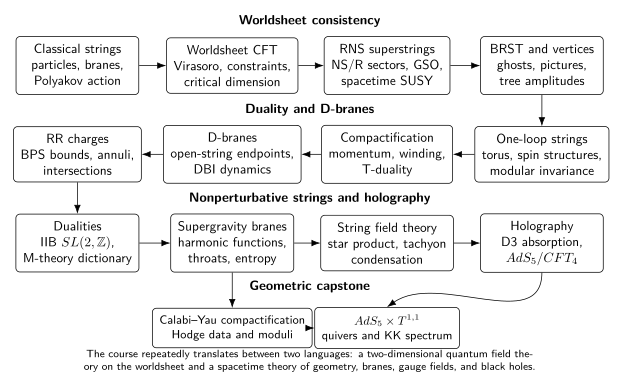
The main reading sequence, with page ranges and the central task of each stage. The arrows indicate course order; they do not assert that every result in one stage logically implies every result in the next. This is a schematic guide, with no quantitative scale.
Use the global conventions as a reference throughout the course. At each new calculation, identify the degrees of freedom, approximation, and observable before manipulating formulas. Then reproduce the central derivation and try the exercises before opening their solutions. Useful recurring checks include conformal weights, form degrees, charge normalization, dimensions, and the limit in which an effective description applies.
Some comparisons concern exact or protected quantities, such as symmetry representations or specified BPS data. Others use classical supergravity, which requires controlled curvature and quantum corrections. For the spherical D3 example, weak curvature requires , while a weakly coupled string description also requires . The pages distinguish these assumptions from the conjectured full duality. A perturbative worldsheet limit is one consistency check; it is not a universal description of every nonperturbative duality.
The translations also have hypotheses. A spacetime modulus can correspond to an exactly marginal physical worldsheet deformation within a consistent family of backgrounds; conformal weight at one point alone does not establish exact marginality. A bulk source and an expectation value are distinct asymptotic coefficients, and their relation depends on the boundary condition and renormalized action.
Prerequisites and review
Section titled “Prerequisites and review”The course assumes graduate quantum field theory and basic general relativity. The early pages review string starting points; the following links give more detailed preparation when needed.
| Background | Working target | Review |
|---|---|---|
| Relativistic field theory | Vary an action, derive currents, use propagators and tree amplitudes. | Particles and extended objects and tree amplitudes |
| Two-dimensional CFT | Extract weights and modes from stress-tensor OPEs; use radial quantization. | Free-boson CFT, primary fields, and radial quantization |
| Spinors and supersymmetry | Work with Clifford algebras, chirality, supercharges, and preserved supersymmetry. | RNS supersymmetry and spin fields |
| Geometry and gravity | Use differential forms, the Hodge star, curvature, and horizon thermodynamics. | Conventions and units, supergravity branes, and black D3-branes |
| Groups and representations | Label physical polarizations, Chan–Paton factors, and symmetry multiplets. | Superstring spectra and the conifold theory |
The three warm-up exercises below check dimensions, electric/magnetic form degrees, and a free-boson OPE. They also illustrate the detail expected in later calculations.
Pages in sequence
Section titled “Pages in sequence”| Page | Subject | Main calculation or question |
|---|---|---|
| 01 | Relativistic Particles, Branes, and the Birth of the String | Worldline actions, reparametrization symmetry, and the extension to strings. |
| 02 | The Polyakov Action, Gauge Symmetry, and Virasoro Constraints | Gauge fixing, boundary conditions, and the Virasoro constraints. |
| 03 | Mode Expansions, Regge Trajectories, and Bosonic String Quantization | Open and closed spectra, normal ordering, and Regge behavior. |
| 04 | Worldsheet Supersymmetry and the RNS Action | RNS fields, worldsheet supersymmetry, and the supercurrent. |
| 05 | The Superconformal Algebra and NS/R Sectors | NS/R moding and the super-Virasoro algebra. |
| 06 | The RNS Spectrum and the GSO Projection | Physical RNS states and the GSO projection. |
| 07 | Bosonization, Spin Fields, and Spacetime Supersymmetry | Bosonization, spin operators, and spacetime supercharges. |
| 08 | Ghosts, Superghosts, and BRST Quantization | Ghost systems, central charges, and BRST cohomology. |
| 09 | Superstring Vertex Operators and Pictures | Pictures, physical vertex operators, and picture changing. |
| 10 | Tree Amplitudes, Chan–Paton Factors, and Gauge Theory from Open Strings | Open-string amplitudes, Chan–Paton matrices, and gauge-theory limits. |
| 11 | Low-Energy Limits: DBI, Type I, and Type II Supergravity | DBI expansion and the massless Type I/II actions. |
| 12 | Physical States and Type II Superstring Spectra | Little-group representations, RR forms, and Type II multiplets. |
| 13 | Unoriented Strings, Orientifolds, and Type I Theory | Worldsheet parity, orientifold planes, and tadpole cancellation. |
| 14 | One-Loop Strings, Tori, and Modular Invariance | Torus moduli, spin structures, and modular invariance. |
| 15 | Circle Compactification and T-Duality | Momentum and winding, radius inversion, and enhanced symmetry. |
| 16 | Thermal Strings and the Hagedorn Transition | Thermal winding states and the Hagedorn regime. |
| 17 | Open Strings, T-Duality, and the Emergence of D-Branes | T-dual boundary conditions and D-brane positions. |
| 18 | The DBI Action and D-Brane Worldvolume Fields | Determinant expansions, electric fields, and brane worldvolume dynamics. |
| 19 | Open/Closed Duality and D-Brane Scattering | The cylinder in open and closed channels and moving-brane interactions. |
| 20 | Type II T-Duality, RR Fields, and Preserved Supersymmetry | Spinor reflection, RR transformation rules, and supersymmetry projectors. |
| 21 | D-Brane Charges, BPS Bounds, and Dirac Quantization | Charge normalization, BPS tensions, and Dirac quantization. |
| 22 | D-Brane Interactions and the Annulus Amplitude | Annulus amplitudes, massless exchange, and the no-force condition. |
| 23 | Intersecting Branes and Preserved Supersymmetry | Compatible brane projectors and intersection rules. |
| 24 | Worldvolume Flux, BIons, and F/D Bound States | Dissolved charge, BIon profiles, and F/D bound-state energies. |
| 25 | Type IIB S-Duality, (p,q) Strings, and the D3-Brane | The axion–dilaton, string charges, and the D3 under S-duality. |
| 26 | Supergravity p-Branes, NS5-Branes, and Throat Geometries | Charged supergravity solutions, fluxes, and throat limits. |
| 27 | M-Theory Origin of Type IIA Branes | Circle reduction and the M2/M5 origin of IIA branes. |
| 28 | Near-Extremal D3-Branes and Entropy | Fixed-charge D3 thermodynamics and the strong-coupling entropy. |
| 29 | Open String Field Theory and Tachyon Condensation | Cubic open string field theory, tachyon energy, and analytic solutions. |
| 30 | Absorption by D-Branes and Two-Point Functions | D3 absorption and the normalization of two-point functions. |
| 31 | The Decoupling Limit and the AdS/CFT Dictionary | The decoupling limit, radial scales, and renormalized source matching. |
| 32 | Holographic Correlators and the Breitenlohner–Freedman Bound | Scalar responses, counterterms, the BF bound, and boundary conditions. |
| 33 | Holographic Anomalies and the Central Charges of N=4 SYM | Metric sources, the Weyl anomaly, and central-charge normalization. |
| 34 | Calabi–Yau Compactification and Moduli | Kähler and complex-structure moduli and Type II multiplet counts. |
| 35 | AdS5 × T¹,¹ and the Klebanov–Witten theory | The conifold quiver, coupled Kaluza–Klein modes, and wrapped baryons. |
Global conventions
Section titled “Global conventions”The shared conventions for this volume are collected here. Spacetime signature, Fourier transforms, and source signs agree with AdS/CFT Foundations: Conventions and Units. The string and D-brane normalizations below supplement that reference. Calculations define their local coordinates and approximations where needed; a different normalization is identified explicitly.
Spacetime and worldsheet notation
Section titled “Spacetime and worldsheet notation”Use natural units and mostly-plus Lorentzian signature,
Spacetime indices are or , with ten target-space dimensions in the superstring theory. Bosonic-string calculations may keep the dimension general until imposing criticality. On a D-brane, or denote worldvolume directions, and denote transverse directions. The pullback is written .
For the worldsheet,
The default open-string interval is , while a closed string has . In Euclidean signature, are complex worldsheet coordinates. A reuse of as a spacetime radial variable is identified in the relevant calculation.
The string scale and holomorphic free-boson normalization are
There is an analogous antiholomorphic OPE. Boundary doubling and changes between plane and cylinder coordinates must retain their associated factors of two.
Spacetime spinors and orientation
Section titled “Spacetime spinors and orientation”In an oriented flat frame use and
The Hodge star is defined by , with the form inner product induced by the mostly-plus metric. Thus and on an -form. This is the star used in the kinetic actions.
When absolute ten-dimensional Ramond polarization chirality labels are needed, take , with in IIA and in IIB. For a two-spinor polarization matrix , its Clifford form is ; consequently and . At and constant dilaton, its linearized coefficients are , where , up to one common external-vertex normalization. In the vertex and spectrum calculations, and the locally reconstructed denote polarization coefficients and their potentials. Converting them to the spacetime fields used in actions includes this normalization and the WZ-to-bulk field translation. With the calibrated WZ field basis and orientation, the democratic relation is
In particular, the IIB five-form is self-dual. Statements using a symbolic chirality describe both representations and do not select a different orientation.
Spatial T-duality reflects the right-moving sector. Its full spinor lift is , with and , so the reverse identification is the inverse. Supersymmetry parameters have the corresponding Ramond polarization chirality, as in the spin-field derivation. If the component charges are written as covariant columns in , those charge columns have the opposite chirality: inserting converts their dual indices. They must not be identified with the polarization columns in . These choices, the RR normalization, and their compatibility with brane charge are derived on the type II T-duality page.
Kähler geometry and internal orientation
Section titled “Kähler geometry and internal orientation”For a Kähler internal space, the complex components of its metric and its Kähler form are related by
On a complex threefold, the positive internal orientation is . The internal Hodge star uses this Riemannian metric and orientation: for complex forms, , with the induced Hermitian inner product. Consequently . This internal star is distinguished from the ten-dimensional Lorentzian star above.
Compactification Kähler moduli are measured in the string-frame metric unless a frame conversion is indicated. Their dimensionless forms are
The dimensionless metric has Hodge star . On a -form, the two stars satisfy
Thus formulas for two-form norms in terms of and use , whereas the two stars coincide on three-forms.
In a fixed integral basis of the free part of , write and . This definition of does not absorb factors of from the worldsheet coupling. The holomorphic three-form is a local holomorphic section over complex-structure moduli space, with in the orientation above. Its freedom , for a nonvanishing holomorphic function of the moduli, is retained when differentiating the moduli-space Kähler potential; a fixed norm for is not imposed across the family. The Calabi–Yau compactification page derives the associated kinetic metrics.
Worldsheet stress tensors
Section titled “Worldsheet stress tensors”The Lorentzian Hilbert stress tensor and the constraint tensor with the tension removed are
Here is the auxiliary worldsheet metric. For the bosonic Polyakov action, with induced metric ,
The metric equation is . In flat conformal gauge, , whereas the canonically normalized chiral constraint densities are . These factors matter in Poisson brackets and mode generators.
The Euclidean CFT stress tensor uses the String I normalization: and . In the free bosonic sector, . The symbols , , and therefore denote related quantities with explicitly different normalizations, not interchangeable formulas.
RNS fermions and supersymmetry
Section titled “RNS fermions and supersymmetry”We use the canonical worldsheet fermions of String I, including its real gamma matrices, Majorana adjoint, complex measure , and unit-coefficient fermion OPE. In particular, the Lorentzian matter action in chiral components is
The constant supersymmetry parameters are Grassmann odd and are written to the left of the fields:
The variations themselves are even. With , their commutator is a translation with coefficients . Closure on the fermions uses their equations of motion unless an auxiliary field is retained. The Lorentzian matter constraints have the normalization
Under with , and . The continued expression is the holomorphic matter stress tensor, with normal ordering in the quantum theory. The Euclidean supercurrent is , also denoted . Its contour parameter is for this continuation of the rigid transformation. Detailed checks of the action, continuation, and current algebra appear in RNS worldsheet supersymmetry.
The shared bosonization, ordered superghost OPEs, and picture grading are summarized in the String I overview.
Dilaton and Einstein-frame normalization
Section titled “Dilaton and Einstein-frame normalization”Distinguish the total dilaton , its asymptotic value, and its dimensionless fluctuation:
For asymptotically flat brane calculations, use the Einstein-frame metric normalized to agree with the string-frame metric at infinity:
The frequently used unshifted definition differs by a constant: . A radius expressed in one metric must be converted before using it in the other.
The physical gravitational coupling includes the asymptotic string coupling:
In the asymptotically normalized Einstein frame, the metric and dilaton terms are
The canonically normalized ten-dimensional dilaton is therefore
In particular, and cannot be interchanged in a brane interaction without converting its coefficient. When an unshifted string-frame action is written with the factor , its coupling without is , so .
Ramond–Ramond potentials and brane couplings
Section titled “Ramond–Ramond potentials and brane couplings”The RR potentials are not rescaled by . In the bulk actions, write , , and use the modified field strengths
The IIB axion–dilaton is , with the total dilaton. These bulk variables differ from the potentials in the compact D-brane coupling , where . Through the degrees displayed above, the translation is
This is a change of field definition, not a change of charge magnitude. In particular, positive D1 charge couples to in this bulk basis. The three-form in is consequently , while its five-form is . The plus-exponential coupling and its RR basis are described by Myers, equations (3)–(5); the exact translation used here and its gauge-invariance check are derived on the low-energy action page. Dual potentials of higher degree require the corresponding duality relations. A brane charge sign or a potential redefinition must be translated together with the action.
Eleven-dimensional fields and the IIA circle
Section titled “Eleven-dimensional fields and the IIA circle”For the massless IIA reduction, the noncompact eleven-dimensional metric agrees with the string-frame metric at infinity. The circle coordinate has period , and the orientation is . The eleven-dimensional Hodge star uses the same form-inner-product definition as above. The physical circle radius and Planck length obey
Using the shifted dilaton and the unrescaled ten-dimensional RR potentials,
In the two-derivative eleven-dimensional theory, the dual potential is defined locally on a source-free patch, on shell, by
The brane tensions are
With vanishing worldvolume flux, an oriented M2 or M5 has electric coupling or , respectively. Reversing its worldvolume orientation reverses the charge. The action reduction derives the metric and three-form normalization; the M-theory brane page derives the tensions and the oriented wrapping relations.
D-brane tensions and D3-brane parameters
Section titled “D-brane tensions and D3-brane parameters”For type II D-branes, separate the charge normalization from the physical tension:
The notation used in some D-brane calculations denotes the same -independent normalization as . With the total dilaton, the DBI prefactor is ; with the fluctuation, it is . These are equal:
For a D3-brane, . For coincident D3-branes in flat transverse , with a round link, the radius of the extremal geometry, measured in the asymptotically normalized metric, obeys
The Hermitian matrix potential and covariant derivative follow the shared matrix gauge-field definitions. The matrix Yang–Mills convention used in the D3-brane holographic dictionary is
A single-brane Abelian DBI expansion written as with a unit generator instead gives . This factor of two is a gauge-field and generator normalization difference. The action and trace must be compared together when translating between the Abelian DBI calculation and the matrix convention. In AdS formulas, is also used for the radius denoted here by .
Bosonic open string field theory
Section titled “Bosonic open string field theory”BPZ sewing uses the inversion . The ordered ghost functional has the normalization derived in the ghost calculation:
The bosonic open string field theory action is written in dimensionless spacetime coordinates, with a dimensionless coupling :
Its overall coefficient is . With this disk normalization, the reference tension of one flat D25-brane is
The normalization follows Sen and Zwiebach, equation (2) and footnotes 7–8, with the spacetime zero-mode volume restored. For homogeneous fields, factoring that volume out of the correlators gives the string-unit energy density , so . The tachyon-condensation calculation uses these definitions. Relating to a coupling in an amplitude or another spacetime action also requires matching the disk and external-field normalizations.
Fourier transforms and response functions
Section titled “Fourier transforms and response functions”For a field on a -dimensional Lorentzian worldvolume or boundary, use
The inverse transform has the phase . Thus , , and . For a Hermitian operator, define
At positive frequency in the vacuum, is nonnegative. The retarded prescription is , supplemented in a gravitational calculation by an ingoing horizon condition.
For Euclidean source derivatives use with the source inserted as . At a classical gravitational saddle, . For a scalar correlator with these definitions, the continuation to the retarded function is
This convention fixes the signs used in absorption and boundary-correlator calculations. The boundary variational problem and local counterterms are part of each calculation, rather than additional choices of Fourier or source convention.
For metric sources, the shared stress-tensor definition fixes the response to a boundary metric variation and the sign of its Weyl anomaly.
Diagnostic warm-up exercises
Section titled “Diagnostic warm-up exercises”These three calculations test tools used throughout the course.
Exercise 1: dimensions of α′ and the string scale
Section titled “Exercise 1: dimensions of α′ and the string scale”In units , take the worldsheet coordinates to be dimensionless and to have dimensions of length. Use the Polyakov action to determine the dimensions of , the tension , and the string mass scale .
Solution
The action is dimensionless. Since is dimensionless and has dimensions of length, the factor must have dimensions of inverse length squared. Thus
The string tension is
so . This is correct for a tension in natural units: energy per unit length has dimensions . The natural string mass scale is
This agrees with in the shared definitions.
Exercise 2: electric and magnetic branes
Section titled “Exercise 2: electric and magnetic branes”Consider an ordinary Abelian -form potential in Lorentzian dimensions, with and a constant kinetic coefficient. An electric -brane couples through . Work in a contractible patch outside sources, so the field equation is . Determine the spatial dimension of its ordinary magnetic dual brane when both and are nonnegative. Apply this degree count to the propagating RR electric/magnetic pairs in ten dimensions, without assuming it fixes their duality signs.
Solution
The dual form has degree
It is closed by the source-free field equation. The Poincaré lemma on the stated patch therefore gives
A -form potential couples electrically to a worldvolume with one time and spatial dimensions. Hence
The final inequality enforces . The transverse sphere linking the magnetic brane has dimension , which independently matches the degree of the flux integrated over it.
In ten dimensions this gives for : the ordinary Type IIA pairs are D0/D6 and D2/D4; the Type IIB pairs include D1/D5 and the D3 sector. The D3 has the same electric and magnetic dimension, while self-duality of its five-form is an additional Type IIB condition. The shared RR relations, including their field basis and orientation, determine the actual signs and duality constraints.
The hypotheses matter. A nonconstant kinetic coefficient or Chern–Simons couplings change the field equation and the form that is locally closed. Degree counting alone does not address global charge patches, D7/instanton duality, or the special roles of D8- and D9-branes; the nonnegative-dimensional Lorentzian pairing derived here assigns none of these a fictitious partner.
Exercise 3: conformal weight of an exponential vertex
Section titled “Exercise 3: conformal weight of an exponential vertex”Suppose the holomorphic scalar has OPE
and stress tensor
Show that the holomorphic conformal weight of is .
Solution
Differentiating the scalar OPE gives
Contracting with the exponential gives
The double contraction in is therefore
The single contraction gives the expected derivative term. Hence
so the holomorphic conformal weight is
For a closed-string plane wave the antiholomorphic weight is the same. Physical-state conditions then relate these weights to oscillator contributions and intercepts.
References
Section titled “References”- Robert C. Myers, “Dielectric-Branes,” Journal of High Energy Physics 1999 (12), 022 (1999). arXiv:hep-th/9910053, doi:10.1088/1126-6708/1999/12/022.
- Ashoke Sen and Barton Zwiebach, “Tachyon Condensation in String Field Theory,” Journal of High Energy Physics 2000 (03), 002 (2000). arXiv:hep-th/9912249, doi:10.1088/1126-6708/2000/03/002.
Further reading
Section titled “Further reading”These references complement the derivations on the numbered pages.
- Ofer Aharony, Steven S. Gubser, Juan Maldacena, Hirosi Ooguri, and Yaron Oz, “Large N Field Theories, String Theory and Gravity,” Physics Reports 323, 183–386 (2000). arXiv:hep-th/9905111, doi:10.1016/S0370-1573(99)00083-6. A broad review of the correspondence and its controlled gravity calculations.
- Katrin Becker, Melanie Becker, and John H. Schwarz, String Theory and M-Theory: A Modern Introduction. Cambridge University Press, 2007. Publisher. A companion for supersymmetry, dualities, and compactification.
- Philippe Di Francesco, Pierre Mathieu, and David Sénéchal, Conformal Field Theory. Springer, 1997. doi:10.1007/978-1-4612-2256-9. Detailed treatments of OPEs, representations, and modular methods.
- Michael B. Green, John H. Schwarz, and Edward Witten, Superstring Theory, Vol. 1: Introduction; Vol. 2: Loop Amplitudes, Anomalies and Phenomenology. Cambridge University Press, 1987; 25th anniversary edition, 2012. Volume 1, Volume 2. A detailed reference for perturbative superstrings and amplitudes.
- Elias Kiritsis, String Theory in a Nutshell, 2nd edition. Princeton University Press, 2019. Publisher excerpt. An advanced reference spanning worldsheet methods, compactification, and holography.
- Joseph Polchinski, String Theory, Vol. 1: An Introduction to the Bosonic String; Vol. 2: Superstring Theory and Beyond. Cambridge University Press, 1998. Volume 1, Volume 2. A reference for string quantization, D-branes, and their spacetime interpretation.
- Barton Zwiebach, A First Course in String Theory, 2nd edition. Cambridge University Press, 2009. doi:10.1017/CBO9780511841620. An accessible review of classical strings and light-cone quantization.