
Why Strings? Regge Behavior and Dual Resonance Models
Why replace an elementary point particle by a string? Two questions led to this idea. In hadron physics, an extended rotating object could explain why heavier resonances often have larger spin. In quantum gravity, quantized strings provide massless spin-two states and a new organization of interactions. These motivations involve very different physical scales, even though they use related mathematics.
This page develops both motivations and then studies the first quantitative example: the Veneziano amplitude. We will derive its convergence domain, its resonance poles and signed residues, and the sense in which two exchange channels describe one analytic function. The required tools are relativistic kinematics, Fourier series, and the Euler beta and gamma functions. Units, metric signature, and the definitions of the string scale follow the global conventions.
Strings and their worldsheets
Section titled “Strings and their worldsheets”A particle trajectory is a one-dimensional worldline . A string has an additional internal coordinate, so its history is a two-dimensional worldsheet . The functions describe where that surface lies in spacetime. Worldsheet coordinates label points on the surface; they are not additional spacetime dimensions.
An open string is an interval with two endpoints. A closed string is a loop, with a periodic internal coordinate. Free propagation therefore has the topology of a strip or cylinder, respectively. The endpoints of an open string require boundary conditions, which will later lead to D-branes.
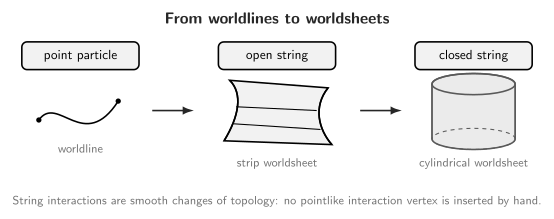
The dimension of the history increases by one when a spatial object evolves in time. The strip and cylinder show free propagation; their coordinates describe the worldsheet, not extra spacetime directions. The drawings are schematic.
String tension is energy per unit length. Stretching a static straight segment to length costs energy ; tension is not a separate bending rigidity. Because a string can oscillate in many modes, quantizing one type of string produces many particle states. Their oscillator masses are typically separated in mass squared by an amount of order , rather than being equally spaced in mass.
When the energy and momentum transfers are small compared with the string scale, massive oscillator states can often be integrated out, leaving an effective field theory for the light states. Compactification can introduce additional light scales, so being below the string scale alone does not guarantee a four-dimensional description.
Rotating strings and Regge trajectories
Section titled “Rotating strings and Regge trajectories”Hadronic resonances approximately organize into trajectories
Here is spin, is the resonance mass, and is an empirical slope. A relativistic string explains the linear dependence through a concrete mechanical calculation.
Consider a straight open string rotating in a plane with angular velocity . Work in its center-of-mass frame and neglect endpoint masses. The free endpoints move at the speed of light, so their distance from the center is . A segment at radius moves transversely with speed . Its energy and angular-momentum densities are
Both halves of the string contribute. With ,
Eliminating , and using in this frame, gives
The endpoint energy density diverges, but the integrals are finite. A slower rotating string is longer, more energetic, and carries more angular momentum. The fully constrained worldsheet solution is developed on the page about classical rotating strings.
Quantization adds an intercept. In the critical open bosonic string, the leading trajectory has oscillator level , maximum spin , and
This is a preview of a result to be derived, not an assumption about every string background. In particular, its state has negative mass squared and is a tachyon, signaling an instability of the bosonic vacuum. At large , the intercept is a small relative correction to the classical relation. Tong, §3.1.3 discusses this spectrum and its relation to hadronic trajectories.
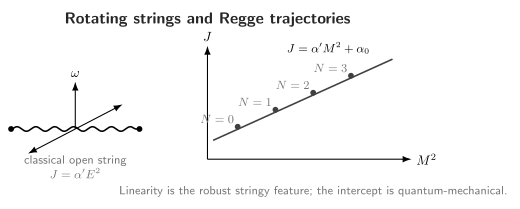
For massless endpoints, the classical rotating string has . The critical open bosonic leading trajectory is shifted to . The dimensionless horizontal coordinate is ; these ideal string relations are not a fit to hadron data.
The hadronic slope and the fundamental string parameter must be distinguished physically. A QCD flux tube is an effective extended object made from gauge fields; a fundamental string is an elementary object in the string description. Their tensions need not coincide. The success of a rotating-string picture for hadron spins does not determine the fundamental string scale or make a QCD flux tube a theory of gravity.
Massless states, gauge symmetry, and gravity
Section titled “Massless states, gauge symmetry, and gravity”The standard flat open-string spectrum contains a massless vector. Its physical polarization obeys a transversality condition, and a longitudinal polarization is a gauge redundancy. Endpoint labels, called Chan–Paton labels, can organize these vectors into a nonabelian gauge theory. Which vectors survive, and which gauge group they form, depend on boundary conditions, projections, and the background.
The oriented closed bosonic string contains a massless rank-two polarization. Its symmetric traceless part is a graviton; the antisymmetric part gives a two-form gauge field, and the scalar part gives the dilaton. The link between a massless spin-two state and gravity is stronger than a resemblance of tensor indices: Lorentz invariance and factorization of soft-emission amplitudes constrain an interacting massless spin-two particle to couple universally to energy and momentum. These assumptions are central to Weinberg’s soft-graviton argument.
These statements describe sectors of specified theories. They do not mean that all gauge fields must come from open strings: heterotic strings also produce gauge fields in a closed-string theory. Nor does the bosonic spectrum give a stable model of nature; its tachyon is a real limitation. Superstrings with suitable projections remove that tachyon, while the amount of spacetime supersymmetry depends on the construction and vacuum.
String interactions also change the ultraviolet problem. Instead of specifying separate pointlike interaction vertices, perturbation theory integrates over worldsheet shapes and their joining and splitting topologies. This organization produces relations between processes that look distinct in a particle description. Smoothness alone is not a proof that every amplitude is finite: degenerating worldsheets can produce infrared singularities, and unstable backgrounds can produce further divergences. The spectrum, gauge symmetries, and integration over worldsheet moduli must all be treated together.
Compact dimensions and physical scales
Section titled “Compact dimensions and physical scales”Extra spacetime dimensions can be present in a consistent string background without being compact. Compactification is one way to obtain a lower-dimensional description appropriate to observations. To see the mechanism, consider a free scalar of higher-dimensional mass on a flat product spacetime with a circle of fixed radius :
Single-valuedness quantizes the circle momentum to . Substitution into the higher-dimensional Klein–Gordon equation gives
A lower-dimensional observer interprets momentum in the hidden direction as additional rest mass. Keeping only is appropriate for processes well below the first nonzero Kaluza–Klein threshold. Warping, varying radii, background gauge fields, or different boundary conditions can modify this simple spectrum.
Closed strings can also wind around the circle. A string wound times has a classical stretching energy
Thus shrinking the circle raises momentum energies but lowers winding energies. The complete string spectrum also includes oscillator excitations and constraints; this energy estimate is a preview of the T-duality analysis, not its full mass formula.
Compactification also affects the gravitational scale. Let a -dimensional Einstein theory have a direct-product metric on , with an unwarped compact space of fixed volume . Keeping the four-dimensional graviton zero mode, the Einstein term reduces as
Comparing with the four-dimensional action gives . Consequently, the four-dimensional Planck length is not determined by the string tension alone. In a weakly coupled critical string with constant dilaton, the scaling gives
Here is the dimensionless string interaction coupling, and numerical factors have been suppressed only in the scaling relation. All lengths and the volume must be evaluated in a consistent metric normalization. Large compact volume or small coupling can separate the string and four-dimensional Planck scales. This elementary reduction assumes fixed moduli and no warping; it does not by itself construct or stabilize a realistic compactification. See Tong, §7.4.1 for the gravitational reduction.
The Veneziano amplitude and channel duality
Section titled “The Veneziano amplitude and channel duality”The original motivation for dual resonance models was hadron scattering. The finite-energy sum rules of Dolen, Horn, and Schmid related averaged direct-channel resonance data to crossed-channel Regge behavior. They indicated that adding these descriptions independently could double-count the same physics. Veneziano then constructed an analytic amplitude exhibiting the desired relation between poles, crossing, and Regge behavior.
For four external momenta, use all-incoming kinematics with and define
On shell, , momentum conservation implies . The variables are not three independent arguments.
Consider the beta-function building block
where and . We define the reduced amplitude by this formula; momentum-conservation delta functions, an overall S-matrix phase, and any endpoint matrix factors are omitted. Its pole residues below have definite signs relative to this choice. The general intercept defines an analytic model; crossing and a pole tower alone do not establish a consistent quantum string theory. For the critical open bosonic string, .
The integral and its two endpoints
Section titled “The integral and its two endpoints”Write and . The Euler representation is
Near zero the integrand behaves as , so integrability requires . The endpoint at one similarly requires . In this domain the integral defines the beta function directly. The gamma-function expression then provides its meromorphic continuation outside the convergence domain; a divergent endpoint integral cannot simply be used as an ordinary real integral there.
In the worldsheet description, is the position of one boundary insertion after three others have been fixed by conformal symmetry. With our definitions of and , choose cyclic order and positions
Then brings particles together, giving the channel. The limit brings together, giving the channel because . The two endpoints belong to one integral.
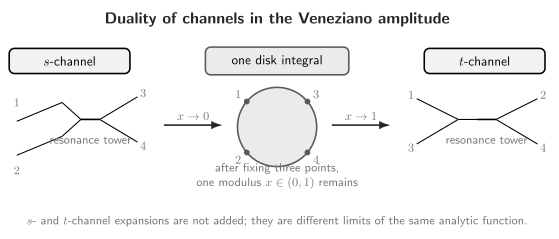
For cyclic order , the modulus has an -channel degeneration at and a -channel degeneration at . These are two limits of the same ordered amplitude. The worldsheet and channel drawings are schematic.
An ordered amplitude versus crossing symmetry
Section titled “An ordered amplitude versus crossing symmetry”The identity makes this block symmetric under . It does not make a single block fully symmetric under all permutations of . In modern open-string scattering, it is an ordered partial amplitude, associated with a fixed cyclic order of boundary insertions.
For identical unlabelled scalar states, a crossing-symmetric completion is, up to a common normalization,
With Chan–Paton labels, the different orderings instead carry their corresponding matrix traces. Summing distinct boundary orderings is compatible with channel duality: the operation differs from adding a second copy of the - and -channel expansions of one already complete block. Tong, §6.3.1 derives this distinction from the disk amplitude.
Pole expansions and exchanged particles
Section titled “Pole expansions and exchanged particles”We can extract all -channel poles directly from the endpoint integral. Expand
where the empty product at is one. Integrating term by term in the convergence domain gives
For generic , the summand falls as , so the series converges absolutely when , away from its poles. Elsewhere the equality is understood through analytic continuation, not convergence of this unsubtracted series. Expanding around the other endpoint exchanges and and displays the -channel tower.
At generic fixed , the pole positions are
The coefficient of is . Since , the residue with respect to the physical variable is
Both the minus sign and the Jacobian matter. They also follow from and the gamma-function recurrence. In the equivalent propagator form the numerator has the opposite sign; residue signs should not be interpreted independently of the amplitude convention.
For example,
| Level | Pole | Residue divided by |
|---|---|---|
At fixed center-of-mass energy, is affine in the cosine of the scattering angle. A degree- residue can therefore be expanded in angular partial waves with spin at most . This is the analytic signature of a growing spin tower. Positivity of the exchanged states requires more than this polynomial property; the quantum constraints will address it later. Special kinematics can make a residue vanish, and summing different orderings can remove some exchanges by symmetry.
For , the pole masses reproduce of the open bosonic string. The beta function is its ordered four-tachyon tree amplitude, interpreted formally around the unstable bosonic background. This identification is a precise mathematical result, not a proposal that observable hadrons are bosonic-string tachyons. The original construction is Veneziano’s 1968 amplitude.
Fixed-momentum-transfer Regge behavior
Section titled “Fixed-momentum-transfer Regge behavior”The same function also produces a power law at large with fixed. Use the gamma-function asymptotic relation
valid in complex sectors staying away from the negative real axis. With and fixed ,
Thus the exponent governing large-energy scattering is the same linear function that locates the resonance spins. A finite collection of fixed-spin exchanges would not reproduce this continuously -dependent exponent; the infinite tower is essential.
This limit is an analytic statement in an appropriate complex direction, with a chosen branch of the power. Along the positive real axis the tree amplitude encounters infinitely many narrow poles, so the expression is not a uniform pointwise approximation there. Channel duality, crossing symmetry, and Regge asymptotics are related properties, but they are distinct statements.
The next step is to derive the dynamics behind these clues. The relativistic point particle introduces the reparametrization symmetry that becomes worldsheet coordinate invariance for a string.
Exercises
Section titled “Exercises”Exercise 1. Rotation, length, and stored energy
Section titled “Exercise 1. Rotation, length, and stored energy”Evaluate the two rotating-string integrals using . If the instantaneous total length is , find and as a function of . Explain why the energy exceeds .
Solution
The substitution turns the dimensionless integrals into
Hence and . Since ,
The factor in the energy accounts for the kinetic energy of the moving segments. A static stretched segment of the same length has energy ; a rotating one has a position-dependent Lorentz factor. The integrable endpoint divergence does not require adding an endpoint mass. Eliminating gives as before.
Exercise 2. When is the circle invisible?
Section titled “Exercise 2. When is the circle invisible?”For a massless higher-dimensional scalar on the product circle, derive its dispersion relation at lower-dimensional spatial momentum . Compare the first Kaluza–Klein energy at with the energy of a singly wound string. Which one is lighter when , and which when ? State the assumptions behind these estimates.
Solution
Substituting a mode into yields
Thus at rest for , whereas the classical winding energy is . Their ratio is
For a large circle, momentum modes are lighter; for a small circle, winding excitations have the lower characteristic energy. The two estimates coincide at . The field calculation assumes a flat product metric, a fixed radius, and periodic boundary conditions. The winding estimate is the tension times the wrapped length, before oscillator contributions and physical-state constraints. It explains why suppressing Kaluza–Klein modes does not by itself remove all string sensitivity to a small circle.
Exercise 3. Mandelstam variables and ordered channels
Section titled “Exercise 3. Mandelstam variables and ordered channels”Prove with all four momenta incoming. Verify that the cyclic order has the adjacent and channels. What are the adjacent channels for order using the same definitions of ?
Solution
Expanding the three squares gives
where the second line uses . For order , the two inequivalent adjacent pairings are and . Their invariants are and , respectively. For order , the pairings are and , which give and . A diagram’s cyclic labels must therefore be specified before naming its two channels.
Exercise 4. Signed residues and a terminating pole sum
Section titled “Exercise 4. Signed residues and a terminating pole sum”Derive the residue at using gamma functions, including its sign. Then evaluate the full amplitude at and explain why only one term remains in its -channel pole sum.
Solution
Set . The singular gamma function and the finite ratio satisfy
Their product gives
To obtain the residue in , divide by . In particular the first three residues in are , , and .
At , the recurrence gives
Every coefficient with vanishes. Thus the infinite pole tower is a statement about generic crossed-channel kinematics; special values can cancel residues. The integral at this value is simply for .
Exercise 5. A pole removed by crossing symmetry
Section titled “Exercise 5. A pole removed by crossing symmetry”Take four identical open bosonic tachyons and the symmetric amplitude . With , show that the residue of its pole vanishes at generic . Does this mean that the open-string spectrum has no massless vector?
Solution
Each external mass squared is , so . Writing , , and gives
At , and . The two blocks containing an -channel pole have total residue
At generic , the third block is regular there. The cancellation expresses the exchange symmetry of identical unlabelled scalar external states: an odd-spin exchange does not contribute to this symmetric amplitude. The vector still exists in the spectrum and appears in appropriate ordered or matrix-valued amplitudes. A spectrum and the exchanges allowed in one chosen scattering process are different pieces of information.
Exercise 6. Intersecting channel poles
Section titled “Exercise 6. Intersecting channel poles”Let and , with nonnegative integers . Determine the leading singularity of as both small parameters approach zero. Is there a term proportional to with a nonzero constant coefficient?
Solution
Apply the simple-pole expansion to all three gamma functions:
Therefore the leading singular part is
The zero of the inverse gamma function removes the putative product pole. The result displays two channel singularities without an independent constant multiple of . The expression describes generic simultaneous approach directions; along special directions such as , the displayed leading singularity cancels and one must examine the full expression.
References
Section titled “References”- R. Dolen, D. Horn, and C. Schmid, Finite-Energy Sum Rules and Their Application to πN Charge Exchange, Physical Review 166 (1968), 1768–1781. The original finite-energy argument for dual descriptions and the danger of double counting.
- D. Tong, Lectures on String Theory, University of Cambridge lecture notes, arXiv:0908.0333 (2009), §§3.1.3, 6.3.1, and 7.4.1. The open-string trajectory, ordered disk amplitudes, and compactification of the gravitational action.
- G. Veneziano, Construction of a Crossing-Symmetric, Regge-Behaved Amplitude for Linearly Rising Trajectories, Il Nuovo Cimento A 57 (1968), 190–197. The beta-function amplitude and its Regge interpretation.
- S. Weinberg, Photons and Gravitons in S-Matrix Theory: Derivation of Charge Conservation and Equality of Gravitational and Inertial Mass, Physical Review 135 (1964), B1049–B1056. The soft-emission consistency argument underlying universal spin-two coupling.