
Closed Superstring Sectors and Type II Theories
A closed superstring combines left-moving and right-moving excitations with the same spacetime momentum and mass. Each side can be Neveu–Schwarz or Ramond. The resulting tensor products contain the graviton, antisymmetric gauge fields, gravitini, and dilatini of ten-dimensional supergravity. The supersymmetric choices, type IIA and type IIB, each have 128 bosonic and 128 fermionic massless polarizations, but their representations differ: IIA has opposite Ramond chiralities, whereas IIB has equal chiralities and a self-dual five-form field strength.
We derive this spectrum for free strings in uncompactified, flat ten-dimensional spacetime. The open-string constraints, physical spinor spaces, and GSO projection supply the chiral building blocks. The shared worldsheet definitions and spacetime spinor and orientation choices apply throughout. Polarization counts below refer to a fixed nonzero momentum; spacetime reality relates conjugate Fourier modes and does not halve those counts again.
Closed-string masses and level matching
Section titled “Closed-string masses and level matching”The bulk plane wave factorizes as . Each factor has conformal weight , as follows from the free-boson OPE. Thus the two chiral constraints act at the same momentum, with a factor of four relative to the open-string mass formula.
Let count nonzero oscillators in one chiral sector. The plane matter generators and their zero-mode conditions are
The Ramond plane shift is the Ramond ground-state weight derived on page 26. It is consistent with . Positive and also annihilate physical states, and an independent tilded copy imposes the right-moving constraints. As in the open-string construction, physical states are taken modulo the appropriate null descendants.
Subtracting the displayed physical weights gives the mass intercepts and . With , both sides must satisfy
The equality is level matching. It equates the shifted oscillator grades, not necessarily and . For example, an NS–R state has
The corresponding squared masses are and . Setting the two unshifted oscillator numbers equal would incorrectly remove these states.
There is a useful check in the vertex description. In canonical pictures the chiral ghost factors have weights and . They cancel the physical NS and R matter weights, respectively. A massless mixed vertex therefore has total weights even though its matter weights are . The superghost construction and physical vertex operators explain this dressing.
Which sectors can be paired?
Section titled “Which sectors can be paired?”The NS GSO grading has an odd vacuum and keeps an odd number of fermion oscillators in . Since each such oscillator has half-integer level,
Consequently cannot pair with or a Ramond sector in this uncompactified theory. It can pair with itself, producing a tachyon of . Level matching restricts possible pairings; the GSO choice determines which permitted sectors are retained.
For type II, take the two Ramond choices specified in the shared definitions:
At every matched grade, the retained sectors are NSNS, RR, NS–R, and R–NS, with on each NS side and the selected total Ramond parity on each R side. On the Ramond oscillator ground state that parity equals spinor chirality. At excited levels it is , so the coefficient spinor chirality depends on the nonzero-mode occupation.
More precisely, at a common on-shell momentum the physical space of each sector is , and the spectrum is the direct sum over matched . An unrestricted product would also contain pairs with unequal masses. At each chiral factor has eight physical polarizations, so every retained sector has . A spacetime rotation gives a minus sign for each Ramond factor: NSNS and RR are bosonic, while the mixed sectors are fermionic.

The two axes measure and with equal unit lengths. Filled points are matched type II grades; open points fail level matching. Along the diagonal . Each of the four massless sectors contains 64 polarizations. The mixed example at has ; marker sizes do not measure degeneracy.
NSNS fields from a tensor and its gauge freedom
Section titled “NSNS fields from a tensor and its gauge freedom”A massless NSNS state has the form
The two supercurrent constraints impose transversality in both indices:
Each chiral vector also has its longitudinal null direction. Hence
There are components before this quotient. The two nine-dimensional gauge-parameter spaces have a common redundancy: , changes nothing. Their image therefore has dimension , leaving states.
To display these states covariantly, choose an auxiliary null vector with . The projector
annihilates and . Its mixed-index form obeys and has trace . Project both indices of to obtain . This chooses a representative on an eight-dimensional Euclidean transverse space. A different changes the representative by a longitudinal gauge transformation, as Exercise 2 verifies.
Writing , the decomposition is
The three pieces are the graviton, NSNS two-form, and dilaton. Their little-group tensor product is
Here counts symmetric traceless tensors and counts two-forms. The scalar polarization of unit norm is . Identifying it with an action-normalized dilaton also requires the string-to-Einstein-frame field redefinition; a trace of the ten-dimensional metric alone does not perform that identification.
The longitudinal symmetric and antisymmetric shifts become linearized diffeomorphisms and two-form gauge transformations in position space. Thus gauge symmetry has emerged from the null-state equivalence, rather than being imposed on an arbitrary collection of tensor components.
Mixed sectors and the gravitino–dilatino split
Section titled “Mixed sectors and the gravitino–dilatino split”Consider NS–R. Its polarization is a vector carrying a Weyl spinor index from the Ramond ground state. The left and right constraints give
The NS longitudinal state supplies the equivalence
At a fixed nonzero null momentum, the Weyl Dirac kernel has complex dimension eight. The vector-spinor initially has components; transversality removes eight, and the injective map removes another eight. The result is .
This quotient can be taken explicitly. Under the displayed shift, changes to . Choose , which itself obeys the Dirac equation. Then both and vanish, leaving eight transverse components , each valued in an eight-dimensional spinor space. This explains the physical tensor product .
Let be the transverse restrictions of the spacetime Clifford operators. The gamma trace is
Because each reverses transverse chirality, belongs to the opposite spinor representation. The trace map is onto: for any such , the vector-spinor has precisely that trace. Therefore
The gamma-traceless part has polarizations and is a gravitino. The trace has eight and is a dilatino. Gamma-tracelessness selects the gravitino species; it is not a condition to impose on the entire mixed sector.
The ten-dimensional statement is equally direct. The covariant trace is gauge invariant because its shift is . It obeys a Dirac equation since
Its Weyl chirality is opposite to that of . Thus a gravitino and its dilatino have opposite ten-dimensional chiralities. R–NS gives a second pair. IIA has two gravitini of opposite chirality; IIB has two of the same chirality, with the dilatini opposite to them.
To keep the representation labels unambiguous, write for a transverse spinor module of chirality and for the vector module. Then
The dimensions are . These are representations of , the double cover of that includes spinors. The null-translation part of the full massless little group acts trivially on the physical finite-spin states, as discussed on page 28.
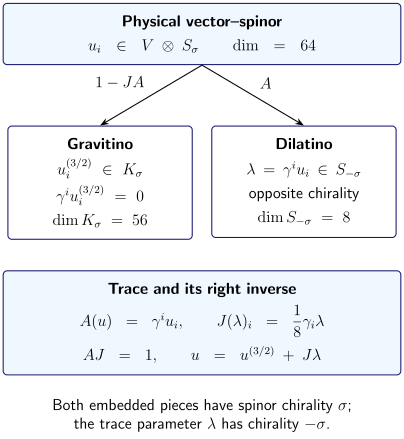
The vector-spinor has already satisfied the Dirac and transversality constraints and the longitudinal gauge quotient. Gamma contraction has right inverse , so . The two particle spaces are selected by and . The dilatino has the opposite spinor chirality; the 56-dimensional kernel retains the vector-spinor’s spinor-index chirality. This is an algebraic decomposition with no geometric scale.
RR bispinors and differential forms
Section titled “RR bispinors and differential forms”Two Ramond ground states give a bosonic polarization matrix with two spinor-coordinate indices. There are two useful descriptions of this object: a covariant ten-dimensional field strength, and an eight-dimensional physical potential polarization. The change in dimension and the change from strength to potential explain their different form degrees.
Charge conjugation fixes the form parity
Section titled “Charge conjugation fixes the form parity”Apply the shared charge-conjugation map to form a Clifford endomorphism:
The antisymmetrized gamma products span the matrices: their number is . For ordered index sets , the Clifford trace identity is , with . It makes the products linearly independent, so this is a basis, not merely a matching dimension count.
The two Ramond chiralities act on as
The identity converts these into
Moving past a degree- gamma product gives . Comparing the two equations proves
Equal ten-dimensional Ramond chiralities therefore give odd field strengths in IIB; opposite chiralities give even field strengths in IIA. Leaving out would reverse this rule.
Before the momentum constraints, each chosen chiral bispinor has components. Multiplication by pairs degrees and through Hodge duality. A nonredundant set of covariant form representations is consequently
Here the forms are ten-dimensional, and the IIB five-form has one duality. They are covariant component spaces, not yet physical polarization counts. In particular, the scalar entry in the IIA covariant decomposition will not survive at nonzero momentum.
The two Dirac equations become Bianchi and Maxwell equations
Section titled “The two Dirac equations become Bianchi and Maxwell equations”The left and right Ramond constraints are independent:
Since , they become and . Their form interpretation follows from the Clifford anticommutator. For a homogeneous form , denote its Clifford image by and write . Antisymmetrizing the new gamma matrix gives a wedge product, while contracting an index gives an interior product:
All retained ranks have the same parity. Adding and subtracting the two zero conditions therefore separates wedge and contraction. Independence of the Clifford basis at each rank gives
For a plane wave these are and : the Bianchi identity and source-free field equation of an -form field strength. This explains why the RR vertex carries a strength rather than a potential, as emphasized by Polchinski, equations (2)–(3). We are using linearized polarization coefficients; conversion to the action and brane-coupling fields uses the shared RR calibration.
Reconstructing the physical potential
Section titled “Reconstructing the physical potential”For , use the same auxiliary null and set . Contract the Bianchi identity:
It follows that
The last identities use and . Thus lives entirely on the eight-dimensional transverse space. For an wave, a potential representative is , since . Its longitudinal changes leave unchanged.
This gives the physical RR states:
| Theory | Independent strengths | Transverse potential polarizations | Number |
|---|---|---|---|
| IIA | one-form and three-form | ||
| IIB | scalar, two-form, one duality of four-form |
Equivalently, the two Dirac kernels reduce the original chiral matrix to . This is already a space of physical field strengths; there is no further quotient of it by a Dirac image.
Why the IIB five-form leaves 35 states
Section titled “Why the IIB five-form leaves 35 states”The sign of five-form duality is fixed by the shared orientation and chirality choice. For example, the Clifford algebra gives
The condition therefore pairs these two coefficients with opposite signs. The shared Lorentzian Hodge star likewise gives
where abbreviates the ordered wedge. The same complementary-index argument for every component establishes .
Choose a null frame , . Its transverse directions are . On the Dirac kernel, , so . The shared IIB chirality thus gives the same positive transverse chirality on both sides. Directly from the oriented Hodge definition,
Hence requires . The 70 transverse four-form components come in complementary pairs; each pair contributes one eigenvector of each duality. There are therefore 35 self-dual components. Reversing both Ramond chiralities in the fixed orientation gives the parity-conjugate IIB spectrum and the other duality.
In little-group language, calling these transverse chiral spinors and ,
The dimensions are and . Using the invariant pairing to identify the transverse spinor modules with their duals, these tensor products also follow from the eight-dimensional Clifford basis: same-chirality blocks contain even degrees, opposite-chirality blocks contain odd degrees, and chirality relates complementary ranks. They describe transverse potential polarizations, whereas the earlier ten-dimensional expansion described covariant field strengths.

Charge conjugation converts to the Clifford form . The upper form degrees are ten-dimensional field-strength representations before imposing momentum constraints; complementary ranks are related by chirality. At nonzero null momentum, the two Dirac equations give Bianchi and Maxwell equations and leave eight-dimensional potential polarizations; the scalar strength vanishes. The IIB five-form and transverse four-form have the indicated positive duality in the shared orientation. Counts are dimensions, and the diagram has no geometric scale.
The type II multiplets and their limits
Section titled “The type II multiplets and their limits”The massless field content can now be assembled without identifying representations merely because their dimensions agree.
| Sector | Type IIA | Type IIB | Physical count |
|---|---|---|---|
| NSNS | graviton, two-form, dilaton | same fields | |
| RR | , with self-dual | or | |
| NS–R | one gravitino and one dilatino | one gravitino and one dilatino | |
| R–NS | a second pair, with opposite chiralities to the first | a second pair, with the same respective chiralities |
Thus and . Each chiral supersymmetry parameter has 16 real Majorana–Weyl components, giving 32 real supersymmetries. Their relative chiralities distinguish nonchiral IIA from chiral IIB. If the charges themselves are written as covariant spinor columns, the shared pairing gives them the dual chirality; they should not be identified with the polarization columns in .
The charge construction, including superghost dressing and locality, is developed in the spin-field analysis. The equal counts are a check of supersymmetry, not its derivation. The low-energy interactions organize these massless states into type II supergravity; their actions and field normalizations require more information than a free spectrum.
Higher RR forms provide dual descriptions of these particles. Two exceptional cases must be kept separate. A constant Romans , equivalently its ten-form dual, is a background deformation; its nine-form potential does not add a nonzero-momentum massless particle. An IIB ten-form can couple to a space-filling D9-brane but has no propagating eleven-form strength in ten dimensions. These top-form issues, discussed by Polchinski, are why a list of D-brane charges is broader than a table of propagating RR polarizations.
Type 0 gives different sector pairings
Section titled “Type 0 gives different sector pairings”The oriented type 0 theories retain NSNS and RR sectors with correlated projections, and no mixed sectors. Both keep as well as . Type 0A keeps both opposite-chirality RR pairings; type 0B keeps both equal-chirality pairings. Their flat perturbative vacua contain the tachyon of and a doubled RR spectrum. Exercise 5 derives the counts and the two four-form dualities in 0B.
These are examples of nonsupersymmetric sector choices, rather than failures of level matching. Their worldsheet consistency involves locality and modular invariance, while the tachyon signals an instability of the flat perturbative vacuum. Counting states alone proves neither a full classification nor the endpoint of that instability. Weigand, sections 6.6–6.7, gives the sector comparison. Type I instead involves worldsheet orientation reversal, the subject of page 33.
The IIA spectrum and an eleven-dimensional circle
Section titled “The IIA spectrum and an eleven-dimensional circle”An eleven-dimensional massless graviton has 44 physical polarizations, a three-form has 84, and a gravitino has 128. Their transverse rotation group is . For circle zero modes, restricting to gives
The metric supplies the ten-dimensional graviton, RR vector and scalar; the three-form supplies and . The gravitino gives the two opposite-chirality mixed sectors. This is precisely the IIA massless spectrum. Exercise 6 derives the branching directly from tensors and the gamma trace.
With the shared circle normalization, . A Fourier mode has ten-dimensional mass , so the Kaluza–Klein spacing decreases as the coupling grows. The spectrum and the protected charged tower motivate the eleven-dimensional strong-coupling interpretation developed by Witten, section 2. Matching the zero-mode fields is the low-energy check performed here; the normalized reduction and brane dictionary are developed on String II pages 11 and 27.
Common pitfalls
Section titled “Common pitfalls”A sector label is not an oscillator level. Mixed NS–R states have different unshifted levels, and the full excited Ramond projection includes oscillator parity. Use the matched grade and the total GSO operator.
A covariant component count is not a physical count. Each chiral RR block starts with 256 components; the two Dirac equations leave 64. Majorana reality does not then reduce 64 to 32 at a fixed momentum.
Duality acts on the field strength. In IIB, induces a condition on transverse four-form polarizations. A ten-dimensional four-form potential cannot equal its ten-dimensional Hodge dual, which has degree six.
Exercises
Section titled “Exercises”Exercise 1: diagonal characters and massive multiplets
Section titled “Exercise 1: diagonal characters and massive multiplets”Let be the common NS and R chiral degeneracy after the supersymmetric projection. Page 29 gives , , . Derive a phase integral that imposes closed-string level matching, and calculate the bosonic and fermionic degeneracies at the first two massive levels. Compare with the unprojected product of one-variable characters. Assuming the zero-central-charge massive algebra of 32 real supercharges, determine the minimal multiplet size and compare the counts.
Solution
Write . For ,
The phase integral kills unequal left and right grades. The square roots ensure that an equal pair contributes , not . There are two bosonic and two fermionic sectors, so
At this gives of each statistic; at it gives . Their masses obey and . By contrast, the coefficient of in is : it pairs grades and , neither of which is a physical closed state.
In a massive rest frame with no central charges, rescale the 32 real supercharges to Hermitian operators with . Pair them into
They obey . Acting on one Clifford vacuum gives states, equally split between the two statistics. The first massive closed level has exactly this number; the second has times as many states. This is a check on the number of Clifford modules. It does not specify how their vacuum space transforms under the massive little group or establish the charge action on the string states.
The count uses the full projected Ramond space at each grade. Replacing its parity by ground-state chirality alone would misassign states with an odd number of nonzero Ramond fermions.
Exercise 2: NSNS gauge reducibility and reference independence
Section titled “Exercise 2: NSNS gauge reducibility and reference independence”Count the symmetric and antisymmetric physical NSNS components separately. Then take a vector transverse to both and and set . Show that is null, that , and that the two projected tensors differ only by a longitudinal gauge transformation. Verify the unit scalar polarization.
Solution
On the nine-dimensional space , a symmetric tensor has components. The map , with , is injective for nonzero : even gives a nonzero tensor. Its image has dimension nine, leaving 36. Removing the physical transverse trace gives the graviton’s 35 and one scalar.
An antisymmetric tensor on has components. The map has the one-dimensional kernel , so its image has dimension eight. This leaves . Together the two quotient dimensions are .
The conditions on give
For an already constrained , expand the double projection:
Every contraction with the extra in vanishes. Let . The difference is
Both and are transverse to , so this is precisely an allowed gauge change. Finally, gives unit norm for . The tempting tensor fails even transversality: its contraction with is .
Exercise 3: complementary vector-spinor projectors
Section titled “Exercise 3: complementary vector-spinor projectors”Take the covariant mixed-sector constraints to a null frame and perform the gauge quotient explicitly. On the resulting , construct the spin- and spin- projectors. Prove their algebra and compute their ranks. Explain why the dilatino’s opposite chirality is compatible with the original Weyl vector-spinor.
Solution
For and a lower-index , transversality gives . The gauge shift is , . Taking sets both longitudinal components to zero. This is allowed because . The remaining have components. The Dirac kernel is a physical polarization space, not an additional gauge image to remove.
Define and . The transverse Clifford algebra gives . Thus
For example,
It follows that both projectors are idempotent, their product is zero, and their sum is the identity. The trace over the vector index and the eight spinor components is
The trace lies in . Its lift lies back in , because the second gamma matrix reverses chirality again. Both pieces of therefore have the original spinor-index chirality, while the independent spinor parameterizing the trace has the opposite one. This is the distinction between the dilatino representation and its embedding in a vector-spinor.
Exercise 4: a self-dual wave and the top-form boundary
Section titled “Exercise 4: a self-dual wave and the top-form boundary”Use and the transverse orientation inherited from directions . Construct an explicit self-dual five-form wave from . Check its Bianchi and Maxwell equations, reconstruct a potential, and count the independent four-form polarizations. Explain separately why , , and an IIB ten-form potential add no propagating nonzero-momentum states here.
Solution
In the transverse eight-dimensional space, . Choose
The wedge square of vanishes, so . Interior multiplication gives
The oriented ten-dimensional star sends to and conversely. For example, , while . Inserting the signs in verifies directly. A potential wave is ; its derivative is .
Every ordered transverse four-index set has a distinct complementary four-index set. The 70 basis forms therefore form 35 pairs, each with one self-dual and one anti-self-dual combination. Keeping both combinations would give an unconstrained four-form and overcount the IIB RR sector by 35. The condition belongs to ; is a six-form and cannot equal .
For a scalar strength, the Bianchi identity is . Nonzero forces . A ten-form is ; its Maxwell equation similarly forces . A constant zero-momentum , or its dual, escapes this argument and describes the Romans deformation. Finally, would be an eleven-form in ten dimensions and vanishes identically. Such a potential can encode a space-filling brane coupling and a charge constraint, but it contributes no propagating wave polarization.
Exercise 5: the correlated type 0 choices
Section titled “Exercise 5: the correlated type 0 choices”Pair NS only with NS and R only with R. Retain equal NS GSO parities. For the Ramond pair, choose opposite parities for type 0A or equal parities for type 0B. Write the retained sectors and calculate the tachyon mass, the massless boson count, and the fermion count. Explain how the two RR four-form dualities in 0B combine, and why equal GSO parity alone would not specify these theories.
Solution
The rules give
In NS−NS−, the ground state has , hence . This sector has no massless level because all its shifted grades are half-integer. NS+NS+ contributes the usual 64 massless bosons.
Each RR sector contributes 64. In 0A there are two copies of the transverse one-form plus three-form. In 0B there are two scalars, two two-forms, and the two complementary four-form dualities:
The two four-form eigenspaces span all , so their combined polarization is an unconstrained transverse four-form. Neither theory contains mixed sectors, and therefore neither has spacetime fermions in this perturbative closed spectrum.
Equal GSO parity by itself would allow, for example, an NS+–R+ pair. The additional requirement to pair the same boundary-condition type is essential. These sector rules and counts describe the proposed projections; their full worldsheet consistency requires the corresponding locality and modular-invariance construction. The tachyon diagnoses the flat vacuum’s perturbative instability without determining its endpoint.
Exercise 6: branching the eleven-dimensional fields
Section titled “Exercise 6: branching the eleven-dimensional fields”Derive the circle zero-mode branching of the eleven-dimensional graviton, three-form and gravitino. Identify the IIA fields. Using the shared radius normalization, calculate the Kaluza–Klein mass spacing and distinguish the massless spectrum check from the strong-coupling interpretation.
Solution
The eleven-dimensional transverse space has nine dimensions. Split its vector representation as , with the last direction along the circle.
A symmetric traceless nine-dimensional tensor has components. Its block supplies a symmetric traceless 35 and a trace. The off-diagonal entries supply eight components. The total trace condition fixes the last diagonal entry in terms of the block trace, leaving one scalar:
These become the ten-dimensional graviton, RR one-form and dilaton combination. For the three-form, separate components with and without the circle index:
They become and .
The Spin(9) spinor has 16 components and restricts to . An eleven-dimensional physical gravitino is a nine-vector spinor subject to . Since , solve
The eight remaining are unconstrained 16-component spinors, so this is an isomorphism to . Applying the two gamma-trace decompositions gives , with opposite spinor chiralities in the two mixed sectors. The count is also .
For a circle coordinate of period , . An eleven-dimensional massless field with this momentum obeys , so
This uses the global asymptotic metric normalization and has dimensions of inverse length. The zero modes reproduce the IIA massless spectrum. The progressively light charged tower supports the eleven-dimensional interpretation at strong coupling; its nonperturbative identification is additional physical input, not a consequence of the zero-mode component count alone.
References
Section titled “References”- Polchinski, Joseph. “Dirichlet-Branes and Ramond-Ramond Charges.” Physical Review Letters 75 (1995), 4724–4727. doi:10.1103/PhysRevLett.75.4724; arXiv:hep-th/9510017. Equations (2)–(3) explain the RR field-strength constraints; the concluding discussion distinguishes nonpropagating top forms.
- Weigand, Timo. Introduction to String Theory. Heidelberg University lecture notes, winter term 2011/12. Author’s PDF, sections 6.6–6.7. Closed-sector tensor products and the type II/type 0 spectrum comparison.
- Witten, Edward. “String Theory Dynamics in Various Dimensions.” Nuclear Physics B 443 (1995), 85–126. doi:10.1016/0550-3213(95)00158-O; arXiv:hep-th/9503124. Section 2 develops the IIA charged tower and eleven-dimensional interpretation, with the metric rescaling explicit in equations (2.12)–(2.14).