
Open Strings, T-Duality, and the Emergence of D-Branes
T-duality converts momentum along an open string’s Neumann direction into a separation of its endpoints in a Dirichlet direction. A Wilson line determines where those endpoints lie. The same spectrum then has two descriptions: charged Kaluza–Klein modes in a gauge background, or strings stretched between D-branes. When the branes coincide, additional vector states become massless and restore a non-Abelian gauge symmetry.
We will derive this correspondence for flat, parallel branes and a spatial circle, using the shared worldsheet normalization, brane tensions and matrix trace, and the circle duality of the preceding discussion. The boundary argument applies to the bosonic string as well as the superstring. A stable supersymmetric low-energy theory requires the GSO-projected open strings on parallel type II branes of the same charge; the bosonic tachyon and brane–antibrane systems require separate treatment.
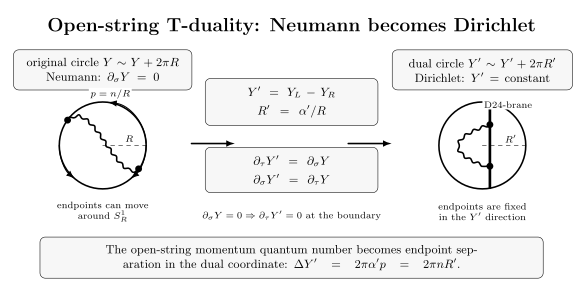
Boundary conditions under T-duality
Section titled “Boundary conditions under T-duality”Let be the compact coordinate. Its Lorentzian worldsheet action and spatial boundary variation are
A freely varying endpoint therefore requires , the Neumann condition. Fixing the endpoint position instead sets and gives a Dirichlet condition. Both remove the boundary term; they describe different endpoint dynamics.
Write the on-shell field as . The dual coordinate obeys
At a Neumann endpoint, the first equation gives : its dual position is constant in time. Conversely, a fixed endpoint in gives . Thus a spatial T-duality along a wrapped D-brane produces a D-brane; dualizing a transverse circle produces a D-brane. The letter D refers to the Dirichlet directions transverse to the brane. In type II theory the accompanying fermion transformation also interchanges IIA and IIB, as discussed in the chirality analysis.
This argument fixes the time dependence at each endpoint. The relation between the endpoint constants follows from the zero modes and, for multiple branes, from the Wilson line. It is not an additional arbitrary boundary condition chosen independently for every string.
From a momentum zero mode to an image sector
Section titled “From a momentum zero mode to an image sector”For Neumann conditions at both ends, the mode expansion is
Integration of the duality equations gives
The missing in the second oscillator sum is essential: differentiating with respect to supplies it with the required minus sign. Both fields are Hermitian when . Since the sine terms vanish at the ends,
For a single brane with no relative Wilson phase, . The lifted endpoints therefore differ by . They are the same point on the dual circle, but they are different images on its universal cover. The integer labels homotopy classes of paths with fixed endpoints. An open string with freely moving Neumann endpoints has no corresponding conserved winding number before duality.
The profiles use , oscillator amplitude , , and origins . The upper panel subtracts the uniform center motion; the lower panel includes the linear lift. Its endpoints at and represent the same brane position modulo the dual circle. Other target-space directions are suppressed. The curves show the quantitative mode profiles.
In the limit , nonzero Neumann momentum modes become heavy. In the dual description , and open-string endpoints remain localized in that enlarged direction. Closed strings can still propagate through the ambient spacetime. There is no inconsistency: localization applies to the open-string endpoints, not to the entire closed-string theory. This is the geometric argument developed in Polchinski, sections 2.2–2.4.
Wilson holonomy fixes the endpoint positions
Section titled “Wilson holonomy fixes the endpoint positions”Consider branes with oriented Chan–Paton sectors . The endpoint at carries label and the endpoint at carries label . Their fields are matrix components transforming as . Thus has charges and under the two diagonal gauge factors, as in the Chan–Paton construction.
A flat connection around the original circle can be diagonalized locally:
The physical information is the conjugacy class of : the eigenphases are defined modulo and up to permutation. A connection may be locally pure gauge without being removable by a single-valued gauge transformation on the circle.
Covariant momentum and the inverse-holonomy twist
Section titled “Covariant momentum and the inverse-holonomy twist”In a periodic trivialization, expand in . Acting with the gauge derivative already used on the amplitude page gives
Here is the eigenvalue of , which enters the mass. The ordinary Fourier label and the covariant momentum are different in this gauge.
The same result follows by removing the connection. Under , the transformed connection vanishes, but the transformed field is no longer periodic:
Its ordinary Fourier momentum is now . The transition function is the inverse holonomy acting on the initial endpoint, combined with the holonomy acting on the final endpoint. Substituting the representation’s charge signs directly into a twisted boundary condition without making this change of trivialization would reverse the shift. Polchinski, equations (32)–(35), makes this inverse-holonomy step explicit.
The dual derivative relation consequently fixes
An overall additive dual position is immaterial to relative separations. A common Wilson phase sets that collective position, while the differences determine stretched-string masses.
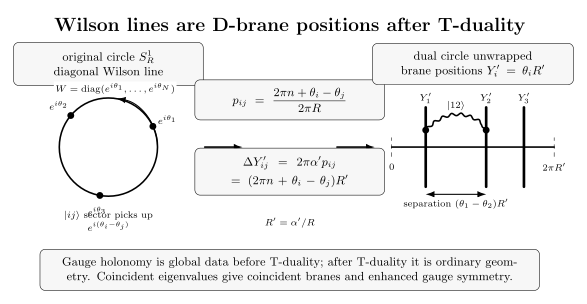
For and , the and lifts have and . Each string arrow follows increasing from to the selected image. A negative displacement is an orientation, not a negative mass. Reversing both endpoints and the image label reverses the signed displacement.
A useful check is the single-brane case. Its adjoint open strings have , so their two endpoint phases cancel and . A fundamental charged probe would see the connection, but it is not the same physical system as a string with both endpoints on that one brane. Translating an isolated dual brane therefore leaves its self-string mass spectrum unchanged.
The stretched-string mass from the worldsheet constraint
Section titled “The stretched-string mass from the worldsheet constraint”For several transverse Dirichlet coordinates, write the fixed image separation as . The zero-mode solution is
Comparison with identifies
This constant is a spatial gradient, not a freely variable Dirichlet momentum. The latter would move the endpoint and violate the imposed boundary condition. Parallel NN or DD ends have integer bosonic oscillators; mixed ND directions would change the moding and are not included here.
Let be the momentum along the brane, so that . The oscillator contribution to the mass-shell constraint is
Thus
These are oscillator intercepts. In the covariant R sector the plane matter generator still contains the vacuum weight ; the physical condition subtracts . It cancels out of the oscillator mass formula above. The NS plane condition instead subtracts , as derived on the RNS spectrum page.
For the branch , the mass is exactly the tension times the minimal length within that fixed image sector:
The same statement does not hold at arbitrary oscillator level. For example, the bosonic ground state has ; it remains tachyonic for . This does not affect the boundary-condition derivation, but it prevents interpreting the bosonic vacuum as a stable supersymmetric gauge theory.
On the dual circle, the compact part of the vector-branch mass is
Additional transverse separations add positive terms. The formula is exact for the free string in this flat brane background; interactions and backreaction are separate questions.
Images, large gauge transformations, and gauge enhancement
Section titled “Images, large gauge transformations, and gauge enhancement”Changing a holonomy phase by cannot change the theory. More generally, the replacements
leave and unchanged. The integer naming an image therefore depends on which lifts of the brane positions were chosen. Reversal maps to , giving the opposite momentum and displacement but the same mass. Hermiticity pairs the corresponding Fourier coefficients as .
A vector becomes massless when its endpoints coincide modulo the circle, possibly in a nonzero image sector. Group the eigenvalues of into multiplicities . The massless gauge algebra is the centralizer of , and the gauge group is
It is generically and becomes when all holonomy eigenvalues coincide. Commuting with a particular logarithm is too restrictive: two eigenvalues of can differ by an integer multiple of while their holonomies agree. The associated massless field then has a compensating nonzero Fourier label.
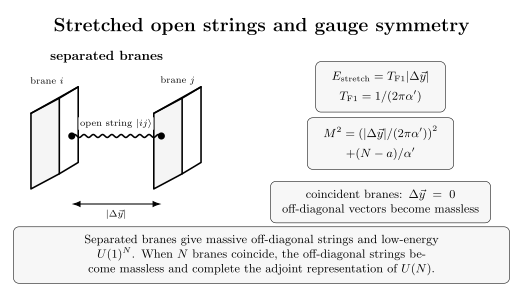
The curves show for and . Only the vector branch is shown. The enlarged lower envelope chooses the lightest image anew at each ; its crossings at are not singularities of any fixed-sector parabola. Its zeros are brane coincidences modulo the circle. Both axes are dimensionless.
For instance, has two equal holonomy eigenvalues despite three distinct displayed phases. Its unbroken group is , and the vector is massless at . Exercise 3 develops this example and distinguishes a fixed branch from the lightest state.
Gauge fields and position fields on the brane
Section titled “Gauge fields and position fields on the brane”At coincidence, a bosonic level-one state has the form . Its Neumann polarizations give , while its Dirichlet polarizations give transverse scalars . The corresponding integrated matter factors involve
Here and are tangent and normal to the worldsheet boundary. The normal derivative operator changes the prescribed transverse position: its coefficient couples to the response to a displacement of that boundary. Under duality it comes from the tangential derivative of the original compact coordinate. For slowly varying backgrounds, the position field is consequently
This identifies the massless scalar as a fluctuation of the brane’s embedding. Fixing a background brane position in the worldsheet problem does not make the brane an intrinsically rigid object. The detailed geometric interpretation of these operators is given in Polchinski, section 2.4.
For the supersymmetric type II system, replace the bosonic level-one state by the NS state and include the GSO-selected R ground state. At nonzero null worldvolume momentum and , the NS states have vector polarizations and scalar polarizations, totaling eight; the R sector supplies eight fermionic polarizations. Their physical constraints, ghost completions and pictures are those of the vertex-operator construction, with boundary gluing in the transverse directions. D0-branes instead give a matrix quantum mechanics with nine scalar coordinates and a nondynamical gauge field; the nonzero-null-momentum polarization count does not apply to a one-dimensional worldvolume.
Chan–Paton components assemble these fields into Hermitian matrices. When the scalar matrices commute, they can be diagonalized simultaneously; their diagonal entries are the brane positions divided by . Permutations identify configurations of identical branes. Noncommuting matrices need not admit a description as a set of simultaneous ordinary positions.
The normalized low-energy Higgs mechanism
Section titled “The normalized low-energy Higgs mechanism”For parallel same-charge type II branes, the leading action for fields below the string oscillator scale is the dimensional reduction of ten-dimensional super Yang–Mills theory. Its bosonic part follows by decomposing the field strength into
The mixed components occur twice in . Using the matrix normalization derived from the disk, the resulting action is
The constant brane rest energy and fermion terms have been omitted. Both transverse indices are summed. Since the commutator of two Hermitian matrices is anti-Hermitian,
Its minima are commuting matrices. Around a two-brane diagonal background, let . An off-diagonal vector acquires the mass ; one off-diagonal scalar along is its Goldstone mode. With the kinetic term normalized at the same time, Exercise 4 gives
in agreement with the string result. This is the geometric meaning of the adjoint Higgs mechanism. Tong, section 7.7, explains this relation between matrix fields and separated branes.
A brief normalization check connects the action to the next page. For one Abelian brane in flat space at constant asymptotic dilaton, the weak-field expansion of the globally normalized brane action is
The physical already contains . In a varying background its prefactor is ; inserting another factor beside would double-count the asymptotic coupling. For a unit Abelian generator, . With the shared matrix trace, comparison instead gives
Substituting also reproduces the scalar kinetic coefficient. The nonlinear Abelian determinant is developed on the Born–Infeld page. The reduced action here is its leading matrix gauge-theory limit; it is not a proposed exact non-Abelian determinant.
The low-energy expansion requires small derivative scales and fields in string units. A stretched vector with can be retained in this gauge theory. A very long string may have the same free-string mass formula while lying outside that truncation. Similarly, the exact radius duality must be accompanied by
Thus shrinking at fixed eventually makes the dual description strongly coupled. Radius duality, a weakly coupled expansion, and a low-energy truncation are three separate statements.
Exercises
Section titled “Exercises”1. An explicit dual wave and its Hamiltonian
Section titled “1. An explicit dual wave and its Hamiltonian”For real and , dualize . Verify both dual derivative relations and the endpoint conditions. Compute the contribution of this coordinate to the worldsheet Hamiltonian, and compare the original and dual results. Explain why it is not itself the target-space energy of a physical string.
Solution
Integration of either derivative relation, followed by the other, gives
Indeed,
The original spatial derivative vanishes at both endpoints. The dual time derivative vanishes there, and the two fixed values differ by . In particular, gives the -image sector.
The coordinate Hamiltonian is
The cross term vanishes because , and each squared trigonometric function integrates to . Duality interchanges the two derivatives, so the integrand and Hamiltonian are unchanged. The momentum contribution becomes the constant-gradient contribution .
This is a positive contribution from one spatial coordinate to the generator of worldsheet time. A physical embedding must also satisfy the constraints involving target time and the remaining coordinates. The target-space energy is the momentum conjugate to , not . No claim that this single-coordinate wave solves all Virasoro constraints is needed.
2. Two descriptions of a flat connection
Section titled “2. Two descriptions of a flat connection”Derive the periodic-gauge and zero-connection descriptions for a general constant Hermitian , not necessarily diagonal in the starting basis. Show how the connection transforms, determine the transformed boundary condition, and explain the difference between a fundamental charged probe and an adjoint open-string component.
Solution
For a fundamental section , covariance of requires
Taking gives . Since , a periodic fundamental section becomes
Diagonalize the Hermitian matrix with a constant unitary transformation. In its th eigenvector, the momenta are , in agreement with the eigenvalues of in the periodic description.
For an adjoint matrix, the two endpoint transformations instead give
Its component therefore has the shift . Directly,
where is a matrix unit. This derivation is independent of the starting basis: conjugation changes eigenvectors but not the eigenvalues of or the spectrum.
For , conjugation by is trivial. The adjoint open string has momentum , even though a fundamental probe has a shifted spectrum. Adding a common multiple of the identity to likewise drops out of every adjoint commutator. It changes the collective dual position without changing the relative separations. If is not periodic, its use is a change of trivialization with the displayed boundary twist, not a periodic gauge transformation that sets a physically nontrivial holonomy to the identity.
3. A massless state in a nonzero image sector
Section titled “3. A massless state in a nonzero image sector”Take with phases . Determine the massless vector sectors and the unbroken group. Establish the large-gauge relabeling and Hermitian conjugation rules. Finally derive the lightest vector mass as a function of a phase difference and locate the crossings of image branches.
Solution
The phases give eigenvalues . A massless vector requires
The three diagonal sectors have . In addition, has and has . They provide five real gauge generators, the dimension of . Hermiticity pairs the two off-diagonal components, supplying two real generators rather than two unrelated complex gauge fields. Inter-stack branches have minimum mass .
One can derive the centralizer without inspecting masses. A covariantly constant gauge parameter satisfies
Periodicity requires . It does not require . In this example the latter condition would incorrectly discard the and generators, whose gauge parameters have nonzero Fourier labels.
For integer , the periodic gauge transformation with diagonal entries changes to and the Fourier label to . Both changes cancel in . Hermitian conjugation changes to and to , proving and .
Writing , the lightest vector mass is
Adjacent minimizing branches meet at half-integer with . A fixed branch is smooth and is not periodic in ; the entire set of branches, and its lower envelope, are periodic after relabeling. Vanishing mass occurs at integer , not only at the representative .
4. Canonical normalization and the eaten scalar
Section titled “4. Canonical normalization and the eaten scalar”Consider two parallel same-charge type II D-branes with . Let , , and let and . Derive their quadratic kinetic and mass terms with the shared matrix trace. Identify the Goldstone mode and compare the polarization count and mass with the open string.
Solution
To linear order, with diagonal fluctuations suppressed,
The entries are the complex conjugates. Taking the actual two-dimensional matrix trace gives
The notation includes the Lorentzian contraction. Define canonical complex fields
The vector kinetic term becomes , the canonical form for a complex vector. The scalar term is .
For an off-diagonal infinitesimal gauge parameter , the transformations are and . When , this removes the scalar component parallel to . In unitary gauge the vector mass term is .
The commutator potential gives the masses of the remaining scalars. Its linear commutator has entry . Using both ordered pairs and the two matrix entries yields
In canonical fields this is the mass matrix . Its zero direction is the Goldstone mode; the orthogonal complex scalars have mass squared . The massive vector has polarizations, so each oriented multiplet has eight bosonic polarizations. At coincidence the vector has polarizations and all scalars remain, again totaling eight. Complex off-diagonal fields package the two reversed string orientations; they do not introduce a second independent Hermiticity copy.
On the string side the effective ten-dimensional momentum of the lowest NS branch is
The physical condition and null-state identification for an arbitrary scalar reproduce the same removal of a longitudinal polarization. Finally agrees with the canonically normalized mass above. The low-energy action is quantitatively appropriate when this mass and the other retained scales are below the string oscillator scale.
5. Wilson lines in an annulus lattice sum
Section titled “5. Wilson lines in an annulus lattice sum”For positive annulus parameter , isolate the compact zero-mode factor
Poisson resum it and sum over endpoint labels. Interpret the resulting Wilson traces. For the phases in Exercise 3, determine their winding dependence. Explain what this calculation does and does not establish about the full annulus amplitude.
Solution
For , the Fourier transform of a Gaussian is
Apply Poisson summation to the shifted Gaussian with . The result is
The sign in the phase follows by shifting the integration variable; reversing the Fourier-transform convention reverses throughout and gives the same sum. Summing the two endpoints factorizes:
Thus the two boundaries couple separately to the same exchanged sector, with conjugate holonomy factors. A common phase of cancels, as required by the neutral collective shift. The prefactor is dimensionless and is essential; it changes under the open/closed channel transformation along with the remaining worldsheet factors.
For ,
This is a nonzero channel check of the compact Gaussian factor and endpoint phases. It does not determine the oscillator determinant, spin-structure sum, ghost measure, full modular Jacobian or tadpole normalization. Those additional ingredients belong to the annulus and transverse-channel analysis.
6. Wrapped tensions and lower-dimensional couplings
Section titled “6. Wrapped tensions and lower-dimensional couplings”A type II D-brane wraps the original circle once. Use the physical tension and the dual string coupling to compare its energy per unit remaining spatial volume with that of the dual D-brane. Derive the corresponding matrix gauge-coupling relation and explain a weakly coupled small-radius limit.
Solution
Here is the string-frame radius used by the worldsheet. The wrapped energy density is
The dual tension gives exactly the same answer:
This comparison uses physical tensions; replacing by the coupling-independent charge normalization without also displaying the dilaton would lose the equality.
For fields independent of the wrapped coordinate, integrating the matrix kinetic action over that circle gives
It agrees with the brane normalization because
The dimensions change from to , as required. The compact gauge component becomes the transverse scalar through ; the mixed components of the higher-dimensional field strength produce its kinetic term with the factor of two derived in the main text.
At fixed , sending to zero drives large. Instead one may keep a small constant in the dual description by choosing . Then while the dual brane tension and lower-dimensional coupling remain finite. Retaining only circle-independent fields additionally requires energies well below ; retaining only the lowest string multiplet requires energies well below . Perturbative gauge interactions can impose further energy-dependent restrictions when the worldvolume coupling is dimensionful.
References
Section titled “References”- Joseph Polchinski, “TASI Lectures on D-Branes,” lectures at TASI 1996, Fields, Strings and Duality, edited by Costas Efthimiou and Brian Greene, World Scientific, Singapore (1997), pp. 293–356; arXiv:hep-th/9611050, revised 23 April 1997. Sections 2.2–2.4 derive the boundary, Wilson-line and massless-field interpretation; section 2.5 develops the action and tension relation.
- David Tong, “Lectures on String Theory,” University of Cambridge Part III lecture notes (2009), arXiv:0908.0333, version 3, 23 February 2012. Section 7.7 treats matrix fields and the Higgs mechanism; section 8.3.2 discusses T-duality of open strings.