
Worldsheet Supersymmetry and the RNS Action
The Ramond–Neveu–Schwarz (RNS) string adds a worldsheet fermion to each embedding coordinate. The resulting two-dimensional supersymmetry relates the bosonic equation of motion to a fermionic one, and it enlarges the Virasoro constraints by a fermionic supercurrent constraint. After quantization, that current generates a superconformal algebra.
Our immediate task is to understand this worldsheet theory in flat target space. Worldsheet supersymmetry alone neither removes every tachyon nor establishes spacetime supersymmetry. Those questions also depend on the Ramond and Neveu–Schwarz sectors, the projection on states, and how the two chiral sectors are combined. They will be addressed on the following pages.
The shared RNS normalizations fix the spinor representation, field normalization, and continuation used below. The worldsheet stress tensors distinguish the Lorentzian constraint tensor from the Euclidean CFT operator . Keeping that distinction makes it possible to follow the same action from its classical equations to its quantum OPEs.
Worldsheet fermions and target-space spinors
Section titled “Worldsheet fermions and target-space spinors”The fields are and . Their transformation properties involve two separate Lorentz groups:
| Field | Worldsheet Lorentz transformation | Target-space Lorentz transformation |
|---|---|---|
| scalar | vector | |
| two-component spinor | vector | |
| Green–Schwarz coordinate | scalar | spinor |
Thus the index on does not label a spinor representation of spacetime. It labels one two-dimensional fermion for each target coordinate. The RNS construction descends from the models of Ramond and Neveu and Schwarz. Its relation to spacetime fermions becomes visible when the Ramond zero modes generate a target-space Clifford algebra.
The Green–Schwarz formulation starts differently: it uses target-space spinor coordinates and makes spacetime supersymmetry manifest. Its complete action includes a Wess–Zumino term and a fermionic gauge symmetry, called symmetry. Merely replacing by a supersymmetric one-form does not give that complete action. Here we use RNS variables because their gauge-fixed dynamics is a free two-dimensional field theory.
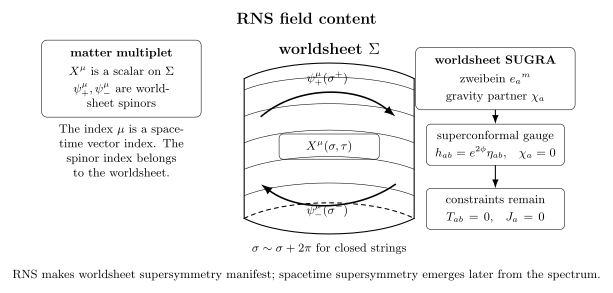
Both and carry a target-space vector index, but only is a worldsheet spinor. Coupling the matter theory to a worldsheet metric and gravitino imposes bosonic and fermionic constraints. Those equations remain after a local gauge choice makes the matter action free. This is a structural diagram, not an embedding of a particular string.
In Lorentzian signature the real matrices in the overview admit a Majorana condition: the two components can be taken to be real Grassmann variables. The chirality matrix obeys
Consequently, the two entries of have opposite chirality. Reality and chirality are compatible in two-dimensional Lorentzian signature, so each entry is a Majorana–Weyl field. Grassmann reality does not make its products commute: for an odd parameter .
The canonical used here carries no target-space length unit; has units of length. Its worldsheet conformal weight will nevertheless be . Target-space dimensions and worldsheet conformal weights answer different questions.
The RNS action and its chiral equations
Section titled “The RNS action and its chiral equations”In flat conformal gauge the action from the overview is
Here the dot contracts target indices with . To obtain the component form, first use
The spinor contraction is just as important. With the shared ordering of spinor components,
and therefore
Substitution gives the computationally useful action
Both the relative sign and the relative coefficient are fixed. Changing only a gamma-matrix convention or only the normalization of would change this translation.
Varying a real Grassmann field
Section titled “Varying a real Grassmann field”The fermion is its own Majorana partner, so both occurrences of must be varied. For either first-order derivative ,
up to a boundary term. Integration by parts supplies one minus sign and interchanging two odd quantities supplies the other. Thus the bulk fermion variation has a factor of two.
The equations are
Locally,
The label therefore denotes the same chiral sector as the untilded oscillators on the previous page. Boundary conditions may relate these local left- and right-moving solutions; they have not yet been imposed.
Supersymmetry as a transformation between equations
Section titled “Supersymmetry as a transformation between equations”Let be constant odd parameters, written to the left of the fermions. The shared normalization gives
The factors of convert between the target-space dimensions of and . The variation is even: it contains an odd parameter multiplying an odd supersymmetry generator. It therefore uses the ordinary product rule, while the parameters themselves still anticommute with fermions.
It is useful to check the invariance explicitly. For the transformation, put . The variations of the bosonic and fermionic Lagrangian densities are
The middle terms cancel, leaving
The minus-chiral transformation similarly gives a derivative. Hence the action is invariant when the parameters respect the spin structure and the surface terms vanish. A constant parameter is not globally compatible with every sector: in particular, it does not preserve antiperiodic NS fermion boundary conditions. The local calculation requires no bulk field equation; compatible global parameters and open-string boundaries are considered below.
The algebra tests a different issue. For two transformations,
Two supersymmetry transformations generate a translation. On the fermions, the same statement uses their equations of motion: mixed terms vanish because . The action is invariant off shell, but this multiplet without an auxiliary field closes on shell. These are distinct statements.
Local parameters reveal the supercurrent
Section titled “Local parameters reveal the supercurrent”Temporarily allow to depend on both worldsheet coordinates. Repeating the variation and discarding only total derivatives gives
where the local bilinears are
This equation identifies their normalization relative to the transformation parameter. The equations of motion imply
For example, each term in vanishes separately. Moreover, parameters satisfying leave the flat action invariant, subject to boundary and global conditions. This infinite chiral extension is the classical superconformal symmetry. It is not invariance under arbitrary local supersymmetry parameters with the metric and gravitino held fixed.
Coupling to worldsheet supergravity retains the constraints
Section titled “Coupling to worldsheet supergravity retains the constraints”In the bosonic string, the metric equation had to be obtained before choosing conformal gauge. The supersymmetric string has an additional version of the same requirement.
A locally supersymmetric formulation contains a zweibein , with , and a gravitino , which carries a worldsheet vector index and a worldsheet spinor index. The fermion derivative becomes a spin-covariant derivative. Terms coupling to the matter supercurrent, together with terms quadratic in , complete the local symmetry. The original constructions are due to Brink, Di Vecchia, and Howe and Deser and Zumino.
The metric and gravitino equations impose, respectively,
Here denotes the spinorial matter-current equation; its independent chiral conditions in the flat gauge are the written above. Its overall nonzero normalization does not affect the constraint. The normalization of the quantum supercurrent will be fixed below by the OPE.
Locally, diffeomorphisms and Weyl transformations bring the metric to a flat representative, while local supersymmetry and super-Weyl transformations remove the corresponding gravitino components. Local Lorentz symmetry removes the redundant choice of frame. This is the origin of the free matter action, not a reason to discard the field equations of the fields that were gauge fixed. On a surface with nontrivial topology, metric and gravitino moduli and spin structures require additional treatment; a local gauge argument does not eliminate them.
Varying the metric or zweibein before this gauge choice gives the matter constraint components
The mixed component vanishes on shell. These formulas use the Hilbert normalization of the overview, including the string tension removed in . For instance, the on-shell fermionic contribution in a flat frame is
Since , this produces the displayed coefficient in . The equations of motion give .
The classical matter constraints are thus
Quantum mechanically, gauge fixing also introduces ghosts and superghosts. The matter OPEs we derive next are not by themselves a complete anomaly-free string theory, and the classical constraints are not operator identities setting every matter oscillator to zero.
Wick rotation and the normalized free-field OPEs
Section titled “Wick rotation and the normalized free-field OPEs”To calculate local OPEs, continue and use the cylinder coordinate . The chain rule gives
Together with , the bosonic and fermionic terms become
The measure is the shared complex-coordinate measure, . The Lorentzian and continue to and with no extra constant phase in this component basis. When computing the Euclidean path integral, the chiral Grassmann fields are continued as independent variables; one must not additionally demand that a nonconstant holomorphic field be pointwise real.
There are two sources of normalization factors in this action: the complex-coordinate measure and the fact that a Majorana kinetic term contains two copies of the same field. To see their effect, work in a local plane coordinate . The distributional identities are
where . In real-coordinate notation these right-hand sides are because .
The inverse boson kernel is , and the inverse fermion kernel is . Applying them to the Green functions yields
Opposite chiralities have no singular contraction. In particular,
The target metric remains Lorentzian in these formulas. The timelike matter field by itself is not a positive-norm Euclidean CFT; removal of unphysical polarizations requires the string constraints and the ghost sector.
The stress tensor and supercurrent as generators
Section titled “The stress tensor and supercurrent as generators”Continuation of gives the holomorphic stress tensor with the shared CFT normalization:
Colons mean that coincident-point contractions have been subtracted. The two minus signs can also be tested directly: the OPE of with a field must generate its holomorphic translation and conformal weight.
For the boson and its derivative, Wick contraction gives
The free coordinate has the local weight-zero transformation law, with its familiar logarithmic two-point function. The current has weight one. For the fermion, moving the external past the differentiated fermion in one Wick contraction is essential:
Thus has holomorphic weight , and its antiholomorphic partner has weights .
The normalized holomorphic supercurrent is
It has weight . The factor compensates for the negative contraction, while the magnitude fixes the coefficient of in the OPE.
Its action on the elementary fields follows from one contraction:
For an even conformal parameter and an odd superconformal parameter , placed on the left, the local Ward transformations are
The contours are counterclockwise, with graded commutators understood for fermionic operators. The two supercurrent OPEs give
With these agree with the continued Lorentzian transformations. The holomorphic parameter has conformal weight , so that the integrand has weight one.
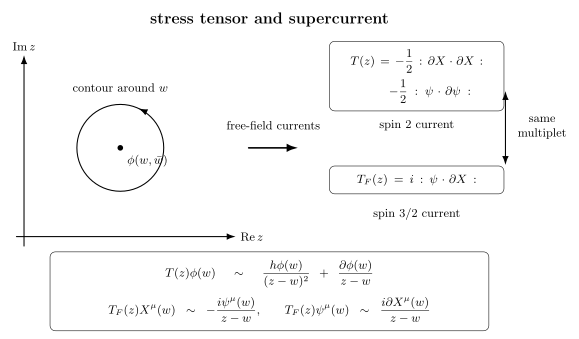
The contour extracts the residue at the operator insertion. generates conformal transformations and exchanges with or its bosonic derivative. The displayed coefficients use canonical fermions, arbitrary , and an odd parameter placed to the left. The contour is schematic; its orientation, rather than its radius, fixes the residue sign.
Why two supercurrents produce the stress tensor
Section titled “Why two supercurrents produce the stress tensor”The product makes the algebra particularly transparent. Its double contraction is
Contracting only the fermions instead gives
Contracting only the bosonic derivatives gives
The coincident normal product vanishes. The first Taylor term is , so this contribution is . Combining all contractions,
Each real boson contributes and each real chiral fermion contributes . Thus the matter central charge is per chirality, and the remaining OPEs are
This is the matter superconformal algebra in each chirality. The full nonchiral matter theory has worldsheet supersymmetry. A systematic textbook treatment of the classical action and these generators is given in Weigand’s lectures, sections 6.1–6.4.
For a critical flat RNS string, cancellation with the reparametrization ghosts of central charge and the superghosts of central charge requires
This conclusion uses the ghost contributions, derived on the ghost and BRST page. It does not follow from classical supersymmetry or the matter action alone. More general backgrounds or an additional internal CFT alter the interpretation of the matter central charge.
Spin structures connect the local theory to the spectrum
Section titled “Spin structures connect the local theory to the spectrum”The local OPE does not choose how a fermion behaves around a closed loop. On the cylinder, a chiral fermion may obey
For the map , the weight requires
The square root changes sign around the origin. Consequently an NS fermion on the cylinder corresponds to a single-valued local fermion field on the punctured plane, while a Ramond fermion corresponds to a square-root branch around a Ramond insertion. Calling a field “periodic” without naming the coordinate and its spin frame can therefore be misleading.
The mode expansion exhibits the same fact:
with in NS and in R. The Ramond sector has zero modes; the NS sector does not. The next page develops their quantization and the corresponding super-Virasoro constraints.
Finally, a projection on states must be specified together with a consistent combination of sectors. The supersymmetric GSO choices introduced by Gliozzi, Scherk, and Olive lead to the familiar supersymmetric string spectra. The existence of worldsheet supersymmetry, or the phrase “GSO projection” without its actual choice, does not guarantee a spacetime-supersymmetric, tachyon-free theory.
Exercises
Section titled “Exercises”1. Test the supersymmetry algebra off shell
Section titled “1. Test the supersymmetry algebra off shell”Compute and without using any equations of motion. Compare with the translation found on . Give a simple off-shell field configuration for which they differ, and explain why this does not contradict invariance of the action.
Solution
The product of the two square-root coefficients in the variations is one. Keep the odd parameters in the order “parameter 1, parameter 2.” For example,
Subtracting the expression with and exchanged gives
Let . The difference between the first commutator and is
Both terms vanish on shell. The analogous difference for also vanishes on shell.
For a counterexample off shell, take , , with a constant odd variable and nonconstant. Take both transformations to have only a minus parameter. Each leaves unchanged, so their commutator on it is zero, but the expected translation is . This configuration violates .
The action variation is a total derivative without imposing field equations; the calculation above concerns closure of the transformation algebra on the chosen fields. Adding an auxiliary field can give an off-shell multiplet. Eliminating it leaves the on-shell closure exhibited here.
2. Supersymmetric open-string boundary conditions
Section titled “2. Supersymmetric open-string boundary conditions”For an open string, derive the fermionic surface term in the variation of . Consider a constant reflection matrix , equal to in Neumann directions and in Dirichlet directions, so that and . At either endpoint impose
Show that the variational principle is consistent, find the preserved relation between and , and determine the periodicity of the doubled fermion for endpoint signs .
Solution
Varying the component action and integrating by parts in gives
The bosonic term vanishes because in Neumann directions and in Dirichlet directions. Since the gluing condition also holds for allowed variations,
Thus the fermionic term vanishes. This uses both the orthogonality of and .
Varying the fermion gluing gives
It is preserved when
In a Dirichlet direction, then makes , as required. Preservation of the Neumann derivative condition follows using the chiral fermion equations at the boundary. The same conditions imply and , so the corresponding currents have no unwanted boundary flux.
To double the fermion, write at the endpoint . Its gluing condition is
Equal endpoint signs give periodic Ramond moding; opposite signs give antiperiodic NS moding. A nonzero constant parameter must satisfy the preserved relation at both endpoints. It therefore exists for equal signs, but not for opposite signs. The NS sector still has the local superconformal algebra; it does not possess this constant globally defined supersymmetry parameter on the strip.
3. Derive the fermion weight and central charge with Wick signs
Section titled “3. Derive the fermion weight and central charge with Wick signs”For one spacelike fermion with , derive the OPE and the double-contraction term in , where . Explain how these calculations give the weight of and the matter central charge in dimensions.
Solution
Put . Contracting the external fermion with the first fermion in the normal product requires moving it past and produces a minus sign:
Multiplying by and Taylor expanding the two uncontracted fields gives
The coefficient of the simple pole contains two equal contributions. Keeping only the second-order pole would miss half the translation term.
For the double contraction, the pairings have opposite Wick signs:
Comparing with gives . This contraction can be computed component by component with a Lorentzian target metric as well: the two metric signs multiply, so the timelike component has the same central-charge contribution. That observation is not a statement of positive norm.
The bosonic and fermionic factors of belong to independent free sectors. Therefore acts on with weight one and acts on with weight . Their second-order poles add to , and their simple poles combine into . Finally,
4. Construct an exponential supermultiplet
Section titled “4. Construct an exponential supermultiplet”In the holomorphic matter theory, let and
Find their conformal weights and the singular terms in and . Interpret the coefficient of the double pole in terms of the weight of . No spacetime mass-shell condition should be assumed.
Solution
The needed bosonic contraction is
Its double contraction with gives
The independent fermion adds , so has weight . Both are holomorphic matter operators; for a full closed-string operator there is an antiholomorphic factor as well.
Contracting the bosonic derivative in with the exponential immediately gives
In , contracting both and gives the double pole. Contracting only the fermions gives the derivative of , since . The result is
The remaining single contraction, of with the exponential, is proportional to . Its leading normal product vanishes by fermionic antisymmetry, so it has no singular term.
For a nonconstant odd parameter,
The derivative of the parameter comes from the double pole. These equations describe a matter superconformal multiplet; they do not yet make either operator a physical string vertex. Ghost factors and the physical-state conditions enter later.
5. Cylinder propagators and the Ramond vacuum shift
Section titled “5. Cylinder propagators and the Ramond vacuum shift”For one real spacelike chiral fermion, derive the cylinder two-point function in the NS vacuum from its plane correlator. Independently sum the positive-frequency modes in a Ramond ground state, using . Check the periodicities and extract the difference of the cylinder stress-tensor expectation values. Infer the Ramond ground-state conformal weight relative to the NS plane vacuum.
Solution
Let with so that the radial ordering is fixed. Applying the two factors of gives
For Ramond integer modes, the annihilation modes give the terms . The diagonal zero-mode product contributes :
These are correlators of a single spacelike component; a general matrix of Ramond zero-mode expectation values can also contain spin-dependent antisymmetric terms. Here and , exactly as required.
Near coincidence,
Use local point splitting in cylinder coordinates:
If , the answer is . Consequently
For one fermion , and the map gives . The NS plane vacuum has , consistent with . The Ramond ground-state weight is therefore
For independent real spacelike fermions the weights add to . This shift arises from the spin structure and its ground state; it is compatible with the identical local short-distance OPE in the two sectors.
6. Obtain the mode algebra from the current OPE
Section titled “6. Obtain the mode algebra from the current OPE”Define plane modes by
Here is half-integer in NS and integer in R, with contours and branches appropriate to the sector. Derive and . Identify the global NS subalgebra and the relation obeyed by the Ramond zero mode.
Solution
In a nested contour computation, first integrate on a small counterclockwise contour about . The OPE gives
Multiplying by and integrating the derivative term by parts yields
For two odd currents use an anticommutator. The third-order pole of contributes
The simple pole contributes . Thus
Together with the Virasoro algebra from , this is the super-Virasoro algebra. In the NS sector the modes have no central terms among themselves and form the global subalgebra. In particular,
the mode version of two supersymmetries generating a translation. In the Ramond sector,
The subtraction is precisely the plane-to-cylinder vacuum-energy shift. A claim that would miss that distinction. Positivity bounds derived from this equation require a positive-norm Hilbert space; they cannot be applied without qualification to the unconstrained timelike matter sector.
References
Section titled “References”- Brink, Lars, Paolo Di Vecchia, and Paul S. Howe. “A locally supersymmetric and reparametrization invariant action for the spinning string.” Physics Letters B 65, no. 5 (1976): 471–474. doi:10.1016/0370-2693(76)90445-7.
- Deser, Stanley, and Bruno Zumino. “A complete action for the spinning string.” Physics Letters B 65, no. 4 (1976): 369–373. doi:10.1016/0370-2693(76)90245-8.
- Gliozzi, Ferdinando, Joël Scherk, and David I. Olive. “Supersymmetry, supergravity theories and the dual spinor model.” Nuclear Physics B 122, no. 2 (1977): 253–290. doi:10.1016/0550-3213(77)90206-1.
- Neveu, André, and John H. Schwarz. “Factorizable dual model of pions.” Nuclear Physics B 31, no. 1 (1971): 86–112. doi:10.1016/0550-3213(71)90448-2.
- Ramond, Pierre. “Dual Theory for Free Fermions.” Physical Review D 3, no. 10 (1971): 2415–2418. doi:10.1103/PhysRevD.3.2415.
- Weigand, Timo. Introduction to String Theory. Lecture notes, Universität Heidelberg, winter term 2011/12, sections 6.1–6.4. Author’s PDF.