
Ghosts, Superghosts, and BRST Quantization
Gauge fixing removes the worldsheet metric and gravitino as local propagating variables, but their constraints remain. The ghost fields encode those constraints in an odd operator . Its square vanishes when the quantum constraint algebra is anomaly free, and physical states are its closed states modulo its exact states.
This page derives the two ghost systems, their charge and picture gradings, and the BRST operator with mutually consistent signs and coefficients. A central result is that the RNS matter theory must have . Ten flat spacetime dimensions are one realization of this condition; a suitable internal superconformal field theory can supply part of the matter central charge.
We use the shared complex measure and ghost normalization, the canonical matter supercurrent, and the plane NS/R algebra. The preceding page introduced spin fields and explained why supersymmetry transformations must track superghost pictures.
Gauge fixing produces two first-order systems
Section titled “Gauge fixing produces two first-order systems”Diffeomorphisms and Weyl transformations permit a locally flat conformal metric; local supersymmetry and super-Weyl symmetry similarly permit a vanishing gravitino locally. On a general surface, moduli, odd moduli, and zero modes remain. Setting the gravitino to zero in a coordinate patch is not a global elimination of this information.
The gauge parameters determine the ghost weights. A holomorphic vector-field parameter has weight , giving a ghost of weight and its conjugate antighost of weight . A local supersymmetry parameter has weight , giving a ghost of weight and antighost of weight . Ghost statistics are opposite to the corresponding gauge-parameter statistics: anticommute, whereas commute.
For one chiral sector the first-order action is
The closed string has an independent antiholomorphic sector. An open-string boundary identifies the two sectors in the doubling construction.
Ordered propagators and their signs
Section titled “Ordered propagators and their signs”The shared measure gives . This identity inverts the first-order kinetic operator. For the commuting system, varying the path integral with respect to gives
Thus . Reversing the ordered fields changes the sign of the first-order kernel; commuting statistics supply no compensating minus sign. For the anticommuting pair, fermionic exchange does supply that sign. The four ordered products are consequently
The relative signs must also be used in the stress tensors and BRST operator. Changing only one OPE sign would change the generated translations or the constraint algebra.
The plane modes and brackets are
Here in NS and in R. These are the cylinder spin structures, even though the displayed expansions are on the plane. The supercurrent and superghosts have matching spin structures, so their product in the BRST current is single-valued.
Stress tensors and the ghost anomaly
Section titled “Stress tensors and the ghost anomaly”For a first-order pair of weights , the stress tensor is
With the appropriate ordered OPEs above, it generates
and the corresponding formula with weight for . For example, the two terms of contribute respectively and . Their sum has the required weight and unit translation coefficient.
Double contractions in give
The statistics reverse the sign of the closed contraction. In the RNS case,
The total ghost central charge is . Therefore a matter superconformal theory can cancel it when . For free flat coordinate multiplets, , giving . The statement concerns the complete matter theory, not just the number of noncompact coordinates.
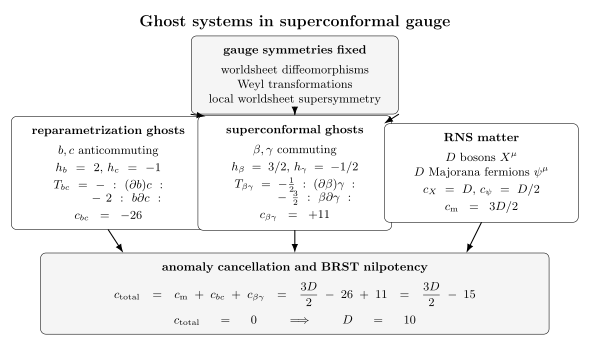
The arrows add the two ghost central charges: . Their horizontal displacements use a common central-charge scale. The condition is ; the conclusion assumes that all matter consists of free flat coordinate multiplets. Internal matter sectors must also be included in .
Cancellation of central charges is necessary. To establish BRST nilpotence one must also construct the nonlinear ghost terms correctly; we will calculate the remaining obstruction below.
Background charge changes weights and central charge
Section titled “Background charge changes weights and central charge”Bosonization is particularly useful for ghost vacua. Begin with a normalized scalar and an improved stress tensor
The improvement changes the coupling to worldsheet curvature. Since
the weight and central charge become
The ordinary quadratic stress contributes to the fourth-order pole of , while the two improvement terms contribute . Their mixed contractions affect the lower poles, not the central coefficient.
Reparametrization-ghost bosonization
Section titled “Reparametrization-ghost bosonization”For a scalar with this same logarithmic OPE, choose and write, with consistent cocycles,
The weight formula gives and , and . The imaginary improvement is part of this nonunitary ghost description; it is not a real spacetime dilaton background.
The background charge also explains anomalous charge selection. For a normalized scalar with improvement , the holomorphic genus- selection rule is , with the corresponding curvature coupling and zero-mode prescription. For in the description this becomes . On the sphere, the three conformal Killing vectors are paired with three zero modes. On the disk, after doubling, three boundary positions are fixed by three insertions. Integrating over moduli requires the appropriate insertions as well.
The related linear-dilaton mechanism
Section titled “The related linear-dilaton mechanism”A real for a spacelike matter scalar raises its central charge. In a bosonic string with another matter sector of central charge , anomaly cancellation would require
This is a different theory from the RNS ghost system. If is a normalized spacetime coordinate, its linear dilaton is and the string coupling varies as . Exercise 2 derives the shifted conformal weights and the associated tachyon mass parameter. It also identifies why this background is not equivalent to flat space with a constant coupling.
The sigma-model and linear-dilaton discussion develops its spacetime interpretation. The Weyl-anomaly discussion explains how a conformal factor can acquire dynamics when the anomaly does not cancel. Neither connection makes the bosonized ghost scalar into an extra physical target coordinate.
Superghost bosonization needs an extra fermion pair
Section titled “Superghost bosonization needs an extra fermion pair”Trying and fails: their exponential product begins as , whereas the first-order system requires a pole. Their weights would also be wrong. Introduce an anticommuting pair of weights , , with
and use
The cocycles assign odd exchange parity, so each product defining or is even. Keeping this ordering gives
Thus the derivative of repairs both the pole and the conformal weight. Matching the stress tensor gives
The scalar has , hence , while the fermion pair has . Their sum is 11. The exponential weight is
In particular, has weight , and have weight , and has weight . Multiplication by or then gives and . This construction and its different vacua are developed in Friedan, Martinec, and Shenker.
Ghost vacua specify which modes annihilate a state
Section titled “Ghost vacua specify which modes annihilate a state”The identity vacuum satisfies
These conditions follow by requiring and to be regular at the origin. The often-used state instead has and ghost number one. The identity vacuum and this state must not be assigned the same zero-point weight.
For the superghosts, let be created by from the regular vacuum. The exponential products imply
Comparing with the mode expansions derives the annihilation conditions
Integer is compatible with the NS mode lattice; half-integer is compatible with R. Three important choices are
| Superghost vacuum | Weight | Annihilators |
|---|---|---|
| NS, | for | |
| R, | for ; for | |
| R, | for ; for |
The Ramond choices exchange the role of the commuting zero modes. In picture , generates a tower and annihilates the vacuum; in picture their roles reverse. This is why stating a picture is part of specifying a ghost Fock representation.
The total weight of a familiar unintegrated NS representative is . Its mass-shell condition is therefore . For it is , giving . These are plane weights, consistent with the physical conditions derived earlier. The Ramond matter vacuum already carries its weight; it is not an additional intercept to be added a second time.
Ghost number, picture, and the small Hilbert space
Section titled “Ghost number, picture, and the small Hilbert space”The bosonized variables permit two distinct gradings. We extend ghost number so that has ghost number , has , and has zero. Picture assigns to , to , and to . The corresponding currents are
Their charges are
| Operator | Ghost number | Picture |
|---|---|---|
For example, and . Derivatives do not change these charges. This extension agrees with the original ghost charges on but also specifies how the enlarged bosonized space is graded; the two gradings must not be collapsed into one. See Fuchs and Kroyter, section 8.1, for the charge assignments.
The original fields involve , not the zero mode . Including that zero mode enlarges the state space. The small Hilbert space is
The large Hilbert space also contains states with dependence. Physical states and their gauge parameters will both be chosen in the small space. This restriction is essential when interpreting picture changing as a BRST commutator.
Constructing the BRST charge
Section titled “Constructing the BRST charge”The matter generators obey the canonical positive-closure OPE
For free matter, the shared normalization is ; the factor of is fixed by this positive closure. The BRST operator begins with , but these terms alone do not square to zero. The algebra generates a Virasoro transformation, which must be canceled by a ghost interaction.
A useful contour-current representative is
All free-ghost products are plane normal ordered with the OPEs established above. The contour is counterclockwise. This is a definition of a representative for the charge; we do not assume that this particular local current is a primary.
Why the cubic term has a minus sign
Section titled “Why the cubic term has a minus sign”Consider the simple graded algebra , , with . Let the odd matter constraint anticommute with , and treat as commuting. For
one finds
Therefore . The complete local algebra also has conformal-transformation terms; these generate and . The finite example isolates the required sign but is not by itself a proof of quantum string nilpotence.
Current representatives and the ghost supercurrent
Section titled “Current representatives and the ghost supercurrent”Define
A compact charge expression is . When its ghost factors are expanded and fully normal ordered, the mixed derivative terms are
Their difference from is . Its contour integral vanishes. Other total-derivative improvements can be used to change the transformation properties of a local current, but the same charge results. A local current’s higher poles must therefore be quoted together with its chosen representative; equality of contour charges does not mean equality of all local OPEs. The expanded charge is also given in Polchinski, section 10.5.
Several direct residues test the full relative normalization:
For example, contracting with gives , and contracting with gives . The resulting ghost terms are exactly . This check tests the derivative coefficients as well as the cubic sign.
The quantum obstruction to nilpotence
Section titled “The quantum obstruction to nilpotence”The terms proportional to , , and the nonlinear ghost monomials cancel using the noncentral super-Virasoro algebra and the ghost brackets. Equivalently, the cubic ghost terms implement the graded structure constants of the constraints. Central contractions leave a possible quantum obstruction.
For an odd contour charge,
The matter central terms are especially transparent. In , Taylor expansion of to third order gives an integrated residue . In , expanding to second order gives .
The free-ghost double contractions give the following coefficients, after integrating by parts. The cross term in the last row includes both orderings.
| Pair of current terms | Coefficient of | Coefficient of |
|---|---|---|
| with itself | ||
| with itself | ||
| with itself | ||
| with itself | ||
| with |
For instance, , exactly the shift required in the first column. Summing and including the factor gives
This formula concerns the integrated residue; total derivatives in the local product have already been removed. It exhibits both independent ghost structures in the anomaly. With the stated plane normalization, makes the charge nilpotent. An incorrect cubic interaction would leave noncentral terms even at that value.
Converting the two residual terms to modes gives a useful check:
The sums run over both signs of the mode number; they must not be compared with positive-mode sums without their factors of two. Plane normal ordering is already included. Reexpressing the charge using creation and annihilation operators relative to a particular ghost vacuum produces the corresponding vacuum constants; it does not permit appending an independent intercept to this OPE result.
Physical cohomology requires a specified state space
Section titled “Physical cohomology requires a specified state space”At criticality, let denote the chosen small-space chain space at ghost number and fixed picture . The charge has ghost number one and picture zero:
The open-string physical cohomology is taken at ghost number one:
Gauge parameters belong to the same small-space, momentum, picture, and boundary-condition sector. Other ghost-number cohomologies have distinct roles; they are not all propagating one-particle states.
For the usual open-string relative cohomology, one further imposes and . These conditions are compatible because . In the canonical Ramond representation, a standard relative choice also uses . Changing Ramond picture changes the zero-mode representation, so these restrictions cannot be copied blindly between pictures.
For closed strings, the physical degree is normally two in total, and the standard semirelative conditions include and , with and . Left and right pictures and any Ramond restrictions must also be specified. We will mainly use open-string representatives below.
Recovering the matter constraints
Section titled “Recovering the matter constraints”In familiar canonical representatives, BRST closure reproduces the positive-mode conditions for and for . In NS the matter plane condition is . In R it is , together with at . The latter implies the mass-shell equation through ; the converse does not follow in a covariant indefinite state space.
These conditions apply to the matter part of the representative, not indiscriminately to a general ghost-excited BRST state. The resulting quotient reproduces the transverse physical spectrum under the hypotheses of the no-ghost theorem. Nilpotence alone does not establish positive norm: a badly chosen matter theory can satisfy a central-charge equation without satisfying the theorem’s unitarity assumptions.
Picture changing acts between complexes
Section titled “Picture changing acts between complexes”In the large space define the even operator
With the displayed ghost ordering, its local expression is
The last two terms follow from : contracting with gives the first simple-pole term, and contracting gives a double pole whose residue differentiates the remaining fields. Each term has weight zero, ghost number zero, and picture . In particular, carries picture without any exponential.
Nilpotence and the graded Jacobi identity imply
The second statement uses and . For a map of states at fixed , use its weight-zero mode
It maps small-space closed states to closed states and exact states to exact states, while raising picture by one. It also preserves the usual relative condition: from one obtains . Ramond zero-mode restrictions require their own compatibility analysis. A local vertex map using instead requires a defined finite-part OPE prescription; it should not be conflated with unrestricted pointwise multiplication.
This state map need not be trivial even though . For a closed small-space state , the would-be gauge parameter is generally not in the small space: . Exactness using a forbidden gauge parameter is not exactness in the physical complex.
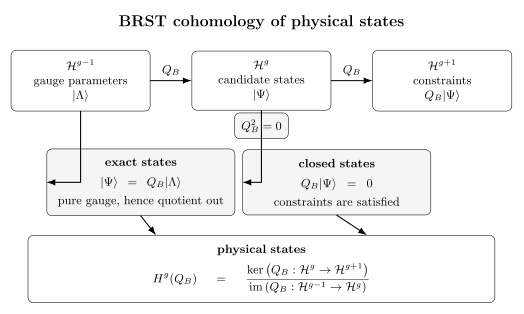
Horizontal arrows are the nilpotent BRST differential. Vertical arrows are the zero-mode maps , which raise picture and commute with the differential; no inverse is assumed. At ghost number one, exact states form a subspace of closed states, and the physical space is their quotient. The auxiliary operator leaves the small Hilbert space, so its appearance in does not make this map trivial there. The regions are schematic vector spaces, not dimension counts.
A local inverse-picture representative is , of weight and ghost number zero and picture . Suitable regulated products implement inverse maps on appropriate physical classes; this is not a claim of invertibility on every off-shell state or at every momentum. The Ramond calculation on the preceding page gives a concrete nonzero-momentum isomorphism and shows why its momentum-slash argument fails at zero momentum.
Colliding picture-changing insertions can have singular OPEs. Normal ordering one product does not by itself settle spurious singularities or the global choice of insertions over supermoduli space. Those require an amplitude prescription, such as the constructions discussed by Sen and Witten. The local identities here are necessary ingredients, not a substitute for that global analysis.
BRST descent relates local vertices and integrated insertions
Section titled “BRST descent relates local vertices and integrated insertions”Write for the graded bracket. For a BRST-closed unintegrated open-string vertex of ghost number one, define
Since , the graded Jacobi identity gives
Thus an integrated boundary insertion is invariant up to endpoint or moduli-boundary contributions. The argument uses parity correctly whether is even or odd.
For a representative of the form with regular, the descent simply removes . That shortcut is not universal. For example, let be a matter superconformal primary of weight , and set . The picture-zero BRST-closed representative is
The extra superghost term is required by BRST closure. Nevertheless , because has no pole with . Exercise 5 derives this expression and its pure-gauge longitudinal specialization.
A closed-string integrated vertex uses two-dimensional descent, with both and . The open boundary formula should not be substituted for that construction. Higher-genus moduli insertions and boundary terms are also part of amplitude calculations, even when every external local vertex is BRST closed.
Picture selection in amplitudes
Section titled “Picture selection in amplitudes”The background charge of gives total holomorphic picture for a genus- small-space amplitude, with the prescribed ghost and moduli insertions. A closed amplitude obeys this separately on the left and right. The doubled disk requires total picture .
These totals include explicit picture-changing operators. With all external NS vertices at picture and all R vertices at , the number of picture-raising insertions needed in one chiral sector is
This formula is a charge count, not a proof that the resulting amplitude is nonzero or that arbitrary insertion locations are acceptable. Spin-structure compatibility, zero-mode saturation, BRST invariance, and avoidance or treatment of spurious singularities still matter. Integrating a vertex changes its ghost number through descent; it does not automatically change its picture.
Common pitfalls
Section titled “Common pitfalls”A sign convention must be changed throughout the calculation. The ordered OPEs, stress tensor, mode bracket, supercurrent, and BRST cubic term form one consistent set. A correct central-charge sum cannot rescue an inconsistent charge.
Picture is not generally the exponent of . That shortcut works for representatives without or . The fields are picture neutral, while has picture and has picture .
Cohomology depends on its domain. The small-space condition, ghost degree, picture, zero-mode restrictions, and boundary conditions are part of the definition. A large-space primitive or a local inverse-picture expression does not automatically establish equivalence in every physical state space.
Exercises
Section titled “Exercises”Exercise 1: stress tensors test the ordered OPEs
Section titled “Exercise 1: stress tensors test the ordered OPEs”For , derive the double-pole and simple-pole coefficients in for both fermionic and commuting first-order systems. Compute the fourth-order coefficient in . Then take an anticommuting pair of weights and a commuting pair of weights . Determine their total central charge and explain the RNS choice. What fails if the commuting ordered OPE signs are reversed without changing ?
Solution
For the commuting pair, use and . Contracting the first term of with gives . The second term contracts with and gives
The sum is . For fermions, still has a positive pole, but contracting across the other odd field contributes the signs needed for the same result. In both cases generates the desired conformal transformation.
Put and . The commuting double contractions of with itself give
For fermions the coefficient has the opposite sign. Multiplying by two gives the central charges in the text. The two systems in the problem therefore have
The RNS ghost weights correspond to , giving .
Reversing both commuting OPE signs while retaining this stress tensor multiplies the entire singular part by . The result has both weight and translation coefficient , rather than merely an alternative name for the same normalization. One would have to change the stress tensor and dependent formulas consistently.
Exercise 2: the linear-dilaton mass shift
Section titled “Exercise 2: the linear-dilaton mass shift”Consider a closed bosonic string with other free coordinates, including one time coordinate, and one spacelike normalized scalar with improvement . Let and take real . Derive the anomaly-cancellation condition and the weights of
where and . Impose the matched closed-string ground-state conditions and determine the effective mass parameter . Explain its relation to the usual flat-space tachyon and the limitation of interpreting this as a translation-invariant scattering problem.
Solution
The scalar contributes and the ghosts contribute , so
A real spacelike slope in this construction therefore requires . Substituting into the improved weight gives
The terms linear in cancel. Including the other coordinates,
Writing therefore gives
At , the slope vanishes and , the closed bosonic tachyon mass. For , the shifted parameter is still negative; at it reaches zero. The factor in the vertex implements the background-charge shift of the momentum basis, so these are not ordinary plane waves of the unweighted field.
The spacetime coupling varies as . A real slope has a strong-coupling end, breaks translation invariance along , and changes the appropriate state inner product. The mass parameter derived from the conformal weight should therefore not be interpreted as establishing a globally controlled flat-space scattering vacuum. This is a bosonic matter example, separate from the superghost and from the RNS condition .
Exercise 3: Ramond ghost zero modes and paired pictures
Section titled “Exercise 3: Ramond ghost zero modes and paired pictures”Derive the annihilation thresholds for from the local OPEs. Realize the Ramond zero-mode algebra by , . Identify representative wavefunctions for the and vacua. Determine which picture pairs with a picture- state in a sphere two-point function, and check that the two paired exponential weights agree. Why is this not an ordinary positive-norm oscillator Hilbert space?
Solution
The first possible power in is . A mode would give , so modes with must annihilate the state. On the unit-spaced mode lattice this is . Similarly, the first power for is , giving as the annihilation range.
In R, the proposed zero-mode realization satisfies . The vacuum is annihilated by , represented by the constant function ; successive actions generate polynomials in . The vacuum is annihilated by , represented distributionally by ; successive actions generate its derivatives. These formal realizations explain the exchanged creator/annihilator roles.
The superghost background charge on the sphere requires , hence
The NS picture pairs with itself, while the R pictures and pair with one another. Appropriate insertions and the small-space prescription are still required for a full nonzero inner product.
The constant function and delta distribution are not two normalizable ground states of a positive-definite harmonic oscillator. Ghost Fock spaces carry an indefinite or distributional pairing and include fields of negative conformal weight. Physical positivity concerns the final BRST quotient under the no-ghost theorem’s assumptions, not the unconstrained ghost sector.
Exercise 4: detect the quantum anomaly beyond global modes
Section titled “Exercise 4: detect the quantum anomaly beyond global modes”Convert the integrated obstruction in the text into mode sums, retaining sums over positive and negative indices. Let . Compute and . Explain why testing only the global NS generators cannot detect the central-charge obstruction. Finally, verify the necessity of the negative cubic sign in the finite model , with .
Solution
In the expansion, three derivatives on give . The contour condition pairs indices and . Two derivatives on the mode give . Thus
Use . Since is odd in , the two contributions add with a minus sign:
For the commuting pair, and is even, giving
The global NS modes have and , where both polynomials vanish. They can therefore close even in a noncritical theory. Modes such as or detect the obstruction. In R, is itself sensitive to the shifted central polynomial.
For the finite sign test, choose odd that anticommutes with both ghost operators, and let be a commuting number. The terms and are the only nonzero contributions to . Therefore cancels them, whereas gives . This verifies a structural sign independently of central charges, but does not replace the full mode or OPE calculation.
Exercise 5: a picture-zero vertex and its exact longitudinal part
Section titled “Exercise 5: a picture-zero vertex and its exact longitudinal part”Let be an odd matter superconformal primary of weight and . Derive the BRST closure of and its descent. For an open massless vector use , , and . Compute and show that the choice is BRST exact with a small-space picture-zero gauge parameter.
Solution
The superconformal algebra gives and
Writing , their transformations are
Combining these with and , and respecting the odd parity of and , gives
They cancel. The residue of the second term vanishes, while that of is . Hence , in agreement with graded descent.
For the vector, contracting with gives
The potential double pole is proportional to and vanishes. At , the fermion bilinear vanishes because its two factors coincide. Meanwhile is a weight-zero primary and
Thus the longitudinal state is exact with gauge parameter , which has ghost number and picture zero and no dependence. Its integrated descendant is proportional to , a boundary total derivative. Removing only the term from the unintegrated expression would miss the superghost contribution essential for exactness and closure.
Exercise 6: small-space picture changing and mixed amplitudes
Section titled “Exercise 6: small-space picture changing and mixed amplitudes”Use the graded Jacobi identity to prove that maps small-space cohomology to small-space cohomology. Explain why its large-space primitive does not trivialize that map. Then count the picture-raising insertions for a disk amplitude with three NS and two R external states, all in canonical pictures, and for a sphere amplitude with two NS–NS and two R–R states. Give distributions that absorb the required insertions into external vertices. Finally count the holomorphic insertions for four canonical NS vertices at genus two, and state what none of these counts establishes by itself.
Solution
At criticality, . Also
where was used. These local identities imply the corresponding identities for . It preserves the small-space condition and commutes with its differential. If with an allowed small-space , then , so the map is well defined on cohomology.
For a closed small-space state , the formal large-space primitive fails the gauge-parameter condition because . It therefore does not prove that is trivial in the small space. Moreover, a commuting chain map need not be invertible; this proof says nothing about kernels at exceptional momentum or singular operator collisions.
On the disk, three NS vertices and two R vertices have total canonical picture . Two picture-raising insertions bring it to . One possible distribution has two NS vertices in picture zero, one in picture , and the two R vertices in picture . The total is .
For the sphere example, each chiral sector has two NS pictures and two R pictures , totaling . One picture-raising insertion is needed on each side. One can place an NS–NS vertex in picture , leave the other in , and retain both R–R vertices in . Left and right totals are then separately . The fixing of three positions and integration of the fourth is an independent ghost-number/descent issue.
At genus two the required holomorphic total is . Four canonical NS vertices contribute , so six picture-raising insertions are required in that sector. For a closed amplitude the right-moving count is imposed separately.
These are necessary charge counts. They neither construct a global supermoduli prescription nor prove a nonzero amplitude: spin structures, zero modes, kinematics, integration boundaries, and spurious singularities remain to be handled. Absorbing insertions into vertices is legitimate only within an appropriate regulated amplitude prescription.
References
Section titled “References”- Friedan, Daniel, Emil Martinec, and Stephen Shenker. “Conformal invariance, supersymmetry and string theory.” Nuclear Physics B 271 (1986): 93–165, especially sections 4–6. Author-hosted full paper.
- Fuchs, Ehud, and Michael Kroyter. “Analytical solutions of open string field theory.” Physics Reports 502 (2011): 89–149, section 8.1. doi:10.1016/j.physrep.2011.01.003; author-accessible article.
- Polchinski, Joseph. String Theory, Volume II: Superstring Theory and Beyond. Cambridge: Cambridge University Press, 1998, sections 10.1 and 10.5. Publisher-distributed preview.
- Sen, Ashoke, and Edward Witten. “Filling the Gaps With PCO’s.” Journal of High Energy Physics 2015, no. 9 (2015): 004. arXiv:1504.00609.