
Absorption by D-Branes and Two-Point Functions
A dilaton incident on a stack of D3-branes can transfer its energy into excitations living on the branes. The same process has a gravitational description: part of the incident wave travels down the throat of the D3-brane geometry. Comparing these descriptions gives a quantitative test of the connection between gauge theory and gravity.
We will calculate the leading low-energy cross-section in both descriptions, including its numerical coefficient:
Here is the incident frequency, is the throat radius, and is the physical ten-dimensional gravitational coupling. The gravitational calculation determines a transmitted flux; the worldvolume calculation counts the states into which the incident quantum can decay. Their relation to a two-point function will then explain why this comparison works across different coupling regimes.
This page assumes familiarity with the D3-brane solution, the quadratic expansion of the Dirac–Born–Infeld action, and relativistic phase space. We use the volume conventions, including its dilaton normalization, and supply the Bessel-function limits needed below. The low-energy limit here is , for an extremal brane at zero temperature and an incident wave with no momentum along the brane.
A dilaton wave in the D3-brane geometry
Section titled “A dilaton wave in the D3-brane geometry”Classical supergravity requires to suppress curvature corrections and to suppress string loops. The free worldvolume calculation instead applies at . Keeping only massless string excitations also requires ; at weak coupling this does not follow from alone. The two calculations therefore have different perturbative regimes. Their agreement will require a protected observable; low incident energy alone does not make the two coupling expansions simultaneously valid.
For worldvolume indices , the extremal Einstein-frame metric is
The background dilaton is constant. The fluctuation has the quadratic action
Varying it gives : the linear dilaton fluctuation is a minimally coupled scalar in this background. We take the s-wave, with no worldvolume spatial momentum:
The determinant and inverse metric give
where is the determinant of the unit-sphere metric. Multiplying the wave equation by therefore gives
Introduce
The dimensionless radial equation is
where primes now mean derivatives with respect to . Removing the first derivative with gives a useful scattering form:
The effective energy is . The positive term creates a barrier, while the negative term opens a propagation region deep in the throat. Even the s-wave has this barrier: the term comes from the radial measure in six transverse dimensions, rather than from nonzero angular momentum.
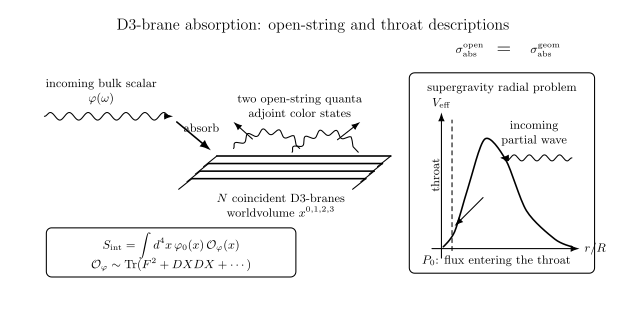
The radial equation has effective energy and potential . The example uses to display the barrier; the analytic calculation below takes . Increasing leads toward the asymptotically flat region, while decreasing leads into the throat.
Matching the throat wave to the incident wave
Section titled “Matching the throat wave to the incident wave”The full radial equation is not a Bessel equation. At small , however, two Bessel approximations have a common domain. Matching their amplitudes in that domain determines how much of a wave sent from infinity reaches the throat. This method follows the original D3-brane absorption calculation, section 2.
The inner solution and its boundary condition
Section titled “The inner solution and its boundary condition”Use the inverted radial coordinate
The exact equation becomes
Setting gives
For , the last term is small compared with the retained inverse-square term when , and small compared with when . Thus it can be dropped in the leading inner approximation. In the original coordinate this domain is . The resulting solutions are and .
At the extremal horizon , impose an ingoing wave: energy travels down the throat, with no wave emerging from it. To fix the Hankel-function choice, the near-horizon tortoise coordinate satisfies
An ingoing mode has phase . Since behaves as at large , a convenient normalization is
The prefactor is a freely chosen overall phase. It makes the small- limit real:
and consequently for within the inner approximation.
The outer solution and the overlap
Section titled “The outer solution and the overlap”In the equation for , the term is negligible for : compare it with at small , and with at large . The leading outer solution is therefore
The two approximations overlap when
Both and are then small. Notice that this overlap is broader than a comparison of with would suggest. Such a comparison would give the incompatible conditions and . The inverse-square term in the transformed equations is what permits matching.
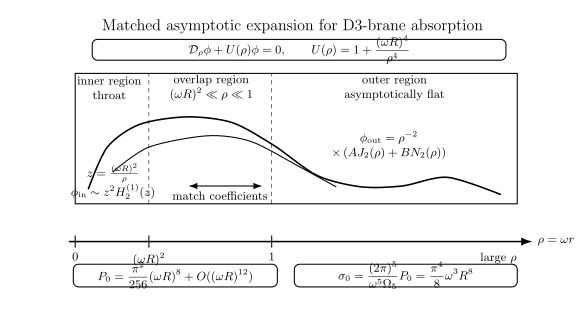
For , the inner approximation applies at and the outer approximation at . In their common domain, both Bessel arguments are small. The logarithmic radial arrangement is schematic; the inequalities denote parametrically separated scales.
In the overlap, , whereas contains a term. Matching the leading constant gives
at leading order. Thus
This leading approximation sets to zero only for the purpose of finding the leading incident amplitude. The exact solution has a small imbalance between its incoming and outgoing components. A pure real wave has zero net flux, so its leading form alone cannot resolve that imbalance. We instead evaluate the transmitted flux directly from the ingoing throat solution and divide by the incident part of the outer solution.
The flux ratio
Section titled “The flux ratio”The radial equation implies conservation of
A positive sign means motion toward increasing . Overall factors from the sphere volume, the bulk action, and converting to cancel in a flux ratio.
The Bessel Wronskian is
For it gives
Using , the transmitted flux is
At infinity,
With time dependence , is the incoming component there. Its coefficient is , so the same Wronskian gives
The probability of absorption is therefore
Here tends to zero as . Leading matching does not determine the next term. In fact, improving the matching produces logarithmic corrections, so an unqualified power-series remainder would be misleading; see Gubser, Hashimoto, Klebanov, and Krasnitz, section 3.
From a partial-wave probability to a cross-section
Section titled “From a partial-wave probability to a cross-section”For an s-wave in transverse spatial dimensions, plane-wave normalization gives
where is the area of the unit sphere. One way to obtain this factor is to project the unit-amplitude plane wave onto its angular average:
Splitting this Bessel function into incoming and outgoing waves gives the incident s-wave flux relative to the original plane-wave flux. For , , and substitution yields
The result has dimension length to the fifth power, appropriate to scattering in six transverse spatial dimensions. For the infinite brane it is understood per unit three-dimensional worldvolume. Expressing through gives the coefficient stated at the beginning of the page.
The worldvolume calculation with normalized states
Section titled “The worldvolume calculation with normalized states”We now calculate the same coefficient using the D3-brane fields at weak coupling. The leading process converts one incident dilaton into two massless gauge bosons with opposite momenta along the brane. Both the field normalization and the number of physical polarizations matter.
Why the leading dilaton vertex contains gauge fields
Section titled “Why the leading dilaton vertex contains gauge fields”For one brane, with the other bulk fields set to zero, start from the string-frame action
Here denotes pullback to the worldvolume. Since , factoring from the four-dimensional matrix supplies from the square root of its determinant. This cancels outside it. The Einstein-frame action is thus
For a flat brane with transverse displacement fields ,
The scalar kinetic term has no direct linear dilaton coupling in this frame. Adding a term by multiplying the entire quadratic action by would count a coupling that the frame transformation has canceled. At the same leading on-shell order there is no dilaton-to-two-fermion contribution. The explicit string and worldvolume amplitudes are given in Gubser, Klebanov, and Tseytlin, section 3.
For branes, canonically normalize the real adjoint gauge fields. Denote their linearized field strengths by , with . Their quadratic action and the relevant interaction become
The canonical component basis removes trace-normalization ambiguity from the amplitude below. The positive sign of the interaction follows by expanding . Nonabelian interactions are omitted only in this leading weak-coupling calculation.
Polarizations and colors
Section titled “Polarizations and colors”The incident particle has worldvolume momentum . Let the final massless momenta be and , and their transverse polarization vectors be and . Differentiating the interaction with respect to the two identical gauge fields gives, up to an overall phase,
This expression vanishes when either polarization is replaced by its momentum, as required by gauge invariance. In the center-of-mass frame,
Choose two real spatial polarizations perpendicular to . The mixed momentum-polarization contractions vanish. Of the four polarization pairs, the two parallel pairs each have for an allowed color. The two perpendicular pairs give zero. Summing over polarizations and colors, with no average over the scalar initial state, gives
The factor follows from , rather than from independent color pairs.
Phase space and the identical-particle factor
Section titled “Phase space and the identical-particle factor”The integrated phase space for two massless particles with total energy is
The momentum delta function first sets ; the two energy denominators cancel the in the radial measure. The remaining energy delta function supplies .
For a canonically normalized incident bulk quantum, dividing the transition rate per unit brane volume by its incident number flux supplies . The final particles are identical bosons, so the phase-space sum also contains . Consequently,
Every numerical factor now has an origin: canonical normalization fixes the vertex, the two physical polarizations fix its squared sum, the adjoint index gives , and the phase space and identical-particle factor fix the denominator. This agrees with the gravitational result after using .
Absorption measures a spectral function
Section titled “Absorption measures a spectral function”The inclusive absorption rate can be calculated without resolving each final state individually. Define the operator sourced by the dimensionless dilaton through
In the free on-shell two-particle calculation its relevant term is
At finite coupling, the source variation defines the full supersymmetric operator, including interaction terms. The quadratic expression alone does not define a complete interacting composite operator. Terms proportional to equations of motion and local contact terms must also be distinguished from the part that creates physical states.
Using the shared Fourier and retarded-response conventions, insert a complete set of states into the spectral density. At positive frequency in the vacuum this gives
The sum includes the appropriate phase-space measures and identical-particle factors. It is nonnegative. With a coupling , the same state sum appears in the absorption rate, so
For the D3 dilaton, . The pair-production calculation therefore determines
This is the optical theorem in a form useful for a brane: the imaginary part of a forward response equals the sum over states that can absorb the incident energy.
The timelike cut and the operator dimension
Section titled “The timelike cut and the operator dimension”For the momentum invariant in this calculation, write
Physical absorption occurs on the timelike cut , or . A dimension-four scalar operator in four dimensions has a separated-point correlator proportional to . Its momentum-space nonlocal part scales as , rather than as a pure polynomial. With the shared retarded and source conventions, the normalized answer can be written
For and , the logarithm is . Therefore , reproducing the state sum at . Changing the subtraction scale adds a local polynomial and leaves the finite-frequency absorption unchanged. This also explains the power law: a dimension-four operator gives , and the incident-flux factor converts it to .
What is protected
Section titled “What is protected”Conformal symmetry fixes the power of frequency once the operator dimension is known. It does not, by itself, fix the coefficient of a two-point function. In this example the dilaton operator is a descendant in the protected stress-tensor multiplet. With its normalization fixed by the bulk source, supersymmetric nonrenormalization relates its two-point coefficient to the protected stress-tensor normalization. This is the additional reason the leading weak-coupling coefficient agrees with the supergravity value. The relation between absorption and protected correlators is discussed in Gubser and Klebanov and in Klebanov’s review, sections 1–2.
The weak-coupling calculation above includes the adjoint, of dimension . The interacting sector has generators; the additional free is the center-of-mass multiplet. Classical throat supergravity resolves the leading large- answer. Inferring an exact finite- geometric result would require the corresponding quantum corrections and careful treatment of the decoupled sector.
Protection of this vacuum two-point coefficient does not make generic correlators, finite-temperature observables, or higher-frequency corrections equal to their free-field values. In particular, the logarithmic corrections to low-energy absorption probe information beyond the leading conformal result.
From the throat to a boundary source in AdS
Section titled “From the throat to a boundary source in AdS”The absorption calculation uses the entire asymptotically flat geometry. Its inner region already contains the spacetime that appears in the AdS/CFT correspondence. At , drop the in and introduce a length-valued coordinate . Then
This is with common radius . The earlier Bessel coordinate is . The Poincaré horizon lies at . In the isolated near-horizon geometry, the conformal boundary is ; obtaining that complete geometry requires the decoupling limit developed on the next page.
For an -independent dilaton fluctuation, integrate its ten-dimensional kinetic action over the unit sphere. The determinant and inverse metric supply and , respectively, while . Hence
The overall minus sign is the Lorentzian mostly-plus scalar-action sign. Wick rotation produces the positive Euclidean action. The coefficient proportional to is the same normalization already detected by absorption.
The equation for a mode with boundary momentum is
At zero momentum its independent behaviors are and . The leading boundary value supplies a dimensionless source, and the response corresponds to an operator of dimension four. For Euclidean momentum magnitude , the solution regular at the Poincaré interior is
normalized so that as . Inserting it into the action reduces the on-shell integral to a boundary term. Regulating at , subtracting the divergent local terms, and differentiating with respect to yields the nonlocal dependence. In Lorentzian signature, the retarded response instead uses the ingoing condition in the interior—the same condition that selected in the absorption calculation. The precise boundary prescription and its renormalization are developed on page 32; its original formulation is given by Gubser, Klebanov, and Polyakov.
Exercises
Section titled “Exercises”1. Angular momentum and operator dimensions
Section titled “1. Angular momentum and operator dimensions”Replace the s-wave by , where . Derive the radial equation in the full D3 geometry. Reduce it in the throat and identify the five-dimensional mass. Use to determine the physical dimension . Explain why the s-wave cross-section cannot simply be reused for .
Solution
The worldvolume derivatives give , and the sphere Laplacian contributes after multiplying the equation by . Therefore
In the throat, put and . Using and dividing out the common factor gives
This is the equation of an scalar with . Substituting near the boundary gives , whose roots are and . The standard source and response behaviors are thus and , with .
The full-geometry radial barrier now contains an additional positive angular-momentum term, so its transmission probability changes. In addition, a plane wave has angular degeneracies beyond the s-wave. Microscopically, the incident angular dependence probes transverse derivatives of the bulk field and different worldvolume operators. Both ingredients must be included to obtain a higher-partial-wave cross-section.
2. Gauge invariance and a small final-state mass
Section titled “2. Gauge invariance and a small final-state mass”Verify the Ward identity of the two-gauge-boson amplitude without choosing a polarization basis. Separately, repeat the phase-space integral for two identical particles of mass , keeping the squared matrix element symbolic. Determine the threshold and the factor that replaces . Which part of the massless absorption argument then ceases to follow from scale invariance?
Solution
Replacing by turns the bracket in the amplitude into
The cancellation for is identical. This checks the vertex before any sum over physical polarizations.
For the separate massive phase-space problem, let . After using the spatial delta function,
There is support only for . At the root, , , and the derivative of is . Hence
For an angle-independent squared matrix element, including any internal-state sum, the identical-particle cross-section is
Here the overbar denotes the angular average, which can also be used when the matrix element depends on the emission direction. This exercise changes only the kinematics; a theory of massive vector particles would also require a new interaction and polarization analysis. The mass introduces the dimensionless ratio and a threshold, so scale invariance no longer determines a single frequency power law.
3. The special role of a D3-brane
Section titled “3. The special role of a D3-brane”Apply the same string-to-Einstein-frame transformation to a D-brane DBI action. Show that the zero-field determinant carries an overall factor , while the quadratic gauge term carries . Explain why the direct dilaton coupling to the transverse-scalar kinetic term cancels specifically at .
Solution
There are rows in the worldvolume determinant. Factoring out therefore supplies after the square root. Combining it with gives
The terms quadratic in a transverse displacement and in the gauge field are
The extra in the second line comes from the two factors of in the determinant expansion. At , the scalar exponent vanishes, whereas the gauge exponent is . At it is instead the direct quadratic gauge coupling that has zero exponent. These statements concern the specified Einstein-frame action at fixed fields; they do not remove other interactions with bulk fluctuations.
4. Spectral scaling and contact terms
Section titled “4. Spectral scaling and contact terms”For a scalar operator of dimension in a four-dimensional conformal theory, determine the timelike spectral scaling and the resulting frequency dependence of absorption for a coupling with fixed . Identify the logarithm required when is a nonnegative integer. Show explicitly why adding a real polynomial in to the retarded correlator does not change absorption at positive timelike frequency.
Solution
The separated-point correlator scales as . A four-dimensional Fourier transform consequently has mass dimension . For a noninteger , its nonlocal part is proportional to , with the retarded branch specified by .
For a scalar with a nonzero continuum spectral density, positivity and scale invariance then give, at positive frequency,
Thus at ,
If is a nonnegative integer, a pure would be local and have no cut. Renormalization instead leaves a nonlocal term proportional to , whose discontinuity has the required dependence. The dimension-one free scalar is an exception to the continuum formula: its spectral weight is concentrated on the light cone, rather than at positive .
A real local counterterm shifts by a polynomial with real coefficients. At real, strictly timelike frequency, . It therefore changes contact terms but not or absorption. The overall remains a dynamical normalization; scale invariance alone does not fix it.
5. A controlled numerical matching check
Section titled “5. A controlled numerical matching check”Integrate the full radial equation for several decreasing values of , imposing ingoing data at a large value of . At large , fit independent incoming and outgoing Hankel waves. Compute absorption both from the throat-to-incident flux ratio and from . Test convergence to , varying both integration endpoints. Explain why subtracting nearly equal reflected and incident probabilities loses accuracy when is small.
Solution
A logarithmic integration coordinate resolves the widely separated inner and outer scales. With dots denoting derivatives, the full equation and its conserved flux become
Choose an inner endpoint using , where . The initial data from the ingoing approximate solution are
At an outer endpoint , fit both and to
The following Python implementation uses NumPy and SciPy. It returns the flux result, the reflection-subtraction result, and their underlying flux-conservation check.
import numpy as npfrom scipy.integrate import solve_ivpfrom scipy.special import hankel1, hankel2, h1vp, h2vp
def absorption(eps, z0=60.0, r1=40.0, tol=5e-12):    r0 = eps**2 / z0                    # r0 and r1 denote rho    y0 = np.array([        1j*z0**2*hankel1(2, z0),        -1j*(2*z0**2*hankel1(2, z0) + z0**3*h1vp(2, z0))    ])    def rhs(x, y):        return [y[1], -4*y[1]                - (np.exp(2*x) + eps**4*np.exp(-2*x))*y[0]]    sol = solve_ivp(rhs, [np.log(r0), np.log(r1)], y0,                    method="DOP853", rtol=tol, atol=tol)    if not sol.success:        raise RuntimeError(sol.message)    phi, dotphi = sol.y[:, -1]    waves = np.array([hankel1(2, r1), hankel2(2, r1)]) / r1**2    dots = -2*waves + np.array([h1vp(2, r1), h2vp(2, r1)]) / r1    cout, cin = np.linalg.solve(np.array([waves, dots]),                                np.array([phi, dotphi]))    f0 = r0**4*np.imag(np.conj(y0[0])*y0[1])    f1 = r1**4*np.imag(np.conj(phi)*dotphi)    pflux = abs(f0) / (2/np.pi * abs(cin)**2)    preflection = 1 - abs(cout/cin)**2    return pflux, preflection, abs(f1/f0 - 1)
for eps in [0.3, 0.2, 0.1]:    p, preflection, error = absorption(eps)    leading = np.pi**2 * eps**8 / 256    print(eps, p/leading, preflection, error)
A converged calculation gives approximately
The ratios approach one without being exactly one at finite frequency. Repeat the calculation, for example, with and and tighter integration tolerances. The endpoint and tolerance changes should affect the answer much less than the finite- deviation from one. Also monitor flux conservation: reducing the integration error cannot by itself remove an inaccurate asymptotic boundary condition.
The flux relation implies
But is of order , so the second method subtracts numbers increasingly close to one. At , the probability is only about . The direct throat-to-incident flux ratio avoids that subtraction and is the more stable way to test the leading coefficient.
6. The boundary logarithm
Section titled “6. The boundary logarithm”Expand through its first logarithmic term. Insert the result into the regulated on-shell action, identify the terms that are local in boundary momentum, and isolate the nonlocal logarithm. Continue it to the retarded frequency prescription used above, checking the sign of the spectral density.
Solution
Write . Its expansion is
For a boundary condition imposed at , use . This holds the cutoff value fixed while the bulk field is varied. Define and . Integrating the Euclidean action by parts and using the equation of motion gives its lower-boundary term:
The minus sign is the orientation of the boundary at the lower endpoint of the integral. The derivative ratio is
where the numerical constant affects only a local term. The and divergences can be subtracted by local boundary counterterms. Finite polynomials in are also scheme dependent. The remaining nonlocal term is
With , two source derivatives of supply both a minus sign and a factor of two from the quadratic functional:
Using the shared retarded convention, the continuation is evaluated at . Thus the retarded logarithm has positive coefficient. At and ,
The positive spectral density agrees with the inclusive worldvolume calculation. The sign of the nonlocal Euclidean momentum expression by itself is not a negative spectral density: analytic continuation and the retarded convention are essential.