
Light-Cone Quantization and the Critical Dimension
Light-cone quantization solves the string constraints before quantizing. Its independent oscillators describe only the transverse motion, so their Fock space has a positive inner product. The difficult question becomes whether these variables still carry the full spacetime Lorentz symmetry. For the ordinary bosonic string in flat, noncompact spacetime with , the quantum boost commutator fixes and the open-string intercept .
We will derive this result, including the operator ordering and the finite sums responsible for the anomaly. We then reconstruct the closed string and explain level matching as the condition that its longitudinal coordinate actually closes. The global conventions, canonical oscillator construction, and covariant physical-state analysis supply the prerequisites. We consider free strings, with Neumann conditions in every open-string target direction; interactions and compact winding sectors are outside this calculation.
Light-cone time and the domain of the gauge
Section titled “Light-cone time and the domain of the gauge”Introduce target-space null coordinates
Then the transverse coordinates are , with and , and
The worldsheet constraints in conformal gauge are
If can be made proportional to worldsheet time, these equations become linear in the derivatives of :
Thus the longitudinal coordinate is reconstructed from transverse motion. It does not supply another independent oscillator.
A regular residual map on the open strip
Section titled “A regular residual map on the open strip”For an open string, the Neumann condition identifies the two chiral functions of . Write
The allowed residual transformation preserving both strip boundaries uses a common lift:
For , a candidate is
It is a regular transformation in the connected orientation-preserving component when everywhere. In that sector,
Dropping the prime and naming the constant gives the open-string light-cone gauge
This construction explains both a local condition and a global one. The chiral derivatives must permit a nonsingular monotone map, and the map must preserve the strip identifications. The common lift ensures the latter, but nonzero average momentum alone does not guarantee the required regularity. A derivative that vanishes can make the inverse map singular; a derivative that changes sign prevents a monotone inverse. We work within this regular gauge sector, usually choosing its branch.
For a closed string with no winding in , the two chiral functions have equal monodromies. Independent monotone lifts can then give
The factor of two differs because the open strip has coordinate width and the closed circle has period , with the zero modes fixed in page 06. A choice of worldsheet clock is involved here, not merely a choice of spacetime Lorentz frame.
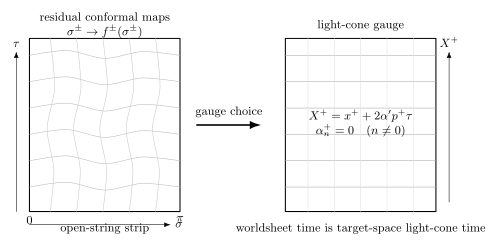
On the open strip both chiral coordinates use the same lift . The two dimensionless derivative profiles have mean one, but only the strictly positive profile defines a regular map in the chosen component. A negative interval cannot be repaired by the nonzero average. The horizontal coordinate covers one period; the vertical axis is .
Reduction to the transverse Hilbert space
Section titled “Reduction to the transverse Hilbert space”First perform the classical reduction. For the open string, the Fourier coefficients of give
Only the transverse modes remain independent. Their reduced brackets quantize to
We therefore define the quantum transverse generators by oscillator normal ordering,
so that
For the calculation below, abbreviate the open-string plus zero mode by . The reconstructed longitudinal modes, including a possible quantum constant , are
For this is a bilinear composite operator. At , using , it yields
The positive modes annihilate the transverse vacuum. With for , each pair is an ordinary harmonic oscillator. In particular,
There are independent oscillators at each positive frequency, and measures their frequency-weighted occupation. Positivity of this oscillator space holds before the Lorentz test. It does not by itself ensure that the theory is Lorentz invariant or that its vacuum is stable.
This procedure is not an instruction to impose every unreduced quantum as an operator identity. We solved the classical constraints, then quantized the independent transverse variables. The longitudinal operators consequently have composite commutators. For example,
The central extension of will be essential rather than inconsistent. It is precisely the effect that the Lorentz calculation detects.
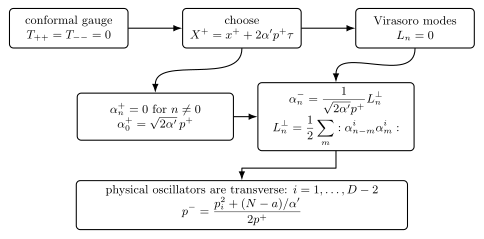
For the open string, is dimensionless. Nonzero longitudinal modes are composites of the transverse modes, whereas the zero mode fixes . The separate closed-string condition is global: for a noncompact longitudinal coordinate, periodicity of the reconstructed requires equal left and right levels. The arrows describe dependencies, not motion in spacetime.
The regulated zero-point energy
Section titled “The regulated zero-point energy”The transverse oscillators have dimensionless frequencies in the standard open-strip coordinates. Their formal vacuum energy is , which diverges. Introduce a positive dimensionless regulator :
The leading term is the local ultraviolet vacuum-energy divergence. Subtracting it leaves the finite Casimir contribution
Writing the light-cone mass operator as therefore suggests
Zeta regularization gives the same finite value, but the ordinary divergent series never equals . The regulator makes the subtraction explicit. A finite constant cannot be chosen arbitrarily once the spacetime symmetry is required: we will keep independent in the boost calculation and obtain a second test of its value.
Three constants that appear in nearby discussions must remain distinct. Plane matter is defined by its oscillator ordering. Mapping all matter scalars to the cylinder gives a shift per chiral sector. The reduced transverse system contains scalars and gives ; its negative is the physical intercept . At the critical point this is . A closed string has two transverse chiral sectors, each with that intercept.
Hermitian boosts and the Lorentz anomaly
Section titled “Hermitian boosts and the Lorentz anomaly”The nontrivial generators are . They mix the longitudinal direction, which has been reconstructed, with a transverse direction. The remaining Lorentz commutators follow directly from the canonical zero modes and transverse rotations. Lorentz symmetry requires
We calculate this for the open string. The oscillator derivation below uses a finite number of operations on every finite-level state. Goddard, Goldstone, Rebbi and Thorn established the light-cone construction; Bering gives a complementary direct calculation of the composite-operator commutator.
The ordered generators
Section titled “The ordered generators”For this calculation define dimensionless zero-mode variables
Together with , their independent nonzero brackets are
Introduce the antisymmetric bilinear , transverse spin , and Hermitian cubic operator :
The generator obtained from is
Here . In dimensional variables, the orbital part is . Symmetrization is required because ; the unsymmetrized expression would not be Hermitian. Each is Hermitian because the two products inside its parentheses are adjoints. Both parts of are dimensionless, as an angular momentum must be in our units.
Separating the orbital calculation
Section titled “Separating the orbital calculation”The elementary identities needed below are
For example, the third identity differentiates the two zero-mode terms in ; substituting it in gives the fourth. The transverse central term follows from the same contractions as on page 06, with replaced by .
For , split with and . Since ,
The last two lines cancel after antisymmetrization: . The mixed terms are
Consequently the entire obstruction is
This equation includes the zero modes and their ordering. Keeping only the oscillator part of the boost would miss the contribution and give a wrong result.
Why a quadratic remainder is enough
Section titled “Why a quadratic remainder is enough”Each is cubic in the transverse modes when zero modes are counted as modes. In its commutator, terms with a single oscillator contraction are quartic; terms with further contractions have lower degree. The quartic terms reproduce the classical reduced Poisson bracket and cancel against the other terms in the last equation.
There is a structural reason for this cancellation that does not assume the quantum answer. The classical Noether charges satisfy the Lorentz Poisson algebra before gauge fixing. They commute with the string constraints, which are target-space Lorentz scalars. In the Dirac bracket for a constraint together with its gauge condition, every correction to a bracket of two such charges contains a bracket with the constraint. Those corrections vanish on the constraint surface. Thus classical reduction preserves the Lorentz algebra. A single contraction in the normal-ordered quantum products is exactly this classical bracket, so it cannot leave a quartic anomaly.
The remaining operator preserves oscillator level, is antisymmetric in , and is quadratic in nonzero oscillators. A scalar remainder cannot have these antisymmetric indices. Level preservation pairs a creator and annihilator at the same mode number. Terms with transverse zero modes cannot contribute a further quantum remainder: two bilinears containing zero modes have only their classical commutator, and a possible linear nonzero-mode remainder would violate level preservation. Therefore
with coefficients independent of . It is enough to find each coefficient between single-oscillator states at . This is an extraction of the full quadratic remainder, not an assumption that a check at one level proves the algebra.
Evaluating the finite contractions
Section titled “Evaluating the finite contractions”Use unnormalized states
The Virasoro–oscillator identity gives
where
The sum is empty for . To evaluate the matrix element for , define the first term without its factor by
The required contractions are
The first line has two Wick pairings and a sum over transverse species. In the third, the two different species force the mode numbers in the two states to be complementary. Hermiticity of now gives
There is no summation over the external . At , the mixed contribution follows from
It is . Combining both contributions and using yields
We have therefore obtained the commutator with its full normalization:
The right-hand side is anti-Hermitian, as a commutator of Hermitian generators must be. Its prefactor is dimensionless. The central-charge term and the intercept term have been determined separately, rather than inferred by substituting the expected critical values.
Extracting the critical dimension
Section titled “Extracting the critical dimension”For at least two transverse directions, the operators are nonzero and independent for different . The first two tests already give
Hence Lorentz closure requires and , and these values make every vanish. They also agree with the regulated intercept . This is the critical bosonic string.
The assumption matters for this particular argument. In three target dimensions there is only one transverse index, so the antisymmetric dangerous commutator vanishes identically. It cannot impose these two conditions; Mezincescu and Townsend discuss this lower-dimensional possibility. This observation alone says nothing about modular invariance or a full interacting theory.
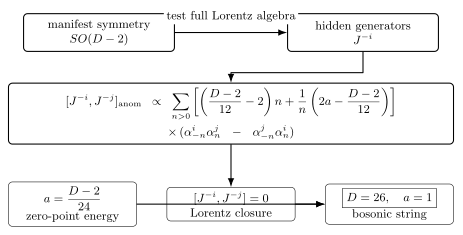
For the flat open bosonic string with , the matrix element of the boost commutator fixes . The independent test then fixes . Both conditions make the full anomaly vanish, not just these two matrix elements. The diagram summarizes the ordered-operator calculation; it is not a spacetime geometry.
At the critical values, the transverse Fock description agrees with the old covariant physical space after quotienting null states. The all-level equivalence and no-ghost statement are theorems, not consequences of counting a few levels. The previous page explains the wider free-state no-ghost domain and why it is distinct from critical interacting-string consistency.
Open-string levels and hidden rotations
Section titled “Open-string levels and hidden rotations”At , the free open-string masses obey . The first levels illustrate how manifest oscillator states form spacetime representations:
| Level | Oscillator families | Number of states | Mass squared |
|---|---|---|---|
| vacuum | |||
| , | |||
| , , |
The vacuum is a tachyon, which signals an unstable bosonic-string vacuum despite the positive oscillator norm. At nonzero null momentum, level one has the polarizations of a massless vector. These statements concern different issues: a norm is not a mass squared.
At level two, split the symmetric product of two vectors into its traceless part and trace. The oscillator content is then
This is the restriction of a traceless symmetric rank-two tensor of to its subgroup. To see the branching, write a traceless tensor with . Its components are a traceless part of , a vector , and one scalar; removes the second scalar. The explicit covariant quotient on page 07 proves the representation assignment; agreement of dimensions alone would not prove it.
Similarly, level three forms a traceless symmetric rank-three tensor and an antisymmetric rank-two tensor of , of dimensions and . The leading trajectory selects the maximal rotation eigenvalue in the symmetric traceless family, giving . A generic product of first-harmonic oscillators also contains lower-spin components and should not be identified wholesale with the leading trajectory.
Closed-string reconstruction and level matching
Section titled “Closed-string reconstruction and level matching”The closed string has two independent transverse oscillator algebras: depends on and continues to the holomorphic sector, while depends on and continues to the antiholomorphic sector. In the light-cone gauge already constructed,
There is a global issue even after these local equations have been solved. A closed string in a noncompact direction must return to the same after .
The average of the left chiral derivative is
where the brackets denote a spatial-period average, not a quantum expectation value. The right derivative has the same expression with . This follows directly from and its right-moving counterpart, including the normal-ordering constant in each chiral sector.
Since , the reconstructed monodromy is
Thus periodicity requires level matching:
The same condition is the residual spatial-translation constraint. Indeed the reduced generator is
With our chirality assignment, . Physical closed-string states are invariant under this remaining gauge transformation.
The sum of the two averaged derivatives fixes the Hamiltonian:
Consequently
The nonzero reconstructed modes are
The closed-string Lorentz test includes both chiral contributions and the level-matching condition; it gives the same critical values. The explicit boost calculation above was for the open string, so its open zero-mode normalization must not be inserted unchanged into a closed-string generator.
At , the closed vacuum has . The states at are massless and span , which decomposes into polarizations. They correspond to the graviton, two-form and dilaton. Their physical transverse decomposition was derived on page 07. Here the new result is why only matched pairs of oscillator levels describe closed strings. Their rapidly growing degeneracies lead to the state-counting and Hagedorn analysis.
Exercises
Section titled “Exercises”Exercise 1. A global gauge map and its failure
Section titled “Exercise 1. A global gauge map and its failure”Let the open-string chiral coordinate be , with . Construct the residual map, determine its regular orientation-preserving range, and verify that it preserves both strip boundaries. Explain why its nonzero average slope does not settle the question.
Solution
The construction in the text gives
Strict positivity for all is equivalent to . At the derivative vanishes at isolated points, so the inverse is not a regular diffeomorphism. For it changes sign.
At , both arguments equal , so . At , the arguments differ by ; hence
The new time is , and . In every case the average of is one. This average fixes the monodromy but does not guarantee a regular inverse.
Exercise 2. Reconstruct the longitudinal harmonic
Section titled “Exercise 2. Reconstruct the longitudinal harmonic”Consider a classical open string with one nonzero transverse coordinate
and . Find , check its Neumann boundary condition, and compare its zero mode with the transverse oscillator energy. Here is a length and the classical intercept is zero.
Solution
The chiral derivatives are . The constraints give
Integrating both chiral pieces yields
Its spatial derivative vanishes at . Substitution of the chiral derivatives into gives zero pointwise. The minus oscillation has twice the transverse frequency because the constraint is quadratic.
The coefficient of is , so
From the open mode expansion,
There is no transverse center-of-mass momentum, and agrees with the reconstructed zero mode. Each term in has dimension of length.
Exercise 3. Casimir energy on a strip and a circle
Section titled “Exercise 3. Casimir energy on a strip and a circle”Put free transverse scalars on an auxiliary worldsheet strip of spatial length with Neumann ends. Regulate their oscillator energies with , where is a length, and subtract the leading local divergence. Repeat for a circle of circumference . Explain the relation to one versus two chiral intercepts.
Solution
On the strip the nonzero frequencies are , with one real oscillator for each and each species. The zero mode has no oscillator zero-point energy. Therefore
The divergent term is proportional to the spatial length and is removed by a local vacuum-energy subtraction. The finite term is . Measuring energy in units gives .
On a circle there are two real oscillators at each , or equivalently two chiral families. Thus
The finite energy in units is , with per chiral family. These are worldsheet Casimir energies, not target-space masses. Their relation to the latter also uses the zero-mode constraints.
Exercise 4. The longitudinal modes are composite operators
Section titled “Exercise 4. The longitudinal modes are composite operators”Using , derive their commutators with transverse modes and with one another. Why would setting the minus-minus commutator to zero be incorrect?
Solution
The independent zero mode commutes with the transverse oscillator algebra. Therefore
For two longitudinal composites,
In deriving the second line, rewrite . Its intercept contribution is .
The unreduced covariant bracket refers to independent covariant coordinates before reduction. Here the constraints and gauge choice have changed the brackets to reduced ones, and is a composite of independent transverse modes. Even its classical bracket is generally nonzero. The quantum central contribution adds to this distinction.
Exercise 5. Two explicit matrix elements of the anomaly
Section titled “Exercise 5. Two explicit matrix elements of the anomaly”Take two different transverse species , set , and use normalized states . Evaluate the off-diagonal matrix element of for directly from and the orbital contribution. Determine which conditions they impose.
Solution
At level one the pair-creation sum in is empty, so annihilates these states at . The only contribution is . Since the normalized spin matrix element is , the answer is
At level two, write and . Then
For , , , and . The unnormalized matrix element of is consequently . Dividing by the norm factor two gives .
The normalized spin matrix element is again , while . Adding the orbital contribution gives
The first test requires , and then the second is . Thus . These matrix elements equal , not , because acts with a factor on normalized one-oscillator states. Two different transverse species were essential; with only one species this test does not exist.
Exercise 6. A closed string that fails to close longitudinally
Section titled “Exercise 6. A closed string that fails to close longitudinally”Take the classical transverse configuration
with other transverse coordinates constant and . Both transverse coordinates are periodic. Find the monodromy of and the further condition for a closed embedding. Then consider a quantum state made only from mode- left oscillators and mode- right oscillators; find the smallest nonzero occupation numbers satisfying level matching and its critical mass.
Solution
The constraints give
Their averages are and . The minus coordinate therefore changes by
around the spatial circle. The embedding closes in noncompact target space only if . The classical levels are and , so this agrees with the general monodromy formula at . Local constraints and periodic transverse coordinates alone were not sufficient.
In the quantum example, let and count left mode- and right mode- excitations. The levels are and . Their smallest positive common value is six, attained at . At ,
Equal numbers of quanta would have been the wrong condition: it is the frequency-weighted levels that must match.
References
Section titled “References”- Klaus Bering, “A Note on Angular Momentum Commutators in Light-Cone Formulation of Open Bosonic String Theory,” 2011, revised 2012, arXiv:1104.4446. Sections 6–8 give a direct ordered-operator calculation of the boost commutator.
- Peter Goddard, Jeffrey Goldstone, Claudio Rebbi and Charles B. Thorn, “Quantum Dynamics of a Massless Relativistic String,” Nuclear Physics B 56 (1973), 109–135. DOI:10.1016/0550-3213(73)90223-X.
- Luca Mezincescu and Paul K. Townsend, “Anyons from Strings,” Physical Review Letters 105 (2010), 191601. DOI:10.1103/PhysRevLett.105.191601; arXiv:1008.2334. The discussion after equations (22)–(23) explains why the dangerous commutator is absent in three dimensions.
- David Tong, Lectures on String Theory, University of Cambridge, 2009, arXiv:0908.0333, section 2.4, especially the quantum Lorentz algebra and transverse spectrum.