
Intersecting Branes and Preserved Supersymmetry
An open string joining different D-branes can be free to move at one endpoint and fixed at the other. These mixed boundary conditions change its oscillator frequencies, its ground-state Clifford algebra, and the supersymmetries shared by the branes. Four mixed directions give the familiar quarter-BPS intersections. Eight require an additional Ramond parity trace: omitting its covariant zero modes loses the contribution associated with fundamental-string creation.
We study static, unfluxed branes aligned with coordinate axes in a locally flat type II background. The shared spinor and spacetime conventions, physical tensions and gravitational coupling, and annulus normalization apply throughout. A local boundary conformal field theory does not by itself supply a globally consistent D8- or D9-brane background.
Mixed boundary conditions and normal modes
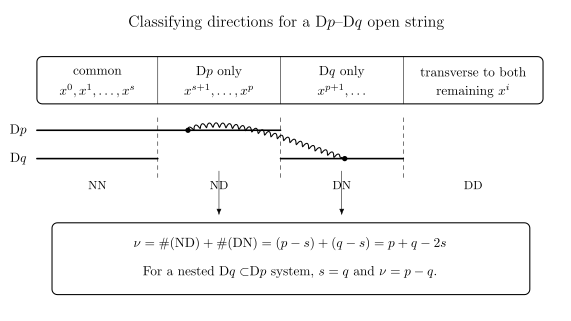
Section titled “Mixed boundary conditions and normal modes”Let a D-brane and a D-brane share spatial directions. Time is common Neumann. The numbers of coordinate directions are
Here counts both ND and DN directions. It is even because and have the same parity in a fixed type II theory. A separation exists only in common DD directions. Only NN directions have momentum zero modes.
For example, take D1 along and D5 along . Directions are NN, are mixed, and are DD. Their open strings propagate along the common string; they do not carry independent center-of-mass momenta along .
Subtract the fixed Dirichlet values and solve the wave equation on . A separated mode obeys . The endpoint equations determine
| Boundary conditions | Oscillatory profile | Positive frequencies | Additional zero-mode data |
|---|---|---|---|
| NN | |||
| DD | fixed profile | ||
| ND | fixed Dirichlet endpoint position | ||
| DN | fixed Dirichlet endpoint position |
In particular, an ND oscillator satisfies and , so . There is no zero-frequency solution other than the fixed constant. The corresponding quantum expansion can be written
The sum includes both signs of , with . This makes Hermitian. A sine expansion gives DN oscillators after the corresponding phase choice for the oscillators.
Why the fermionic frequencies are reversed
Section titled “Why the fermionic frequencies are reversed”At an endpoint let for a Neumann coordinate and for a Dirichlet coordinate. The fermion gluing has the form , where the endpoint signs distinguish the spin sectors. Doubling the interval gives the monodromy
For ordinary NN or DD directions, . Choose the R sector to have and NS to have . Mixed directions multiply either monodromy by another minus sign. Thus
| Coordinate type | Bosons | NS fermions | R fermions |
|---|---|---|---|
| NN or DD | integer | half-integer | integer |
| ND or DN | half-integer | integer | half-integer |
The integer NS fermions in mixed directions have zero modes. This fact changes the GSO projection as much as the shift in vacuum energy does. The derivation and its spacetime interpretation are developed in Polchinski, §4.2.
The profiles have unit amplitude and use . Their endpoint values and slopes implement ND or DN conditions; they are string-coordinate profiles, not drawings of brane shapes. The D1–D5 coordinate table identifies four mixed directions. Reversing one endpoint gluing also reverses the fermion periodicity.
Vacuum energies and physical intersection fields
Section titled “Vacuum energies and physical intersection fields”For each real oscillator, the vacuum contribution is for a boson and for a fermion. A common exponential regulator gives the finite parts
An ordinary boson–NS-fermion pair therefore contributes , whereas a mixed pair contributes . Covariant matter and ghost determinants cancel two ordinary coordinate pairs. This leaves
The R cancellation occurs frequency by frequency. Each additional mixed direction raises the NS vacuum energy by ; each additional pair raises it by .
When a common spatial NN direction exists, the same eight-pair calculation follows in a compatible light-cone gauge. A D0–D4 or D0–D8 string has no such common spatial direction. Its determinant calculation must instead use covariant matter and ghosts, or a justified T-dual description; the counting of eight effective oscillator pairs is not permission to impose an unavailable light-cone gauge. The zero modes of this cancellation need special care at .
The stretched mass formulas are
The term proportional to is the energy of the linear DD profile; a mixed direction adds no analogous freely adjustable separation.
Clifford ground states and orientation
Section titled “Clifford ground states and orientation”For , the NS zero modes generate a Clifford module of dimension . Its two chiralities have equal dimension. The GSO projection keeps one, so it retains ground states per endpoint orientation. In the R sector, after the physical constraints the corresponding ground multiplicity is :
| Retained NS ground multiplicity | Retained R ground multiplicity | ||
|---|---|---|---|
| 2 | 1 | 4 | |
| 4 | 0 | 2 | 2 |
| 6 | 4 | 1 |
These are complex polarization counts for one oriented sector, without Chan–Paton multiplicity. At the NS ground state survives the projection and is tachyonic when . At there is no NS ground-state tachyon even at , but the system need not preserve supersymmetry. Absence of a tachyon and absence of force are different tests.
For , the two bosonic and two fermionic ground polarizations in one orientation combine with their orientation-reversed partners into one hypermultiplet, rather than two independent complex hypermultiplets. With stacks, the – sector transforms in and the opposite sector supplies its conjugate. D3–D7 gives four-dimensional matter; D1–D5 gives its two-dimensional reduction with eight supersymmetries. D0–D4 gives the corresponding quantum-mechanical fields: an on-shell massless particle count in zero spatial dimensions is not the appropriate interpretation.
Intersecting supersymmetry graphs
Section titled “Intersecting supersymmetry graphs”Use the parameter relation derived on page 20. For an ordered coordinate-aligned brane, it reads
The sign distinguishes charge orientations. These are supersymmetry parameters, with the shared chiralities; covariant charge columns have dual indices and must not be substituted for them. The actual projector acts on the pair of parameters:
The inverse matters because need not be one. A single graph has real dimension sixteen.
For nested branes along and , equating the two graphs gives
The last equality uses even and this specific inverse order. Reversing the order takes the inverse of the spatial product; for two mixed directions this changes its sign. Since
allows no eigenvalue or , even over the complex numbers. No parameter survives. For , the relative product squares to one and has zero trace on the allowed sixteen-dimensional Weyl space. Its two eigenspaces each have dimension eight. Equal orientations select one and reversing one orientation selects the other. Both are quarter-BPS local boundary configurations.
For example, D0–D4 selects ; D1–D5 selects . The product also has two eight-dimensional eigenspaces. This establishes compatibility of the local supersymmetry conditions. It does not decide the background charge, vacuum choice, or stretched-string content required for a globally supersymmetric D0–D8 configuration.
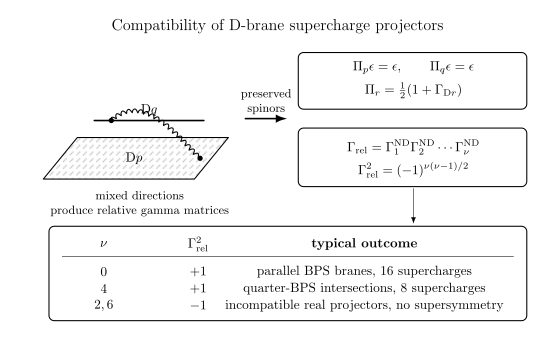
The graph projector contains , not a second copy of . In the smaller-brane inverse order, splits the allowed right-parameter space into two eight-dimensional eigenspaces. By contrast, prevents a common parameter. The drawing describes linear subspaces and dimensions, not physical angles or norms.
Nonzero spin structures in the annulus
Section titled “Nonzero spin structures in the annulus”Write and let be the Euclidean intersection volume. For one brane of each kind, the two endpoint orientations cancel the cylinder factor , while the GSO factor remains inside the projected character:
The static interaction energy per spatial intersection volume is . Only common NN momenta enter the Gaussian. Divergent integrals are compared with common cutoffs before their limits are taken.
Use the product functions from page 22, with . To see their coefficients directly, set and introduce the bosonic oscillator product
The ordinary unprojected characters are
The prefactors come from Clifford zero modes. The superscript distinguishes the Ramond character from the bosonic product. In terms of ,
For , both inserted parity traces vanish: NS has mixed fermion zero modes, while R has ordinary physical zero modes. Thus, in precisely these cases,
The minus sign is the spacetime-fermion statistical sign. Reversing one brane does not reverse it. Reversing a GSO projection exchanges equal-sized Clifford chiralities. Consequently this unrefined character is unchanged for , although the representations and the preserved parameter subspace can change. Neither the parallel-brane formula nor the exceptional eight-ND formula can be obtained by changing this statistical sign.
At , the two nonzero products are identical:
Their GSO-projected expansions begin . Bosons and fermions therefore cancel level by level after the mixed frequencies have been reorganized. This is not the parallel-brane Jacobi cancellation between three nonzero spin structures.
Modular transformation and the massless coefficient
Section titled “Modular transformation and the massless coefficient”Set and . The transformations are , , and . Hence
where the last functions have argument . Both terms are now in the closed NSNS channel. The inserted open traces, which would provide RR exchange, vanish here. The measure becomes
The leading terms of and have opposite signs at order . Subtracting the two numerator products gives . The denominator before its factor two has leading term . Therefore
At the cancellation is exact, not just a vanishing leading term. To calibrate an exchange coefficient, however, use a nonzero case such as or ; a zero total cannot test normalization.
Graviton and dilaton exchange between unequal branes
Section titled “Graviton and dilaton exchange between unequal branes”The Einstein-frame DBI action at zero worldvolume flux is
Use and from the overview. If denotes the tangent projector with indices raised by , its linear sources are
In the graviton propagator the trace subtraction is . Since and , the two exchange coefficients are
Relative brane directions are integrated over in the exchange diagram; the remaining Green function lives in the common DD space. For ,
The same coefficient follows from the annulus by and the shared tensions. It has dimension , as required for energy per spatial intersection volume. This is a long-distance, weak-backreaction exchange calculation; requires regulated differences, forces, and boundary data rather than a decaying isolated-source .
For D0–D4 the separate coefficients are and . Gravitational attraction and dilaton repulsion cancel inside NSNS. An ordinary equal-rank RR propagator is not responsible for this cancellation. For a D0–D6 pair the sum is , so the long-distance NSNS interaction is repulsive despite the positive NS ground mass squared.
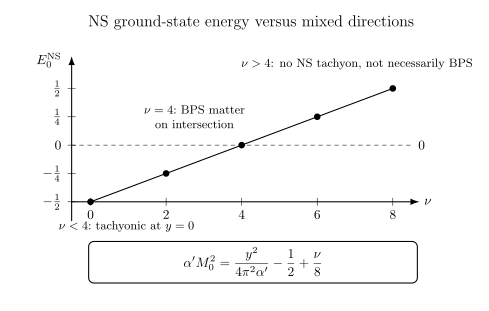
Only the discrete even values of are physical points in this comparison. The upper panel plots the unprojected NS vacuum energy; the equal-charge vacuum is removed. The lower panel specializes to D0–D: , , and their sum . These are dimensionless source coefficients, not a plot of the full potential. At , the nonzero pieces and cancel. The force also needs the exceptional odd spin structure and a specified background.
Eight mixed directions and the odd spin structure
Section titled “Eight mixed directions and the odd spin structure”Consider D0 along and D8 along , with signed separation along . There is only one NN direction and one DD direction. In the R sector, the two covariant zero modes remain even though there are no transverse R zero modes. A statement that there is “one transverse state, then half survives GSO” is not a physical state count.
A matched matter–superghost regulator
Section titled “A matched matter–superghost regulator”The periodic matter zero-mode pair is a two-state Clifford system. In its graded trace, regulate its occupation by , with :
The corresponding commuting superghost zero-mode oscillator contributes the inverse factor,
These two factors must use the same regulator. Their product is one before . Setting the matter trace to zero first discards a finite contribution. Equivalently, a common small twist regulates the fermionic determinant and its bosonic inverse together. This isolates the zero-mode part of the covariant prescription; the accompanying ghost insertions and nonzero-mode determinants are those of the gauge-fixed annulus. Bergman, Gaberdiel, and Lifschytz, §2 and Appendix A, explain why the naive vanishing RR overlap is a zero-times-divergence problem.
More generally, the covariant R ground algebra has Clifford pairs. After cancellation of one pair against superghosts, the graded factor behaves as . It vanishes for but equals one for . The NS parity trace at eight ND still vanishes because its mixed fermion zero modes have no NS superghost zero-mode pole to cancel them.
The R parity insertion also changes each nonzero-mode fermion factor to , canceling the matching bosonic denominator. Thus the surviving odd-spin contribution is a constant, not a tower of additional states.
Let denote its sign after inclusion of the R statistical minus. This is a label for the RR orientation and vacuum prescription in this local calculation, not a redefinition of the fermion loop sign. The full character is
The first two terms come from the ordinary NS and R traces and combine into ; the odd spin structure gives . In a zero-mode projection the resulting coefficients are zero or one, such as in the R ground contribution, never half of a physical state. A branch’s vacuum prescription must be specified before assigning it a spectrum or comparing it across a crossing.
A finite force and the half-string coefficient
Section titled “A finite force and the half-string coefficient”For D0–D8, a constant character contributes
The integral has a separation-independent ultraviolet divergence. Subtract at a reference before integration. Direct differentiation with respect to followed by integration back gives
Since , the finite energy difference is . Consequently
up to the same subtraction constant. The NSNS force is repulsive, . Its magnitude is . The branch cancels it; the branch doubles the repulsion. Dropping the odd spin structure leaves neither complete branch.
The two vacuum branches differ by , the energy of one stretched fundamental string. An adiabatically transported state need not remain the vacuum defined on the other side of a D8-brane. The change in vacuum charge and the occupation of a stretched string must be tracked together. The half-string term is a contribution to this regulated background energy and induced charge, not a freely propagating object with half the elementary string charge. This distinction is central to Danielsson, Ferretti, and Klebanov, and to the subsequent vacuum analysis of Bergman, Gaberdiel, and Lifschytz.
A D8 changes the Romans background; orientifold and other brane charges can change the required strings and subtraction data. The flat calculation is a local static diagnostic. It does not construct a globally isolated D0–D8 solution, or justify using the static zero-mode limit for arbitrary time-dependent crossings.
D1–D9 and a genuinely chiral field
Section titled “D1–D9 and a genuinely chiral field”A D1 along and a D9 have two NN directions and eight mixed directions, with no DD separation. Their NS ground energy is , but the covariant R ground algebra is generated by . It has two spinor components before GSO. The GSO condition selects one eigenvalue of the two-dimensional chirality matrix, and imposes
Thus a positive-energy excitation moves in only one spatial direction. Reversing one brane’s RR charge orientation reverses the GSO choice and the selected chirality. This is distinct from exchanging the 1–9 and 9–1 endpoint labels, which gives conjugate sectors. An absolute left/right name also depends on the orientation of the string coordinate. The covariant Clifford projection precedes the Dirac equation, so no “half a one-state module” occurs.
In the consistent type I construction, the O9-plane and 32 D9-branes supply the additional global data. The projection relates 9–1 to 1–9 and imposes the appropriate field reality condition. One D1 therefore carries 32 real chiral worldsheet fermions in the vector of , rather than two independent sets of 32 complex fermions. They have the opposite propagation chirality to the supersymmetric 1–1 fermions. This derivation, including the two covariant ground components, is given in Polchinski, §5.1; the orientifold background is discussed on page 13.
The present analysis is for right-angle, unfluxed intersections. A tachyon signals an unstable quadratic fluctuation, not a universal recombination endpoint. Flux, charges and global topology constrain any final configuration; the next page develops examples of bound states carrying worldvolume flux.
Exercises
Section titled “Exercises”Exercise 1. Modes, orthogonality, and a nonnested intersection
Section titled “Exercise 1. Modes, orthogonality, and a nonnested intersection”Derive the normalized positive-frequency profiles for NN, DD, ND and DN conditions. Determine the coordinate counts for D3 along and D5 along . State where momentum and a separation can occur, and derive the fermion doubling sign.
Solution
The endpoint equations applied to give the table in the text. Every nonconstant profile has norm , so its normalized version has factor . The NN constant mode is . For the mixed cosine family,
The product-to-sum formula proves this since both resulting sine endpoint terms vanish. The sine family has the same norm. Orthogonality is asserted within each boundary-value problem, not between the ND and DN families.
For the stated branes, are NN, are ND, are DN, and are DD. Thus , , . Momenta run along ; the separation has two components along . A DD profile is fixed by both brane positions and contributes to ; it is not a momentum zero mode. The mixed directions have neither type of free zero mode.
Doubling transports a fermion through both endpoint reflections. The total sign is . Therefore each mixed direction interchanges periodic and antiperiodic fermions, yielding integer NS and half-integer R frequencies. This example has no ordinary decaying two-dimensional Green function at infinity; a force calculation requires a regulated logarithm or specified boundary conditions.
Exercise 2. Regulated vacuum sums and ground representations
Section titled “Exercise 2. Regulated vacuum sums and ground representations”Derive the finite parts of the two frequency sums from geometric series. Obtain the NS vacuum shift and the projected Clifford multiplicities at . Explain both why the two-ND tachyon survives GSO and why applying the same halving formula at eight ND is invalid.
Solution
Differentiate the two geometric sums with respect to the regulator:
Their finite parts are and . Applying the bosonic factor and fermionic factor gives the ordinary NS pair and mixed NS pair . Replacing one ordinary pair by a mixed pair raises the energy by . In R, bosonic and fermionic frequencies coincide, so their regulated sums cancel before any limit.
Pair the real NS zero modes into complex Clifford oscillators. Each has occupation zero or one, giving states. The parity insertion has trace , and either chirality projector retains half. The same argument for physical R zero modes gives
At two ND, the unprojected NS ground space already has two components. Removing one leaves a genuine ground state with , so its instability threshold is . This differs from the equal-brane zero-ND vacuum, whose parity removes it completely.
At eight ND the transverse R module would have dimension one, but its inserted trace is not zero. The covariant two-component ground algebra and the superghost zero modes must be treated together. The full GSO projector then retains or removes an integer-dimensional physical sector. It never assigns dimension to a physical state space.
Exercise 3. Solve the simultaneous parameter constraints
Section titled “Exercise 3. Solve the simultaneous parameter constraints”Use the shared and actual inverses to determine the preserved dimensions for D0–D2, D0–D4 and D1–D5. Reverse one brane orientation in each example. Show explicitly why replacing the graph projector by fails.
Solution
Since and , . Hence
The first relative matrix squares to . A putative equation would imply both and , so . Reversing a charge changes the requested eigenvalue but cannot fix this incompatibility.
The four-gamma products square to one. Their trace on a chiral sixteen-dimensional space vanishes: an invertible even gamma product containing one included and one excluded spatial direction anticommutes with the four-gamma product and preserves chirality. It pairs its and eigenvectors. Each eigenspace therefore has dimension eight. The first brane determines from those eight right parameters. Both D0–D4 and D1–D5 preserve eight real supersymmetries; reversing one brane exchanges the two eigenspaces.
For a single D0, is not a projector:
By contrast because its off-diagonal blocks are and its inverse. Its positive eigenspace is the graph of arbitrary allowed , of real dimension sixteen. This derivation concerns parameters; extracting preserved covariant charge combinations additionally uses the pairing on page 20.
Exercise 4. Separate the two NSNS forces
Section titled “Exercise 4. Separate the two NSNS forces”Derive the graviton and dilaton contractions from the linear sources. Evaluate them for D0–D4 and for the nonnested D3–D5 example of Exercise 1. Verify the dimensions after integrating out the relative brane directions, and explain the limitations of interpreting the sum as a force.
Solution
The determinant variation is , while differentiating the dilaton exponential gives . Contract the two tangent sources with
Both projectors are symmetric. Their mutual contraction counts common tangent directions, including time, and equals . The trace term gives . Scalar-source multiplication gives . Summing and substituting yields .
For D0–D4, and :
Each exchange is nonzero; their energies have opposite signs and cancel. For D3–D5, , so and . The vanishing D3 dilaton source does not imply vanishing NSNS interaction. Here and the appropriate Green-function difference is logarithmic.
The overall coefficient has dimension
Since , their product has dimension . The Green function comes from integrating the ten-dimensional propagator over all source directions except the common-volume factor. For and positive , a positive coefficient gives attraction. For , source completion and subtraction data must be specified. At eight ND the odd-spin contribution must also be included, so the NSNS coefficient alone is not the total interaction.
Exercise 5. Count occupations and follow a nonzero channel
Section titled “Exercise 5. Count occupations and follow a nonzero channel”For four ND directions, count the first two oscillator levels above the ground state in each sector. Then derive the closed massless coefficient for two and six ND, including the modular weight and heat-kernel normalization. Explain why changing a relative GSO chirality leaves these unrefined characters unchanged.
Solution
At four ND, the bosonic product has four integer and four half-integer species. The NS fermions have four of each frequency type; the R assignment interchanges the coordinate labels but leaves the product unchanged. After GSO, both ground spaces have dimension two.
In units of , the first excited level uses a frequency- oscillator. There are four mixed bosons and four ordinary NS fermions, giving states. At the next level, frequency-one bosons and fermions give eight choices. Two frequency- excitations give
The total is . Occupation parity is correlated with which ground Clifford chirality survives; it does not eliminate another factor of two at each excited level. R gives the same counts with the fermion labels interchanged.
For general , the modularly transformed difference is the one displayed in the text. Expanding its numerator and denominator gives and . The latter negative supertrace is allowed: it is a signed difference, not a state multiplicity. Including the modular weight gives the common-DD kernel .
With ,
Multiplying by and gives
because and . The energy has the opposite sign to . This matches two independently nonzero source calculations; the four-ND zero would not test these constants.
In either sector at , the ground Clifford parity trace vanishes. Every oscillator parity can therefore be paired with an equally large ground subspace of either requested total GSO parity. Reversing the projector exchanges those subspaces while leaving the ordinary trace unchanged. The R contribution still enters the vacuum loop with a minus sign.
Exercise 6. The regulated eight-ND term, charge jump, and chirality
Section titled “Exercise 6. The regulated eight-ND term, charge jump, and chirality”Evaluate the matched zero-mode trace and the finite D0–D8 energy difference. Independently recover the half-unit induced D8 gauge charge by integrating the D0 flux through its worldvolume. Finally, solve the D1–D9 massless Dirac condition in a two-component representation and explain the type I reality count.
Solution
For , the matter graded zero-mode trace is and the ghost sum is . Their product is exactly one. A finite ghost cutoff gives ; take at fixed before the matched limit. Reversing these limits gives zero and misses the finite term. For more than one matter pair, the extra graded factors survive as powers of , so the trace vanishes when .
The nonzero-mode graded R product cancels its bosonic partner. Combining it with the ordinary terms yields . To integrate a constant term, use
Integrating from to gives the finite difference in the text, without assigning a value to either divergent integral. Thus the NSNS slope has magnitude , the odd term has the same magnitude, and changing the odd branch changes the energy by .
For the independent charge calculation, the shared WZ coupling contains . Integration by parts makes the pullback of a source for . Its sign depends on the stated source and worldvolume orientations; its magnitude follows without that ambiguity. The D0 flux is , and an infinite plane on either side of it intercepts half the flux. Explicitly, with the unit--sphere area,
The magnitude of the induced endpoint charge in the normalization is consequently
Crossing changes this charge by one unit, matched by an oriented F1 endpoint. This is the shared-field translation of the effective-action calculation in Danielsson, Ferretti, and Klebanov, §3. The magnitude is local; an absolute charge assignment and actual string content require the global background. The half-unit contribution does not enlarge the spectrum of free elementary string charges.
For the chirality calculation choose a representation of the local two-dimensional zero-mode algebra,
The component obeys and the component obeys . GSO retains one of these, so the field is chiral. Opposite endpoint orientations give conjugate amplitudes; they are not an independent duplication after the appropriate field reality condition. In type I, identifies the 1–9 and 9–1 sectors, and the 32 D9 labels give 32 real Majorana–Weyl fields. There is no DD direction here, so no separation-dependent D0–D8 potential should be assigned to the D1–D9 geometry.
References
Section titled “References”- Bergman, Oren, Matthias R. Gaberdiel, and Gilad Lifschytz. “Branes, Orientifolds and the Creation of Elementary Strings.” Nuclear Physics B 509 (1998), 194–215. doi:10.1016/S0550-3213(97)00632-9, arXiv:hep-th/9705130, especially §§2–3 and Appendix A.
- Danielsson, Ulf H., Gabriele Ferretti, and Igor R. Klebanov. “Creation of Fundamental Strings by Crossing D-branes.” Physical Review Letters 79 (1997), 1984. doi:10.1103/PhysRevLett.79.1984, arXiv:hep-th/9705084, especially §§1–3.
- Polchinski, Joseph. TASI Lectures on D-Branes. TASI 1996 lectures, report NSF-ITP-96-145 (1996; revised 1997). arXiv:hep-th/9611050v2, especially §§4.2 and 5.1.