
The Nambu–Goto and Polyakov Actions
The Nambu–Goto action assigns an area to a string’s history. Its square root makes the geometry transparent but the dynamics nonlinear. The Polyakov action introduces an independent worldsheet metric and replaces that square root by a quadratic action for the embedding coordinates in flat spacetime. Eliminating the metric recovers the area action on the appropriate classical branch.
We will derive both descriptions and use a long, nearly straight string to identify its physical oscillations. Quantizing those oscillations gives a finite correction to its energy whose coefficient depends on the boundary conditions. The global conventions fix the signature, tension, and stress-tensor normalization. The particle action provides the auxiliary-field analogy; only elementary variational calculus and harmonic-oscillator quantization are needed below.
Open and closed worldsheets
Section titled “Open and closed worldsheets”A string history is a map from a two-dimensional parameter space into spacetime. Holding fixed selects a spatial string; varying sweeps out its worldsheet.
For an open string, belongs to an interval, which may be chosen as . The worldsheet is a strip, and its two physical boundaries are the endpoint histories. For a closed string, is periodic, conventionally with period , and the worldsheet is a cylinder. These numerical coordinate periods do not determine the string’s physical length.
In a noncompact target direction, a closed embedding obeys
For a target circle , closure instead permits winding:
The two values represent the same point of the target circle. Equality of coordinate values would incorrectly exclude the sectors with .
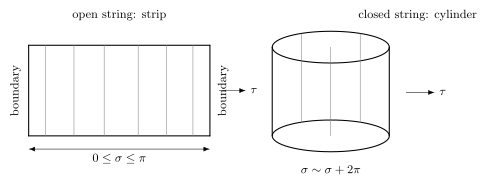
Time runs along the strip boundaries and the cylinder axis. The strip has two endpoint boundaries; the cylinder has no spatial boundary. The displayed time cuts only delimit the illustrated history. These are topology diagrams, not surfaces drawn to physical scale.
The induced metric and the area action
Section titled “The induced metric and the area action”The worldsheet acquires a metric from its embedding. To derive it, take a small displacement . The corresponding target displacement is , so
This induced metric is determined by ; it is not an additional field. We keep the target metric flat from here onward. Writing and in this subsection,
Assume the embedding is regular and its tangent plane is timelike: is nondegenerate and Lorentzian, hence . Its positive area element is . The Nambu–Goto action is
The coefficient is the physical energy per unit length. For a static straight string of length , using target time and physical distance along it gives and
The minus sign agrees with the massive particle action. In Lorentzian signature the equations extremize the area; they need not minimize it against every possible variation.
Why the coordinate labels do not matter
Section titled “Why the coordinate labels do not matter”Let for a nonsingular change of worldsheet coordinates. Then
The factor in the square root exactly cancels the change of integration measure. Thus the area depends on the embedded surface, not the labels used on it. Two of the embedding functions can consequently be fixed locally by a coordinate choice.
The dimensions of the metric components depend on those labels. With dimensionless and of length dimension, has dimension length squared. With physical coordinates , the corresponding components are dimensionless. In both descriptions the area has dimension length squared and is dimensionless.
The embedding equation
Section titled “The embedding equation”The determinant identity and the variation of the induced metric are
Consequently,
Integrating by parts gives the flat-target bulk equation
It resembles a wave equation, but itself depends on , so it is nonlinear. Boundary variations must also vanish; we will specify them when needed. This geometric derivation and the auxiliary-metric construction below can be compared with Tong, sections 1.2–1.3.
Physical transverse oscillations of a long string
Section titled “Physical transverse oscillations of a long string”Consider a nearly straight string aligned with . It may be held between fixed endpoints separated by , or it may wind once around a target circle of circumference . These backgrounds have the same local fluctuation action but different spatial boundary conditions. An unsupported contractible circular loop in noncompact space is a different, generally time-dependent background.
In a region where the surface can be represented as a graph over , choose static gauge:
Here and are dimensionful physical coordinates, with . They are not the earlier dimensionless coordinate interval . The fields describe transverse displacements. Static gauge is a local description around this background; folds that prevent from being a coordinate require another description.
Write and . Their contractions use the positive transverse metric. The induced metric and its determinant are
For small slopes and velocities, the final two terms are fourth order in derivatives of the displacement. Expanding the square root gives
and therefore
This is an expansion in derivatives of , not its absolute displacement. Translating the whole string by a constant costs no bulk energy.
Coordinate rescaling and canonical fields
Section titled “Coordinate rescaling and canonical fields”A dimensionless spatial coordinate is equally valid. Defining gives
The same action through quadratic order becomes
The two derivative terms acquire different powers of because only the spatial coordinate was rescaled. Dropping either factor would change the physical wave speed or the mode frequencies.
In physical coordinates, define the canonically normalized fields
Thus the small transverse oscillations are massless scalars with propagation speed one. The two longitudinal coordinate functions have been used to choose the worldsheet coordinates. In a covariant description, the metric constraints implement the same reduction.
For the low-energy quantum expansion at fixed , a useful control parameter is . A long string has ; quartic interactions in the canonical fields then have small effects on modes of wavelength of order . If this action describes an effective string with additional massive excitations, one also needs much larger than their inverse masses. Aharony and Field develop this effective description, including its boundary interactions.
Fixed endpoints and the finite vacuum energy
Section titled “Fixed endpoints and the finite vacuum energy”Take the open string with fixed transverse endpoints,
The normalized eigenfunctions of are
Substituting into gives independent harmonic oscillators:
Each oscillator contributes to the vacuum energy. The sum of these contributions diverges, so a finite answer requires a prescription for separating local short-distance energy from the length-dependent Casimir energy.
A regulator with physical units
Section titled “A regulator with physical units”Introduce a short-time cutoff of length dimension and weight each frequency by . For one transverse field,
Here DD means Dirichlet at both ends. The convergent sum is obtained by differentiating a geometric series:
Its small- expansion is
Hence
The divergent term is proportional to . It renormalizes a local energy density, the string tension. With fields, combine it with the bare tension so that
in the chosen renormalization prescription. A local endpoint energy can also be present; denote its total finite value by . After these local terms have been fixed, the long-string ground-state energy has the form
The inverse-length contribution is the Lüscher term. Its coefficient counts the massless transverse fields for these boundary conditions. It is unaffected by a redefinition of the tension or an -independent endpoint energy. Additional gapless fields, different propagation speeds, or different boundary conditions can change the coefficient. The original effective-string analysis is due to Lüscher, Symanzik, and Weisz.
Zeta regularization encodes the same finite part through . It does not assert that the ordinary divergent series converges to a negative number.
Periodic strings have a different Casimir coefficient
Section titled “Periodic strings have a different Casimir coefficient”Return to a straight string wrapped once around a target circle of circumference . The transverse fields now satisfy . For each positive integer , there are two real spatial modes, sine and cosine, with frequency
The spatially constant mode is a free center-of-mass coordinate, not a harmonic oscillator with nonzero frequency. Work in the sector of zero transverse momentum, so it contributes no vacuum energy.
For one field, the regulated nonzero-mode energy is
The local extensive divergence is the same as for the interval, but the finite term is four times as large in magnitude. After tension renormalization,
There is no endpoint term on this cylinder. The factor four comes from the doubled positive-mode frequency and the two independent real oscillators per frequency; it is not a change in the definition of or .
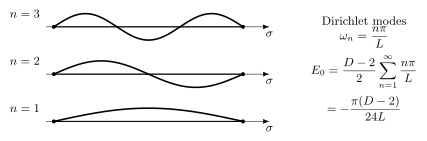
Compare equal physical length and one transverse field. A DD interval has and finite Casimir energy ; a periodic string has two modes at and finite energy . The periodic panel unwraps a circle onto an interval with identified ends. The curves show with schematic amplitudes. The same local divergent energy density has been subtracted in both cases.
These are leading quantum corrections about long strings. They do not establish the full short-string spectrum, critical dimension, or consistency of a quantum string theory. Those questions require the constraint and anomaly analysis developed later in the course.
The independent metric in the Polyakov action
Section titled “The independent metric in the Polyakov action”Introduce a Lorentzian worldsheet metric , independent of the embedding and its induced metric . With , the Polyakov action is
For a prescribed and flat target metric this action is quadratic in . The auxiliary field has no derivatives in this action, so its field equation is algebraic. It constrains the embedding instead of adding a propagating worldsheet graviton. In a curved target background , the dependence on is generally nonlinear even in the Polyakov form.
The action is invariant under worldsheet coordinate changes and, specifically in two dimensions, under local Weyl rescalings:
The two factors cancel without using any field equation. This freedom explains why the metric’s overall local scale will remain undetermined. The quantum use of the metric path integral and the role of Weyl invariance were developed by Polyakov.
Vary the embedding and the metric separately
Section titled “Vary the embedding and the metric separately”At fixed , varying gives
The bulk equation is
For an open strip, with variations fixed at the initial and final time slices, integration by parts also gives
Fixing an endpoint coordinate makes its vanish. Allowing that coordinate to vary freely instead requires the corresponding flux to vanish. The next page develops Neumann, Dirichlet, and mixed conditions systematically.
Now vary the inverse auxiliary metric. Since
we find
The expression in parentheses is the constraint tensor used in the global conventions. Thus
Its trace vanishes identically:
There are therefore two independent metric equations, rather than three. In conformal gauge these become the classical Virasoro constraints. The vanishing trace expresses classical Weyl invariance; it does not by itself rule out a quantum trace anomaly.
Removing the tension does not make unconditionally dimensionless. Its components have the same dimensions as : length squared with dimensionless worldsheet coordinates, and dimensionless with the physical static coordinates . The Hilbert tensor includes the displayed factor of ; the holomorphic CFT stress tensor has the further normalization specified in the overview.
Eliminating the auxiliary metric on the physical branch
Section titled “Eliminating the auxiliary metric on the physical branch”The equation can be written
For nondegenerate and , is nonzero. We choose the branch , so the two metrics have the same timelike directions on a solution. The metric equation then determines their conformal class; the local Weyl scale remains free.
Taking the determinant and the trace gives two useful identities:
Substituting directly into the action, without fixing the remaining Weyl scale,
The embedding equations agree as well: on this branch . The same combination multiplies both the bulk variation and its boundary term.

For a nondegenerate timelike embedding, the metric equation gives . Choosing and substituting the trace and determinant identities yields the Nambu–Goto action. This is a classical elimination of an auxiliary metric, with its Weyl scale undetermined.
The positive branch matters. If one allows , the same algebraic metric equation instead gives , the opposite-sign area action. Positive Weyl rescalings do not connect those branches. Degenerate induced metrics, null surfaces, and a tensionless limit also lie outside this elimination argument.
The classical calculation is valid without choosing a critical spacetime dimension. Equivalence of quantum path integrals requires more: a measure, gauge fixing, ghosts, and control of the Weyl anomaly. These issues are developed in the Polyakov path integral and Weyl anomaly and BRST quantization.
Common pitfalls
Section titled “Common pitfalls”Fixing the metric too early. Setting in the action makes the embedding equation free, but varying that already-restricted action cannot recover . Derive the metric equation before gauge fixing, and impose it on the gauge-fixed solutions.
Confusing coordinate period with physical length. A choice such as is a coordinate convention. The static length is a property of the embedding and must reappear when a dimensionless coordinate is converted to .
Using the open-string Casimir coefficient for a periodic string. Endpoint conditions determine the oscillator spectrum. Equal physical length does not give equal frequencies or equal oscillator multiplicities.
Extending a long-string expansion to arbitrarily short strings. The inverse-length term is reliable when the low-energy derivative expansion is controlled. A large negative correction at small signals failure of this expansion; it is not, by itself, a derivation of a short-string instability.
Exercises
Section titled “Exercises”Exercise 1: A uniformly moving straight string
Section titled “Exercise 1: A uniformly moving straight string”Consider the embedding , , , with and . Both endpoints follow the prescribed transverse motion. Compute the induced metric, the action per unit target time, the momentum conjugate to the uniform transverse position, and the energy . Check the relativistic invariant built from and .
Solution
The tangent vectors have inner products
Thus the target-time Lagrangian for this collective motion is
Differentiating with respect to and taking the Legendre transform gives
Consequently . The straight string has rest energy and transforms as an object of that mass under a transverse boost. The limit makes the induced metric degenerate and the energy diverge, even though the square-root Lagrangian tends to zero.
Exercise 2: Quantization with a dimensionless spatial coordinate
Section titled “Exercise 2: Quantization with a dimensionless spatial coordinate”Use and one canonical transverse field with DD endpoints. Expand it in and derive a canonically normalized oscillator action. Show explicitly that the frequencies remain .
Solution
Write
These functions have unit norm on . The rescaled quadratic action becomes
The coordinates do not yet have unit oscillator mass. Setting yields
This agrees with the physical-coordinate expansion because
In units where length is the basic dimension, and are dimensionless, has dimension length to the one-half power, and the frequency has dimension inverse length. Coordinate relabeling has changed neither the physical spectrum nor its normalization.
Exercise 3: A mixed-boundary Casimir energy
Section titled “Exercise 3: A mixed-boundary Casimir energy”For one massless scalar on , impose and . Determine the mode frequencies. Using the same physical cutoff as in the main text, find the finite Casimir term after subtracting the extensive divergence. Compare its sign with DD boundaries.
Solution
Dirichlet at zero selects . Neumann at then requires , so
With , use
Its negative derivative gives
Therefore
The finite term is positive. The local bulk divergence agrees with DD and periodic boundaries, while the changed spectrum changes the finite part. This example shows why specifying the number of fields alone is insufficient to determine a Casimir energy.
Exercise 4: The first nonlinear interaction
Section titled “Exercise 4: The first nonlinear interaction”For the static-gauge action, set , , and . Expand the Nambu–Goto Lagrangian density through fourth order in derivatives of . Rewrite the interaction using , and estimate the finite-size energy scale that it can produce for modes of wavelength .
Solution
The determinant is . Since are each second order in derivatives, the expansion through fourth order is
Multiplying by and collecting terms,
Thus the quartic interaction in canonical fields is
For a single transverse field, it simplifies to . The coupling has dimension length squared. After local ultraviolet contributions are renormalized, a four-derivative term on a length- background can contribute an energy of order
Relative to the quadratic Casimir scale , this is suppressed by . This is power counting, not a calculation of the coefficient; boundary interactions or additional fields require their own analysis.
Exercise 5: Why the free wave equation is not enough
Section titled “Exercise 5: Why the free wave equation is not enough”Use dimensionless coordinates and fix . For a constant length , consider
Show that the embedding satisfies the free wave equation but not the Polyakov metric constraint with this chosen . Explain what this does, and does not, say about the geometric surface.
Solution
All second derivatives vanish, so . However,
It follows that
The trace is zero, as it must be, but the tensor is not zero. The pair is therefore not a Polyakov solution.
The embedded surface is nevertheless an ordinary straight timelike plane. Taking instead gives and satisfies the constraint. Equivalently, rescaling the time coordinate puts this metric in the standard flat form while changing the coordinate expression for . What failed was the simultaneous choice of the displayed embedding and the initially fixed metric, not the geometry of the surface. Varying an action after discarding would fail to detect this incompatibility.
Exercise 6: The sign branch of the metric equation
Section titled “Exercise 6: The sign branch of the metric equation”Use physical coordinates and a straight induced metric . Evaluate and the Polyakov action density for both and . More generally, show what happens for with nonzero real . Can a real Weyl transformation connect the two signs?
Solution
For , the contraction is and . Thus and . For , the contraction is while is still one. Again , but now .
For the general proportionality relation,
so
The usual Nambu–Goto action follows from . A real Weyl transformation multiplies by and cannot reverse its sign. The branch restriction is therefore substantive, even though both two-by-two matrices have one positive and one negative eigenvalue. The case would make degenerate and is excluded from this argument.
References
Section titled “References”- Aharony, Ofer, and Matan Field. “On the Effective Theory of Long Open Strings.” Journal of High Energy Physics 2011, no. 1 (2011), 065. doi:10.1007/JHEP01(2011)065; arXiv:1008.2636. Sections 1–2 explain the long-string expansion and the role of boundary conditions.
- Lüscher, Martin, Kurt Symanzik, and Peter Weisz. “Anomalies of the Free Loop Wave Equation in the WKB Approximation.” Nuclear Physics B 173, no. 3 (1980), 365–396. doi:10.1016/0550-3213(80)90009-7. Original analysis underlying the universal long-string energy correction.
- Polyakov, Alexander M. “Quantum Geometry of Bosonic Strings.” Physics Letters B 103, no. 3 (1981), 207–210. doi:10.1016/0370-2693(81)90743-7. Foundational metric-path-integral treatment and Weyl-anomaly analysis.
- Tong, David. Lectures on String Theory. University of Cambridge lecture notes, 2009. arXiv:0908.0333; author-hosted text. Sections 1.2–1.3 cover the Nambu–Goto and Polyakov descriptions and their classical symmetries.