
The Superconformal Algebra and NS/R Sectors
The same local superconformal OPEs describe two different state spaces. Neveu–Schwarz fermions have half-integer oscillator frequencies; Ramond fermions have integer frequencies and Clifford zero modes. Understanding how these sectors share one algebra requires distinguishing three quantities: a conformal weight on the plane, an energy on the cylinder, and a physical string intercept.
This page develops that distinction from the current OPEs through oscillator representations and explicit states. We use the shared canonical fermions and arbitrary , together with the ordering prescriptions in the overview. The previous page derives the currents and their Wick contractions. Here denotes the supercurrent also called .
We first discuss one holomorphic matter sector. A closed string has an antiholomorphic copy; an open string with reflecting boundary conditions can be described by one doubled chiral theory. A superconformal representation is not yet a physical string spectrum: the constraints, ghosts, and choice of projection on states still have to be included.
Current OPEs become a mode algebra
Section titled “Current OPEs become a mode algebra”The local input is
For free coordinate multiplets, consisting of one boson and one Majorana fermion per coordinate,
The alternative notation then gives . The formulas below use , the ordinary Virasoro central charge.
The Laurent expansions and their inverse contour integrals are
Contours are counterclockwise. Products of odd currents lead to anticommutators. The allowed lattice of depends on the sector, but the contour calculation itself is local.
For example, the cubic pole in contributes to the inner contour
The outer contour multiplies by and gives . The simple pole gives . This explains both the central term and its otherwise unexpected subtraction .
In the calculation, the double pole contributes , while integrating the simple-pole derivative by parts contributes . Their sum is . The fourth-order pole in similarly gives . Together,
This is the plane super-Virasoro algebra. The central terms follow from short-distance singularities; they do not disappear because the underlying matter fields are free.
Spin structure determines the oscillator lattice
Section titled “Spin structure determines the oscillator lattice”On the cylinder , with , the two spin structures are
A mode gains the phase . Hence in the Neveu–Schwarz sector and in the Ramond sector. These are the sectors originating in the constructions of Neveu and Schwarz and Ramond.
The bosonic derivative is periodic and has integer modes. The coordinate itself is periodic for a noncompact target coordinate with no winding; a compact coordinate may instead shift by its winding period around the spatial circle. This does not change the integer moding of .
Under , a weight- fermion transforms as
The Jacobian changes sign after one turn. Thus cylinder antiperiodicity in NS becomes single-valuedness on the plane, whereas cylinder periodicity in R becomes a sign change around a Ramond insertion. The location of a drawn branch cut is a choice; the monodromy around its endpoint is the physical information.
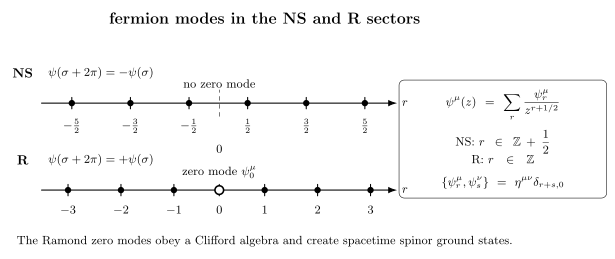
NS modes lie halfway between the integers and have no zero mode. R modes include zero, where the fermions act on a spinor ground-state space. The square-root Jacobian in reverses the cylinder sign when expressed in the plane spin frame. The lattice spacing is one in the dimensionless frequency ; the diagram does not represent spacetime energy levels.
The fields have expansions
Their OPEs imply
For instance, the two fermion contours leave the integral . The canonical normalization of is what makes its coefficient one. Bosonic and fermionic oscillators commute with each other.
A sector Fock ground state is annihilated by and for positive . Negative modes create excitations. The zero modes are different: records momentum, while exists only in R and acts within a degenerate ground-state space.
Current modes and the ordering constant
Section titled “Current modes and the ordering constant”Substituting the field expansions into the shared current makes the two square-root coefficients cancel:
There is no mixed boson–fermion contraction to subtract here. In the stress tensor, the bosonic contribution is the usual quadratic oscillator expression. Differentiating in the fermionic contribution first gives a coefficient . Antisymmetrizing the two fermions at fixed replaces it by . The coefficient symmetric under their exchange drops out.
To make the finite vacuum term explicit, write for ordering with positive-frequency annihilation operators to the right in the chosen sector. Ramond zero modes remain Clifford operators; they are not assigned to the annihilation modes. This is not the unmarked local plane OPE ordering. Define the oscillator bilinear
This is a convenient representation of the operator, but it is not yet the plane generator in every sector. The relation is
The Ramond value will be derived below. It is required by plane point splitting and by the plane super-Virasoro algebra. Calling the bilinear alone the plane would silently lose that finite term.
Let denote the dimensionless eigenvalue of . For a closed string in a noncompact direction, . The doubled open-string convention instead gives . These are the zero-mode factors already encountered in the bosonic theory; the oscillator formulas do not require a new choice of .
At , combining positive and negative frequencies gives
For example, a bosonic oscillator raises by , and a fermionic oscillator raises it by . The factor of in the bosonic number is already contained in .
The occupation levels above either vacuum are nonnegative. This does not make the covariant matter inner product positive: a timelike oscillator can have negative norm. Representation-theoretic positivity statements below will be restricted explicitly to unitary Hilbert spaces. The covariant construction and its normal ordering are also developed in Weigand’s lectures, sections 6.3–6.4.
The cylinder shift changes the central polynomials
Section titled “The cylinder shift changes the central polynomials”The fermion and supercurrent are primary fields of weights and . The stress tensor has an anomalous transformation law because its OPE with itself has a fourth-order pole:
For , all ratios in the Schwarzian are one, so . It follows that
Expanding in cylinder Fourier modes defines the energy generators
The supercurrent has the same coefficients on plane and cylinder. Only the bosonic zero mode shifts.
Substitute into the plane algebra. In the Virasoro commutator, the linear-in- term from the zero-mode shift cancels the in . In the odd anticommutator, it cancels the constant . Therefore
These are the same operators written with a different energy origin. In particular,
The cylinder and plane formulas must not be mixed. The central polynomials differ precisely because the stress tensor is not a primary field.
Highest-weight states and the NS vacuum
Section titled “Highest-weight states and the NS vacuum”An NS superconformal primary state obeys
Negative modes raise the weight because and . In particular, the first possible superpartner is
when this vector is nonzero. Since , applying this odd mode twice gives a translation descendant.
The partner is a Virasoro primary:
It is generally not a superconformal primary, since
For and , its norm is
A positive-norm unitary representation therefore has ; at the partner is removed as a null vector. The covariant Lorentzian matter Fock space is not such a unitary space before the string constraints are imposed.
An explicit free-field multiplet
Section titled “An explicit free-field multiplet”The NS Fock state with no nonzero oscillators is a superconformal primary of weight . Using the oscillator expression for ,
At zero momentum the first vector vanishes. For another useful example, take . Then
All higher positive supercurrent modes annihilate this one-oscillator state. Thus makes it a superconformal primary, of weight . This is an algebraic transversality condition; the complete physical-state and mass-shell conditions are still needed to interpret the state as a spacetime particle.
Why the identity vacuum is globally invariant
Section titled “Why the identity vacuum is globally invariant”For the identity state , regularity at the origin gives stronger conditions than highest weight:
Indeed, a nonzero term with in or with in would create a pole at a point with no operator insertion.
The five generators close without a central term. They form the global algebra, and the identity vacuum is invariant under all five. This regularity argument does not require a positivity assumption for each covariant matter state.
On the cylinder the same vacuum has . This negative Casimir energy does not violate NS unitarity: the NS bound concerns plane , and there is no NS mode whose square would equal .
Ramond zero modes and the free ground-state weight
Section titled “Ramond zero modes and the free ground-state weight”A Ramond highest-weight space is annihilated by and , but it carries an action of . In the free theory the fermionic zero modes obey
Thus zero modes act as gamma matrices on a spinor ground-state space. They are not independent creation operators. In even , an irreducible complex representation of the full Clifford algebra has components. In ten dimensions this is a 32-component Dirac space, which splits into two 16-component Weyl spaces under the Lorentz generators. Reality conditions, the physical constraints, and the GSO choice must still be applied before counting physical superstring polarizations.
On a Fock ground state , labeled by a spinor , all nonzero modes in annihilate the state. Therefore
Comparing this with fixes
For the free coordinate multiplets, . At zero momentum this derives the constant in the plane oscillator formula.
Point splitting checks the finite shift
Section titled “Point splitting checks the finite shift”The same constant can be found without using the supercurrent algebra. For one real fermion, the symmetric Ramond ground-state contraction on the plane is
The positive integer modes give a geometric series, and gives its constant term. For a diagonal component in an orthonormal target basis, this is the relevant scalar kernel; the two-point function includes the corresponding metric sign. Spin-dependent antisymmetric zero-mode expectations do not enter the trace defining .
Write . Expanding near coincidence gives
In the expectation of , the derivative acts on the second insertion before taking the coincident limit:
Thus each real fermion supplies plane weight , and the zero-momentum bosons supply zero. The result also follows from the cylinder-kernel calculation on the previous page.
Notice that uses the central charge of the full boson–fermion system. It is not , since .
A bound does not guarantee saturation
Section titled “A bound does not guarantee saturation”For a positive-norm unitary Ramond representation, implies
Equality holds precisely when . The algebra and unitarity do not guarantee that a state attaining equality exists. The free zero-momentum vacuum saturates the bound by the explicit calculation above.
For a concrete contrast, the unitary tricritical Ising superconformal theory has and lowest Ramond weight , which is greater than . This example and the representation-theoretic distinction were established by Friedan, Qiu, and Shenker. In the covariant RNS matter theory, the algebraic free-vacuum weight remains correct, but its indefinite target-time inner product precludes applying the positive-norm proof indiscriminately.
Compare plane weights, cylinder energies, and string intercepts
Section titled “Compare plane weights, cylinder energies, and string intercepts”At zero momentum the free matter vacua have
| Quantity for one chiral sector of coordinate multiplets | NS | R |
|---|---|---|
| Plane vacuum weight | ||
| Cylinder vacuum energy |
The Ramond spin field creates a state of nonzero plane weight while the corresponding cylinder ground state has zero energy. This is a coordinate-dependent energy shift, not a disappearance of the spin field’s scaling dimension.
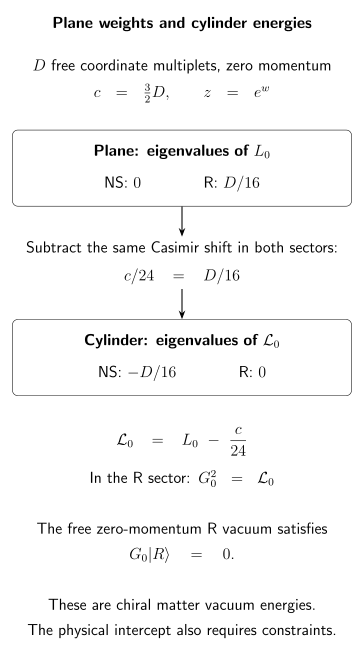
For free coordinate multiplets at zero momentum, both sectors undergo the same shift . The resulting cylinder energies are in NS and zero in R. In R, uses this cylinder generator. These are chiral matter quantities; physical string intercepts require the transverse or equivalent constrained theory. The comparison is schematic, not an energy-axis plot.
After the light-cone constraints remove the two longitudinal multiplets, replace by the number of transverse directions . The physical intercept is minus the transverse cylinder vacuum energy. At critical ,
This is not a prescription to insert into a covariant mass formula as its intercept. The transverse reduction and the criticality conditions are essential; exercise 5 checks the zero-point energies directly.
For closed strings, the two chiral sectors can be combined as NS–NS, NS–R, R–NS, or R–R. Tensor representations arise from NS–NS and R–R, while the mixed sectors carry spacetime spinors. A consistent projection and left–right pairing must still be chosen. The supersymmetric choices and the physical spectrum are the subject of the next page.
Exercises
Section titled “Exercises”1. How the currents act on individual oscillators
Section titled “1. How the currents act on individual oscillators”Starting from the oscillator bilinears, derive , , , and . Use them to verify the levels and the transversality condition for .
Solution
The scalar ordering term in commutes with every oscillator, so it does not enter these calculations. In the bosonic bilinear, contracting either oscillator against gives the same contribution. The factor cancels their multiplicity:
For an even product of two odd operators, use
The two contractions in the fermionic bilinear then give
The remaining two relations follow from the mixed bilinear :
For the second identity the bosonic oscillator commutes past , and the fermion anticommutator selects the single term with bosonic index .
Setting verifies that raises the weight by and by . Furthermore,
For , the selected is a positive mode and annihilates the ground state. Positive also annihilate the state, because they produce a positive fermion mode. Thus is exactly the additional superprimary condition at this level. Its norm is proportional to ; a covariant timelike polarization would have negative norm, illustrating why superprimary and physical positive-norm state are different notions.
2. A level-three-halves Gram matrix and a null state
Section titled “2. A level-three-halves Gram matrix and a null state”Let be a normalized NS superconformal primary. At level , use the ordered basis
Compute its Gram matrix and determinant. At , , find the singular vector. Then realize in a single free spacelike coordinate multiplet at zero momentum and check that the singular vector has zero image in this Fock module.
Solution
The first norm follows directly from the odd anticommutator:
For the off-diagonal entry, commute past . The commutator is , and the remaining positive modes annihilate . Therefore
The state is a Virasoro primary of weight and norm . Its descendant has norm times that norm. Thus
and
At , , every matrix entry is , so
has zero norm and is orthogonal to the level- space. It is also annihilated by the positive modes. In particular,
Higher positive modes vanish by the highest-weight conditions and the grading. The vector is therefore a singular vector in the abstract Verma module. The irreducible module removes it and its descendants.
Now use one free spacelike boson and fermion. At zero momentum,
Also,
Here , so the second term is zero because . Both descendants equal . The abstract singular vector thus maps to the zero vector in this free-field representation.
3. Ramond doublets and the saturation condition
Section titled “3. Ramond doublets and the saturation condition”Consider a positive-norm Ramond representation with a fermion-parity operator , satisfying , , and . For a normalized highest-weight state with and weight , construct its partner and the matrices representing and on the pair. Explain what changes at and whether the algebra fixes the number of ground states there.
Solution
Put . Define
The zero-mode identity gives , and fermion parity makes the two states orthogonal. Since , their weights agree. Positive modes also annihilate the partner:
Moreover, . In the basis ,
Thus positive cylinder energy occurs in opposite-parity pairs. Such a pair contributes zero to a fermion-parity weighted count of states at the same energy.
At , positivity implies for every vector in that eigenspace. The normalization used above is then unavailable: there is no nonzero partner generated by . The algebra allows unpaired states, but does not determine their number or their parities, and does not require a saturating state to exist.
In a free zero-momentum RNS ground space, on every ground state even though the individual act nontrivially as Clifford generators. There is no contradiction: is the contraction there, not an individual Clifford generator. The positive-norm reasoning applies directly to a spacelike or transverse unitary matter system, not to the unconstrained Lorentzian covariant Fock space.
4. Finite circumference and coordinate-independent norms
Section titled “4. Finite circumference and coordinate-independent norms”Consider a two-dimensional CFT cylinder of spatial circumference , with propagation speed one, using . Derive the Hamiltonian for two chiral sectors of equal central charge . Then check that the norm of , , is unchanged when calculated with plane or cylinder generators. Contrast it with the norm above a free Ramond ground state of plane weight .
Solution
Write . The Schwarzian is , so
Radial evolution by corresponds to cylinder time evolution by . The Hamiltonian and spatial momentum are therefore
The factor converts dimensionless mode eigenvalues to inverse-length energy units. These are worldsheet CFT energies and momenta, not target-space string energies.
For the NS–NS identity vacuum, . For two free Ramond vacua, each with , the total vacuum energy is zero. The same subtraction is present in both sectors.
For one chiral NS vacuum, the plane calculation gives
For , . In cylinder language,
The nonzero vacuum energy compensates for the changed central polynomial. In particular the descendant remains null.
For a normalized free Ramond ground state, the plane weight is and the cylinder energy is zero. Hence either calculation gives
The different norm is a property of the state, not a coordinate artifact. Changing coordinates changes both the zero-mode eigenvalue and the displayed central term together.
5. Regulate the transverse zero-point energies
Section titled “5. Regulate the transverse zero-point energies”For one free spacelike boson–fermion pair, regulate each positive oscillator frequency with the same factor . Compute the finite parts of
Obtain the NS and R intercepts for the eight transverse multiplets of a critical superstring. Explain why neither the critical dimension nor spacetime supersymmetry follows from this sum alone.
Solution
The boson sum is a derivative of a geometric series:
In the NS sector,
Taking minus its derivative gives the frequency-weighted sum. Thus
The divergent terms cancel within the pair, leaving
In R the positive fermion frequencies are the same integers as the boson frequencies, so exactly. Zero-frequency Clifford modes contribute degeneracy but no zero-point energy. Therefore .
After the longitudinal constraints are solved, eight transverse pairs give
The open-string mass equations then take the form
The unprojected NS ground state is still tachyonic; the first fermionic excitation has and is massless. The Ramond ground state is massless. Selecting the supersymmetric spectrum requires the appropriate GSO projection and physical constraints.
The calculation assumed eight transverse multiplets rather than proving that number. Criticality requires anomaly cancellation or quantum Lorentz consistency. Nor does cancellation of the R zero-point energy by itself establish a spacetime supercharge relating the physical NS and R states.
6. A finite Fock-space check of the Ramond ordering term
Section titled “6. A finite Fock-space check of the Ramond ordering term”Use one real spacelike fermion and its oscillator bilinear to compute for positive integer , separately in NS and R. Write the state as a finite sum of two-fermion creation states, treating the R zero mode separately. Compare with the Virasoro algebra at , and then add one boson to recover the full free-multiplet result.
Solution
For , only terms with two nonpositive frequencies survive on the vacuum. Pairing terms related by fermion exchange gives
The would-be equal-frequency term at vanishes, both by its coefficient and by . Each positive-frequency pair has unit norm. Distinct pairs are orthogonal. In R, the final state has norm because .
It follows that
These sums are finite. For example, if , the NS sum is , while the R sum is . If , the NS sum is ; the R sum is . All four expressions reduce to the two displayed polynomials.
For a Virasoro highest-weight state, the same norm must equal
With , the NS result gives . The R result instead requires . Omitting the R zero-mode contribution would give the wrong polynomial; omitting the plane constant would also disagree with the finite Fock calculation.
A zero-momentum boson adds in both sectors. Thus one complete multiplet has
Since for the pair, these agree with the plane/cylinder state-norm comparison in exercise 4. This independent check uses finite oscillator states, without assigning a value to an infinite vacuum sum.
References
Section titled “References”- Friedan, Daniel, Zongan Qiu, and Stephen Shenker. “Superconformal invariance in two dimensions and the tricritical Ising model.” Physics Letters B 151, no. 1 (1985): 37–43. doi:10.1016/0370-2693(85)90819-6.
- Neveu, André, and John H. Schwarz. “Factorizable dual model of pions.” Nuclear Physics B 31, no. 1 (1971): 86–112. doi:10.1016/0550-3213(71)90448-2.
- Ramond, Pierre. “Dual Theory for Free Fermions.” Physical Review D 3, no. 10 (1971): 2415–2418. doi:10.1103/PhysRevD.3.2415.
- Weigand, Timo. Introduction to String Theory. Lecture notes, Universität Heidelberg, winter term 2011/12, sections 6.3–6.4. Author’s PDF.