
Tree Amplitudes, Chan–Paton Factors, and Gauge Theory from Open Strings
An open-string tree amplitude is an integral over the positions of vertex operators on a disk boundary. Collisions of adjacent insertions produce poles corresponding to intermediate string states. Endpoint labels multiply in boundary order and become color traces. Together, these two facts explain how a single string construction produces both nonabelian gauge interactions and their massive completion.
We will compute the vector and gaugino cubic interactions, derive a four-fermion amplitude and its gauge-exchange poles, and compare the result with the bosonic Veneziano amplitude. At four massless points the ordered superstring amplitude equals its super Yang–Mills counterpart times a scalar beta-function factor. This particularly simple statement does not extend unchanged to arbitrary multiplicity.
The shared spacetime and worldsheet normalization and previous page’s physical vertices apply. We use physical boundary momentum, so , and the shared matrix normalization . External momenta are incoming. Common momentum delta functions, disk normalization constants, and an overall consistent vertex phase will usually be suppressed. Relative signs, powers of , color order, and pole locations will be kept explicit. The superstring examples concern the flat ten-dimensional massless gauge multiplet; dimensional reduction to D-branes follows the preceding page.
Ordered punctures and factorization channels
Section titled “Ordered punctures and factorization channels”Mapping the disk to the upper half-plane puts open-string insertions on the real axis. Its three real conformal Killing parameters form . For four external states with cyclic order , fix
There is one real modulus. The three fixed vertices supply three ghosts; the remaining vertex is an integrated density. For superstrings, total disk picture must also be . These are independent requirements.
The universal plane-wave correlator is
For massless external particles define and . The finite-position dependence of this factor is . The remaining matter and ghost contractions determine additional powers and a polarization numerator.
As , the adjacent vertices 1 and 2 fuse and a long strip carries momentum . As , vertices 2 and 3 fuse and the strip carries . These are two degeneration limits of the same ordered disk, not two copies of the disk amplitude to add. A nonadjacent pair such as does not define an independent boundary of this ordering domain; its channel appears in other orderings.
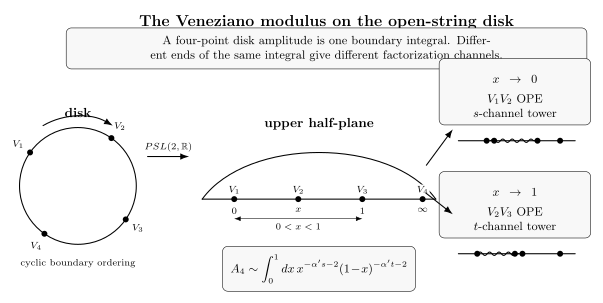
The ordering has . Its endpoint limits carry and , with and . The degenerating strip is schematic. Both limits belong to one integral; external reordering changes its integration domain, not its worldsheet genus.
The beta integral and a tower of exchanged states
Section titled “The beta integral and a tower of exchanged states”A useful comparison is the critical bosonic open string, where the ground state is a tachyon with . This is a separate bosonic example, not an external state retained by the supersymmetric GSO projection.
Its boundary density is , of weight one. Fixing punctures 1, 3, and 4 gives . To handle infinity, first put and take . The plane-wave factors involving leg 4 scale as
The ghost correlator grows as , so the full limit is finite. The remaining exponents follow from the on-shell conditions:
Introduce the dimensionless invariants and . The ordered amplitude is proportional to
The integral converges initially for and . The gamma-function expression defines its meromorphic continuation to scattering kinematics. A divergent real integral outside that initial domain is not itself the prescription. This beta-function structure is the central construction of Veneziano.
Expanding near the -channel endpoint gives a direct interpretation of the poles:
first where the interchange of sum and integral converges. The Pochhammer symbol is , with . The poles occur at
The degree- residue is consistent with exchange of finitely many spins up to the leading spin at that level. Special values of can make a residue vanish. A residue with respect to physical has an additional factor . Exercise 1 derives the result directly from gamma functions and shows why two overlapping channel limits do not produce a double propagator pole.
Endpoint matrices become color traces
Section titled “Endpoint matrices become color traces”Let an oriented string carry a fundamental endpoint space and a dual endpoint space . Its internal wavefunction is an endomorphism,
A unitary change of endpoint basis acts as . The Hermitian gauge-field generators span , already including its central :
The one-particle coefficients may be complex even though a real spacetime gauge field is expanded in Hermitian generators. For a stack of coincident oriented D-branes, the labels identify the branes on which the endpoints lie. Historically, the fundamental/antifundamental pattern was motivated by meson flavor labels; the trace prescription originated with Paton and Chan.
On a disk, successive boundary insertions join endpoint indices. The sum around the closed boundary is
Cyclically choosing a different starting point leaves the trace unchanged. Reversing the order generally gives a different trace. Every such external ordering is still a disk.
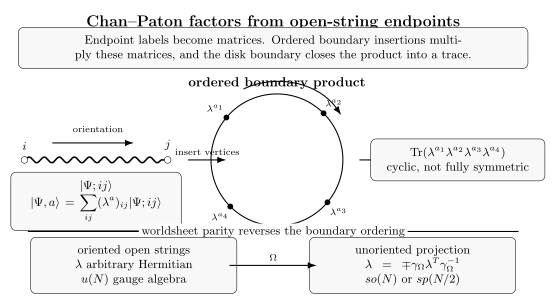
The ordered index chain closes into . Cyclic changes of the starting point preserve the trace; reversal changes the matrix order and must be accompanied by the corresponding kinematic and, for fermions, statistics signs. The arrows denote index order.
For bosonic external states the tree color decomposition takes the form
Here is the partial amplitude for that cyclic ordering, with the coupling removed. The disk contributes and external vertices contribute , giving the indicated power. With external fermions, the same trace organization applies, but each partial amplitude must include the sign needed to express its fermion operators in one fixed external ordering.
Reversal and the vector cubic coupling
Section titled “Reversal and the vector cubic coupling”The three-vector calculation on the preceding page used two complete picture- vertices and the complete . Only the term saturates the three zero modes in that particular correlator.
Up to a common normalization, the result is
It is cyclic and changes sign under exchanging legs 1 and 2. Adding the two inequivalent cyclic orientations therefore gives
With the shared generator normalization and ,
This is the Yang–Mills color tensor, derived together with its momentum and polarization structure. In particular, a central generator commutes with everything and has no Yang–Mills cubic self-coupling. This does not imply that finite- Abelian four-point amplitudes vanish.
The bosonic three-vector correlator also permits a term cubic in momenta, associated with an interaction. The RNS superstring result above has only the Yang–Mills three-vector structure. The absence of that extra term is consistent with the first superstring corrections starting at order in the four-point derivative expansion.
Two Ramond fermions and one vector
Section titled “Two Ramond fermions and one vector”The Ramond vertex carries more information than its conformal weight: it must generate the spinor current appearing in the gaugino interaction. Take two picture- vertices and one picture- vector,
Each is unintegrated. Total picture is , and there are three insertions. The polarization columns obey and have the chosen common Weyl chirality. We retain the state–operator and charge-conjugation notation: the invariant bilinear is
The transpose here is not Hermitian conjugation. Amplitude polarizations may be complex; Majorana reality is imposed on the corresponding spacetime field, not separately on every complex momentum-space coefficient.
The position dependence cancels
Section titled “The position dependence cancels”Conformal covariance fixes the powers in the spin correlator. With and , and with the usual spin-field normalization compatible with ,
A common branch and cocycle phase is understood for the chosen ordering. The superghost and reparametrization-ghost factors are
All powers cancel. The plane-wave factor is also position independent because on-shell three-point momentum conservation gives . Thus
This calculation is an example of the spin-field correlator methods developed in Friedan, Martinec, and Shenker, section 5.4.
The Ward identity follows directly from the two Dirac equations:
As for three vectors, nonzero massless three-point kinematics is understood analytically, for example with complex momenta.
Spinor symmetry and the color commutator
Section titled “Spinor symmetry and the color commutator”In ten dimensions is antisymmetric and is symmetric. For commuting polarization columns, therefore, . A minus sign under exchange of the two external fermions comes from Fermi statistics, not from this numerical bilinear.
Fix an external fermion order once. The two boundary orientations then contribute the same current with opposite signs after expressing both in that order. Their color sum is
Equivalently, if the polarization parameters are treated as Grassmann odd, the bilinear itself is antisymmetric under exchanging the two labeled parameters, and one must not insert that statistics sign a second time. Either description gives the adjoint gaugino coupling with covariant derivative .
The same-chirality selection can also be checked without bosonization. Since and anticommutes with , the bilinear satisfies . A vector current can therefore be nonzero for equal Weyl chiralities. The spinor charge-conjugation matrix is distinct from the worldsheet orientation-reversal operator discussed below.
Four fermions: a full ordered amplitude
Section titled “Four fermions: a full ordered amplitude”Four Ramond vertices may all be placed in picture , so their total picture is already . Fix three punctures and integrate the fourth. No separate picture-changing insertion is needed.
Write
For four commuting polarization columns of the same ten-dimensional chirality, the Fierz identity is
Only two of these vector-bilinear contractions are independent. The spin-field correlator, with the same overall phase choice as above, is
This is the genus-zero specialization of Härtl and Schlotterer, equation (6.1), translated into the invariant bilinears above. It includes both independent spin contractions.
Several checks explain its form. Each numerator term contains each insertion coordinate once, so the weight at every point is . Its singularity has the vector-channel power , while the Fierz identity relates the other pairings. Direct bosonized charge correlators fix the relative terms and normalization; Exercise 2 verifies a nontrivial component.
Multiplying by four insertions adds . The dressed correlator therefore has the rational denominator . Setting and multiplying the three- factor at , the limit gives
The displayed overall minus can be absorbed into the common disk amplitude phase. The relative minus cannot. Including the massless plane-wave factor, the ordered amplitude is consequently proportional to
The letter without arguments denotes the spinor contraction; denotes Euler’s beta function. The two integrals converge together for and , and are then continued meromorphically.
Define
The identities
give the complete result
After absorbing a common coupling and external-state normalization, this is the ordered super Yang–Mills four-gaugino amplitude multiplied by . Both adjacent massless channels are present, together with the massive superstring poles. Keeping only a single spin contraction would not determine the full amplitude or its relative channel sign.
The massless pole is gauge exchange
Section titled “The massless pole is gauge exchange”The dressed Ramond densities have the leading fusion
up to the fixed ordering phase. The exponent combines the spin-field power , the superghost power , and the plane-wave power . Integrating the leading term near zero produces after continuation. This is precisely the massless pole of , because :
At the pole, and both currents are conserved, . A sum over the eight physical vector polarizations therefore reduces to ; the gauge-dependent terms in the polarization completeness relation drop out. The residue is the product of the two cubic fermion–fermion–vector couplings. Exercise 3 checks this factorization and its color sum explicitly.
The massless four-point form factor and low energy
Section titled “The massless four-point form factor and low energy”The four-vector calculation gives the same scalar function:
Here the Yang–Mills partial amplitude contains its massless poles and polarization numerator. The gamma ratio supplies the massive poles and contact corrections. The result holds for the massless four-point supermultiplet; the four-fermion derivation above is one component check. It is also the four-point case of the general disk-amplitude organization in Mafra, Schlotterer, and Stieberger, equations (1.1)–(1.2). At higher multiplicity, a basis of Yang–Mills partial amplitudes is multiplied by several disk integrals. There is generally no single universal scalar multiplier for an arbitrary -point amplitude.
The low-energy expansion follows from the convergent local series for :
The linear terms cancel. Since the logarithm begins at degree two, exponentiating does not change the displayed terms:
with fixed. The first correction to the four-vector action is of type, accompanied by its supersymmetric completion. Exercise 5 derives the next order and shows why the Abelian amplitude survives even though the Yang–Mills Abelian cubic coupling vanishes.
To state the derivative expansion with consistent units, use the shared connection normalization,
The matrix trace gives the component coefficient . In ten dimensions , , and . Schematically, the disk effective action has the structure
The gaugino term includes its kinetic operator with the covariant derivative above. The local invariants have dimensions ; includes the appropriate contractions and fermions. Each term inside brackets has dimension . The symbols do not specify all tensor, color, or higher-field completions; amplitudes determine those up to field redefinitions.
For , the massive poles are far away and the leading disk amplitudes reduce to super Yang–Mills. This is a statement about low-energy amplitudes at fixed perturbative order. It does not by itself construct a complete ten-dimensional quantum decoupling limit: the scaling of , the dimensionful gauge coupling, gravity, and loop corrections must also be considered. On D-branes the corresponding leading field theory is dimensionally reduced super Yang–Mills.
Orientation reversal acts on endpoint labels
Section titled “Orientation reversal acts on endpoint labels”Spinor charge conjugation and worldsheet orientation reversal are different operations. The latter exchanges the string’s endpoints and acts on Chan–Paton matrices by transposition, possibly conjugated by a matrix :
The intrinsic oscillator sign depends on the state. For a gauge boson with the standard orthogonal choice , the surviving wavefunctions satisfy .
For Hermitian gauge-field generators this means imaginary antisymmetric matrices. Multiplying them by gives the real antisymmetric representation of the compact Lie algebra . Over arbitrary complex one-particle coefficients, the same transpose equation describes its complexification. A symplectic choice instead produces a compact symplectic algebra, with an even-dimensional fundamental space.
These algebraic projections do not alone prove global string consistency. In the type I theory, the familiar condition comes from additional one-loop and tadpole constraints, developed on the orientifold page. One should not infer it just from the disk commutator.
Color factors, topology, and the large-N expansion
Section titled “Color factors, topology, and the large-N expansion”The two lines of an adjoint propagator carry a fundamental and a dual color index. Summing a closed index loop produces a factor . This connects color combinatorics to surfaces, but a permutation of external legs is not a change of topology.
For an orientable worldsheet with handles and boundaries,
For a vacuum diagram in which each boundary carries a summed Chan–Paton identity, its color factor is . Introducing the dimensionless combination gives
At fixed , each additional handle costs . At fixed genus, adding an identity boundary changes the power of , not the displayed power of . Boundaries with prescribed external matrices carry traces instead of an automatic factor ; their scaling depends on how the external states are normalized.
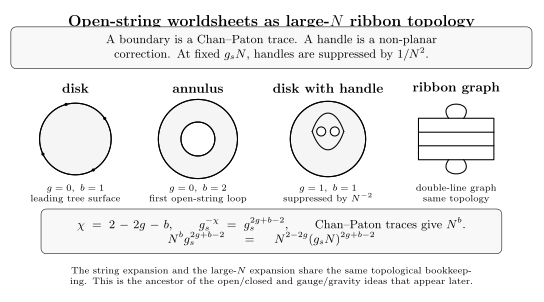
The weights assume orientable vacuum diagrams and a Chan–Paton identity summed on each boundary. The variables and count handles and boundaries; is dimensionless. External color traces require their own normalization. Topology is specified by the surface or gluing data, not by crossing external labels in a drawing.
For example, a disk has , an annulus , and a once-punctured torus . The annulus is the planar open-string one-loop surface; a handle is an additional possible source of open-string loop order. For connected orientable open vacuum surfaces, that order is , so . Adding boundaries alone describes only the planar sequence.
The corresponding gauge-theory counting can be derived directly. With a matrix action normalized as , a propagator contributes , a vertex , and each closed color face . A connected vacuum ribbon graph has
Here can be dimensionful; in ten dimensions it has units and is not identical to . The topology organizes powers of even when momentum integrals carry additional scales. This is the reasoning behind ’t Hooft’s planar expansion.
The historical meson picture uses a related but distinct count: a fundamental quark loop has a color factor , and a normalized meson operator contains . A leading connected -meson amplitude scales as . Additional quark loops at fixed flavor number are suppressed by , unlike an identity Chan–Paton boundary with . Exercise 6 makes these assumptions explicit.
Exercises
Section titled “Exercises”Exercise 1: pole residues and overlapping channels
Section titled “Exercise 1: pole residues and overlapping channels”Derive the residue of at directly from the gamma-function expression. Write the first three residues and convert them to residues in physical . Then approach simultaneously and , with nonnegative integers. Show that the leading singularity contains simple channel poles but no term.
Solution
Near a nonpositive integer, . Here , so
The ratio is a product of factors:
The signs combine to give the residue in the text. For the results are
Since , the physical- residue is each expression divided by . At isolated values of the polynomial can vanish, canceling that pole in this kinematic slice.
For the simultaneous limit, the numerator gives
The reciprocal denominator vanishes linearly:
Hence the leading expression is
There is no product of two propagator poles. The two endpoints correspond to overlapping channels of a four-point tree: neither endpoint can simultaneously be the other endpoint of the same modulus. The meromorphic function encodes this through the zero in the reciprocal gamma function.
Exercise 2: a bosonized component of the four-spin correlator
Section titled “Exercise 2: a bosonized component of the four-spin correlator”Use five bosons with and spin fields . Consider the four weights
Verify equal chirality and charge neutrality. Compute the position dependence of their correlator and explain how it tests the relative sign in the covariant four-spin formula. Keep the overall cocycle phase separate.
Solution
The four weights contain respectively zero, four, two, and four minus signs, so all belong to the same chiral spinor representation. Their sum vanishes coordinate by coordinate. The bosonic charge correlator is therefore nonzero and has the form
The pair exponents are
Thus
The identity rewrites the numerator in the two structures used in the text.
The pair cannot fuse to a single vector fermion, whose bosonized charge has only one nonzero component. Therefore the vector contraction vanishes for this component. The Fierz identity then gives , and the covariant numerator becomes
The normalization and match after choosing the same spin-field basis; with the displayed factor , this component has . Replacing the relative minus in the covariant formula by a plus would give a difference of the two products and would fail this direct free-field test. Charge exponents alone do not determine all cocycle phases, so they should not be used to change the independent fermion-ordering convention.
Exercise 3: sewing the four-fermion gauge pole
Section titled “Exercise 3: sewing the four-fermion gauge pole”At the -channel pole, prove that the two currents and are transverse to . Use a physical polarization sum to recover the residue of the ordered four-fermion amplitude. Then sum the intermediate color index of the full color-dressed cubic couplings and express the result as a trace of two commutators.
Solution
The Dirac equations and imply
For the second current, gives the same result. These conservation statements hold before setting ; the pole additionally puts the exchanged particle on shell.
At , choose a null with . The eight transverse vector polarizations have completeness tensor
Consequently
The reference-vector terms drop out. Multiplying the two cubic currents and the propagator therefore gives the numerator of the pole. With the dimensionless integral normalization in the text, ; at the other endpoint, . These relative signs agree with the complete two-beta-function result, while a common scattering-amplitude phase remains conventional.
For the color sum, an orthonormal Hermitian basis of obeys
Taking and gives
The same result holds when the sum is restricted to , since the subtracted term is . Thus the central does not mediate this Yang–Mills gauge pole. Restoring the conventional cubic factors converts this expression into the familiar product of two structure constants.
This color-dressed sewing combines the appropriate partial-amplitude orderings. It should not be confused with assigning a commutator to each isolated trace in a single ordered disk integral.
Exercise 4: endpoint completeness and an orthogonal projection
Section titled “Exercise 4: endpoint completeness and an orthogonal projection”Derive the completeness relation used above by expanding an arbitrary matrix in the normalized generator basis. Find the subtraction for and the normalized central generator. For the orthogonal orientation projection, construct Hermitian generators satisfying and explain precisely how they represent the compact real algebra rather than an unrestricted complex matrix space.
Solution
Any complex matrix can be expanded using a Hermitian trace-orthonormal basis:
Comparing coefficients of yields
equivalent to the completeness relation in Exercise 3 after relabeling indices. The central generator is
Removing its contribution gives
For the orthogonal projection, let denote the elementary matrix and define, for ,
These matrices are Hermitian, antisymmetric under transpose, and satisfy . There are of them. A Hermitian gauge field retained by the projection is a real linear combination of this basis. The matrices are real antisymmetric and generate real orthogonal rotations upon exponentiation.
Commutators of Hermitian generators are anti-Hermitian, conventionally written with real structure constants. Equivalently, the real antisymmetric matrices close directly under the ordinary commutator. Arbitrary complex coefficients give the complexified algebra used for one-particle wavefunctions. The condition without a reality or Hermiticity statement does not by itself distinguish these real and complex spaces.
Exercise 5: string corrections in the Abelian amplitude
Section titled “Exercise 5: string corrections in the Abelian amplitude”Expand through order . For four massless vectors, write the ordered Yang–Mills amplitude as , where the common gauge-invariant four-vector numerator is symmetric under the corresponding external permutations. After pairing reversed orderings and stripping their common factor, the Abelian amplitude contains
Show that the Yang–Mills term and the order- term cancel, but the order- term survives. Find also the order- coefficient.
Solution
The logarithm through total degree four is
Exponentiation adds at degree four. Since , the result is
The leading Abelian sum vanishes because
The next two orders in the bracket are
At fourth order, use to obtain
Thus the normalized Abelian bracket is
The surviving leading term multiplies the local four-field numerator , producing the Abelian interaction. The vanishing commutator removes Yang–Mills poles, not the entire open-string amplitude. The all-orders four-field derivative expansion is studied by de Roo and Eenink; this exercise fixes the displayed four-point terms, not a complete action at arbitrary field order. The symmetric numerator representation is a property of the four-vector amplitude, not a universal form for all external string states.
Exercise 6: distinguish handles, boundaries, and meson normalization
Section titled “Exercise 6: distinguish handles, boundaries, and meson normalization”Compute the vacuum weights of the disk, annulus, and once-punctured torus in both and variables. Determine their open-string loop orders. Then consider a gauge theory with colors and a fixed number of fundamental quark flavors. Derive the leading connected scaling of normalized meson insertions, and the suppression of one additional quark loop or one additional handle. Explain why merely reversing the external cyclic order cannot change any of these topological powers.
Solution
For identity Chan–Paton boundaries, the weights are
| Surface | and weight | Fixed form | Open loop order | |
|---|---|---|---|---|
| Disk | ||||
| Annulus | ||||
| Once-punctured torus |
The last column follows from . Relative to a planar surface at the same fixed , one handle lowers the power of by two. These are vacuum coupling/color weights; a supersymmetric vacuum amplitude may still vanish after the dynamical and spin-structure sums.
For the meson count, first keep the composite current unnormalized. A leading connected planar graph with all insertions on one quark loop has one such boundary and scales as . Defining each normalized meson operator by gives
Thus two-point functions are order one, a three-meson coupling is order , and a four-meson amplitude is order . At fixed ‘t Hooft coupling, an additional closed quark loop lowers the color power by one and contributes a flavor sum, giving . An extra handle gives . These statements assume fixed ; the limit with fixed has a different hierarchy.
An identity Chan–Paton boundary summed over branes and a quark loop summed over fixed flavors are therefore not interchangeable counting assumptions. Finally, cyclic permutation or reversal changes which external matrices appear in which order. It does not change , , or the number of closed color faces of an otherwise specified ribbon graph. A crossing in a particular drawing of external labels is not evidence for a handle.
References
Section titled “References”- de Roo, Mees, and Martijn G. C. Eenink. “The Effective Action for the 4-Point Functions in Abelian Open Superstring Theory.” Journal of High Energy Physics 2003, no. 8 (2003), 036. arXiv:hep-th/0307211; doi:10.1088/1126-6708/2003/08/036.
- Friedan, Daniel, Emil Martinec, and Stephen Shenker. “Conformal Invariance, Supersymmetry and String Theory.” Nuclear Physics B 271 (1986), 93–165. Author-hosted full text. Section 5.4 develops spin-field correlation methods for amplitudes.
- Härtl, D., and Oliver Schlotterer. “Higher Loop Spin Field Correlators in Various Dimensions.” Nuclear Physics B 849 (2011), 364–409. arXiv:1011.1249; doi:10.1016/j.nuclphysb.2011.03.022. Equation (6.1) gives the four-spin correlator used here in its genus-zero limit.
- ’t Hooft, Gerard. “A Planar Diagram Theory for Strong Interactions.” Nuclear Physics B 72 (1974), 461–473. Author-hosted full text; doi:10.1016/0550-3213(74)90154-0.
- Mafra, Carlos R., Oliver Schlotterer, and Stephan Stieberger. “Complete N-Point Superstring Disk Amplitude I: Pure Spinor Computation.” Nuclear Physics B 873, no. 3 (2013), 419–460. arXiv:1106.2645; doi:10.1016/j.nuclphysb.2013.04.023. Equations (1.1)–(1.2) specify the Yang–Mills basis and ordering-dependent disk integrals at general multiplicity.
- Paton, J. E., and Chan Hong-Mo. “Generalized Veneziano Model with Isospin.” Nuclear Physics B 10 (1969), 516–520. doi:10.1016/0550-3213(69)90038-8.
- Veneziano, Gabriele. “Construction of a Crossing-Symmetric, Regge-Behaved Amplitude for Linearly Rising Trajectories.” Il Nuovo Cimento A 57 (1968), 190–197. doi:10.1007/BF02824451.