
Operator-Algebra QEC, Edge Modes, and the Area Operator
The previous page described bulk reconstruction in the language of quantum error correction: a bulk operator can have several boundary representatives, and a boundary region reconstructs operators in its entanglement wedge . That story is powerful, but it is still a little too close to ordinary finite-dimensional quantum information.
In gravity and gauge theory, a spatial region usually does not come with an independent Hilbert-space tensor factor. A naive equation such as
is too simple. Gauge constraints, diffeomorphism constraints, and edge degrees of freedom obstruct such a factorization. The better object associated with a region is often not a Hilbert-space factor, but an operator algebra.
The slogan for this page is therefore
This point is not mathematical decoration. It explains why the RT/HRT/QES area term behaves like an entropy, why fixed-area sectors are useful, why complementary recovery avoids cloning, and why black-hole interiors should be discussed with care.
The factorization problem in gauge theory and gravity
Section titled “The factorization problem in gauge theory and gravity”In an ordinary lattice spin system, the Hilbert space factorizes over sites. If the sites are divided into a region and its complement , then
The reduced density matrix is
and the entanglement entropy is
This is the right starting point for ordinary spin systems. It is not the right final language for gauge theories.
Gauge theories have constraints. In electrodynamics, Gauss’s law is
If is a spatial region, integrating Gauss’s law over gives
The normal electric flux through the boundary is seen by both and . It is not an independent variable belonging only to one side. Thus the gauge-invariant physical Hilbert space does not factorize as a tensor product of gauge-invariant Hilbert spaces for and .
Gravity has an even sharper version of the same issue. The Hamiltonian and momentum constraints generate diffeomorphisms. A local bulk excitation must be gravitationally dressed, and the dressing typically reaches a boundary or an entangling surface. Geometric quantities at the cut, including the area of an extremal surface, become part of the shared boundary data between two would-be subregions.
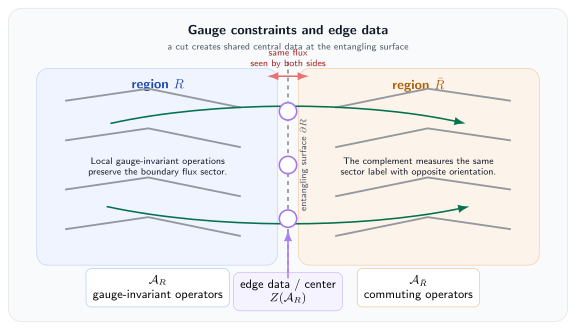
There are two common ways to proceed.
One can use an extended Hilbert space. Artificial edge degrees of freedom are introduced at the entangling surface so that the enlarged Hilbert space factorizes. The price is that the edge modes must be treated carefully, and their entropy contributes boundary-local terms.
Alternatively, one can avoid introducing unphysical tensor factors and work directly with operator algebras. The observables localized to a region form an algebra, and the algebra may have a nontrivial center. This is usually the cleaner language for holography.
Algebras instead of factors
Section titled “Algebras instead of factors”An operator algebra is a collection of operators closed under addition, multiplication, adjoint, and scalar multiplication. In finite dimensions, the essential idea is simple: a region is characterized by the observables one can measure or reconstruct there.
The commutant of is
The center is
Operators in the center commute with everything in the algebra and with everything in the commutant. They behave like shared classical labels.
A finite-dimensional von Neumann algebra has a canonical block decomposition. Up to unitary equivalence, the Hilbert space can be written as
and the algebra takes the form
Its commutant is
and its center is
The label is the central sector. Measuring the center tells us which block we are in, but it does not measure the quantum state inside or .
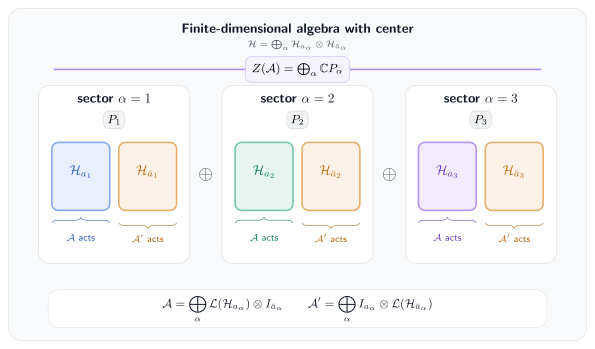
This block decomposition is the algebraic version of “a region and its complement.” When the center is trivial, there is only one sector and the usual tensor-factor picture is recovered. When the center is nontrivial, the correct structure is a direct sum of tensor products, not a single tensor product.
Algebraic entropy
Section titled “Algebraic entropy”If has a nontrivial center, there is no unique reduced density matrix in the naive tensor-factor sense. But there is a natural entropy associated with the algebra.
Let a state decompose into central sectors with probabilities
where projects onto sector . Inside each sector, let be the normalized density matrix seen by the algebra . Then the algebraic entropy is
where
The first term is the entropy of the central, effectively classical sector label. The second term is the average quantum entropy inside each sector.
This formula separates two kinds of uncertainty:
In gauge theory, the central label can be electric flux through the entangling surface. In gravity, the analogous central data are geometric variables at the cut. In holography, the leading central variable is the area of the RT/HRT/QES surface.
There is a convention-dependent issue here. In an extended Hilbert-space treatment of gauge theory, one often obtains additional terms associated with edge-mode degeneracies. In an algebraic treatment, these terms are associated with choices of algebra and regulator. Universal quantities such as relative entropy and mutual information are usually less sensitive to these boundary-local ambiguities.
Edge modes in gauge theory
Section titled “Edge modes in gauge theory”The simplest place where these ideas become physical is lattice gauge theory. Consider a gauge theory on a spatial lattice and cut the lattice into a region and its complement . Gauge-invariant states obey Gauss constraints at vertices. The electric flux through the cut must match on both sides.
Schematically, the physical Hilbert space decomposes as
where labels the flux sector at the cut. The electric flux through the entangling surface is measured by an operator in the center of the gauge-invariant algebra of region .
For an Abelian gauge theory, may be a set of electric-flux eigenvalues. For a non-Abelian gauge theory, the boundary data include representation labels and additional electric or magnetic edge structure. In either case, the lesson is robust: when one cuts a gauge theory, one either works with algebras with centers or enlarges the Hilbert space by adding edge modes.
The two descriptions are closely related:
The extended Hilbert-space description introduces extra boundary variables so that each side can be treated as if it had its own Hilbert space. Gauge invariance is restored by gluing the edge variables across the cut. The algebraic description keeps the physical Hilbert space but accepts that the local algebra has a center.
Gravity has an analogous but deeper edge-mode story. The gravitational edge data include the location and geometry of the entangling surface and transformations that move or rotate the normal frame. The area term is the most familiar remnant of these gravitational edge degrees of freedom in semiclassical entropy formulas.
Operator-algebra quantum error correction
Section titled “Operator-algebra quantum error correction”Now combine this with quantum error correction.
Let
be an encoding map. The physical Hilbert space might be the boundary CFT Hilbert space, and might be a semiclassical bulk code subspace.
For ordinary subregion reconstruction, we ask whether every logical operator acting on a bulk factor has a physical representative supported on a boundary region :
Operator-algebra QEC replaces the factor by a logical algebra . The reconstruction condition is
This is the right language when the logical region has gauge constraints or a nontrivial center.
There is also an algebraic version of the Knill-Laflamme condition. Suppose erasure of is the noise channel, with error operators . Let be the projector onto the code subspace. Then the algebra is correctable if
For ordinary subspace QEC, this reduces to the usual statement that the error algebra acts trivially on the logical information. For operator-algebra QEC, the error algebra is allowed to act nontrivially on degrees of freedom in the commutant, but not on the algebra we want to recover.
This is exactly what one expects from entanglement wedge reconstruction. A boundary region need not reconstruct the entire bulk code subspace. It reconstructs the algebra of bulk observables in .
Complementary recovery
Section titled “Complementary recovery”The central structural property of holographic subregion duality is complementary recovery.
Let and be complementary boundary regions. Let be the entanglement wedge of , and let be the entanglement wedge of . Then, schematically,
In words:
If the wedge cut has a nontrivial center, central operators may be represented on both sides. This does not violate no-cloning, because central operators carry commuting classical data. They are not arbitrary noncommuting quantum operators.
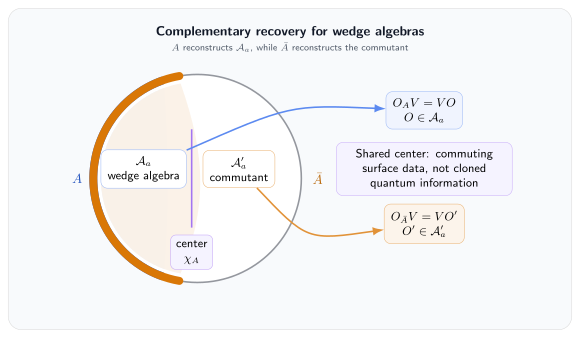
This is the algebraic form of subregion duality. It is more precise than saying “the bulk region belongs to .” A region does not own a Hilbert-space factor in a gauge-invariant gravitational theory. Rather, a boundary algebra represents a bulk algebra.
The RT area term as an operator
Section titled “The RT area term as an operator”The quantum-corrected RT/QES formula has the schematic form
where is the entanglement wedge bounded by and .
In the operator-algebra QEC interpretation, the entropy of boundary region is written as
Here is a positive operator that lies in the center of the logical algebra. In holography, it is identified with the area operator plus counterterms:
The fact that is central is crucial. The area of the entangling surface is shared data between the two wedge algebras. It is not an operator localized strictly on one side in the same way as an ordinary matter field.
In a basis of area sectors,
where projects onto the sector with area .
If the state has sector probabilities , then a schematic entropy formula is
Depending on conventions, the Shannon term may be grouped with the bulk algebraic entropy. The important point is invariant: the entropy separates into a geometric central contribution and a bulk-algebra contribution.
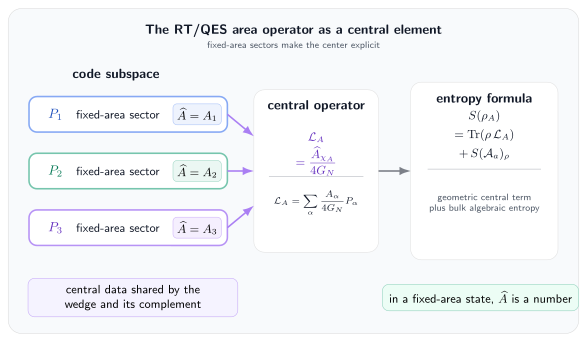
This viewpoint explains why the area term can behave like an entropy without being the entropy of ordinary local bulk matter. It is the entropy cost associated with the way the code is glued across the entangling surface.
Fixed-area sectors
Section titled “Fixed-area sectors”A particularly clean limit is obtained by projecting onto states in which the RT/HRT surface has definite area. In such a fixed-area state, the area operator is approximately a number:
Then the leading geometric part of the entropy is fixed:
Fixed-area states are useful because they remove fluctuations in the central area label. Many otherwise mysterious properties of holographic entropy become simpler in these sectors. For example, the leading area contribution behaves like a fixed edge-mode contribution across the RT surface.
General semiclassical states can be thought of as superpositions or mixtures of fixed-area sectors:
The reduced state of a boundary region is then organized into central blocks. The RT area is not just the expectation value of a classical geometric quantity; it is part of the algebraic structure of the encoding.
Relative entropy and the JLMS cancellation
Section titled “Relative entropy and the JLMS cancellation”Recall the JLMS relation:
within the regime where the same entanglement wedge is being compared. Operator-algebra QEC explains why this relation is natural.
Suppose the boundary entropy has the algebraic form
For a reference state , the modular Hamiltonian restricted to the code has the schematic form
Relative entropy is
Substituting the two algebraic formulas gives
The area terms cancel. This cancellation is the algebraic heart of JLMS.
The cancellation also clarifies the relation between entropy and reconstruction. Relative entropy measures distinguishability. If the boundary relative entropy equals the bulk algebraic relative entropy, then the boundary region has exactly the distinguishability needed to reconstruct the bulk algebra.
The homology constraint and central data
Section titled “The homology constraint and central data”The classical RT formula includes a homology constraint: the surface must be homologous to the boundary region . This constraint is essential in black-hole backgrounds. For example, in a thermal state dual to an AdS black hole, the homology constraint allows the horizon area to contribute to the entropy of the boundary region.
The algebraic viewpoint gives a complementary way to think about this. Instead of saying only that a surface is allowed or disallowed by homology, one asks which algebra is being reconstructed and what its center is.
The entanglement-wedge algebra associated with includes central data on the RT/HRT/QES surface. The complementary wedge algebra associated with includes the same central data. The surface is therefore not assigned exclusively to one side as an ordinary tensor factor. It is a shared gluing structure.
A useful mnemonic is
This mnemonic should not be interpreted too literally, because the exact separation of bulk entropy, edge entropy, and counterterms is regulator dependent. But it captures the semiclassical organization of the formula.
Black holes, islands, and interior reconstruction
Section titled “Black holes, islands, and interior reconstruction”The algebraic language is especially useful for black hole information.
Before the Page time, the radiation region has no island. Its reconstructible bulk algebra is essentially the algebra of ordinary exterior radiation modes. The black-hole interior is not in the entanglement wedge of .
After the Page time, the island saddle dominates. The radiation entropy is computed by
The algebraic interpretation is
The island is not an independent Hilbert-space factor secretly stored inside the radiation. Rather, within the gravitational code, the operator algebra of the island is encoded in the radiation degrees of freedom. The QES area is a central contribution associated with the interface .
This wording helps avoid several common misconceptions.
First, the statement is not that the same interior quantum system is literally duplicated in the black hole and in the radiation. Quantum error correction allows different reconstructions of the same logical operator on different physical regions, but only within a code subspace.
Second, the island formula does not mean that all interior operators are simple radiation operators. Reconstruction may be highly complex, state-dependent in practice, and limited to a specified code subspace.
Third, the area term should not be thought of as ordinary matter entanglement. It is geometric edge data, and it belongs naturally to the center of the relevant algebra.
Common pitfalls
Section titled “Common pitfalls”Pitfall 1: “The bulk Hilbert space factorizes across the RT surface.”
Section titled “Pitfall 1: “The bulk Hilbert space factorizes across the RT surface.””This is usually too strong. A better statement is that the bulk algebra associated with a wedge has a commutant and possibly a center. In a fixed sector, the description may look approximately factorized, but the full structure remembers the surface data.
Pitfall 2: “The area term is just ordinary bulk entropy.”
Section titled “Pitfall 2: “The area term is just ordinary bulk entropy.””The bulk entropy term is the entropy of quantum fields in the entanglement wedge. The area term is a gravitational surface contribution. In the code-subspace description it is represented by a central operator.
Pitfall 3: “If both sides see the center, information has been cloned.”
Section titled “Pitfall 3: “If both sides see the center, information has been cloned.””A center is classical superselection data from the algebraic viewpoint. Two commuting algebras can share the same central label without each containing an independent copy of the full noncommuting quantum algebra.
Pitfall 4: “The island is literally a tensor factor inside the radiation.”
Section titled “Pitfall 4: “The island is literally a tensor factor inside the radiation.””The island is part of the radiation entanglement wedge. This means that the radiation algebra has representatives of island operators. It does not mean that the radiation Hilbert space literally factorizes as in any simple microscopic way.
Pitfall 5: “Operator-algebra language is optional formalism.”
Section titled “Pitfall 5: “Operator-algebra language is optional formalism.””For many leading-order computations one can avoid it. But for edge modes, fixed-area sectors, gauge constraints, state dependence, complementary recovery, and precise versions of subregion duality, the algebraic language is the clean one.
Summary
Section titled “Summary”The operator-algebra viewpoint refines the earlier QEC story as follows:
The finite-dimensional algebraic model is
with
This formula is the clean algebraic version of the quantum-corrected RT/QES formula. It explains why the area term appears in entropy, why it cancels in relative entropy, why edge modes matter, and why black-hole interior reconstruction should be stated in terms of algebras rather than naive tensor factors.
Exercises
Section titled “Exercises”Exercise 1: Commutant and center of a direct-sum algebra
Section titled “Exercise 1: Commutant and center of a direct-sum algebra”Let
and define
Find and .
Solution
The commutant acts as the identity on the factors where acts nontrivially and acts freely on the complementary factors. Therefore
The center consists of operators that are in both and . Inside each block, the only operators that commute with the full matrix algebra on both tensor factors are scalar multiples of the identity. Hence
The center measures which block the state occupies.
Exercise 2: Algebraic entropy with two sectors
Section titled “Exercise 2: Algebraic entropy with two sectors”Suppose an algebra has two sectors with probabilities and . In sector , the reduced state on the algebraic factor has entropy . In sector , it has entropy . Write the algebraic entropy.
Solution
The entropy is the sum of the classical Shannon entropy of the sector label and the average entropy within each sector:
The first two terms are central entropy. The last two terms are ordinary von Neumann entropies inside the fixed sectors.
Exercise 3: Why electric flux is central
Section titled “Exercise 3: Why electric flux is central”In Maxwell theory, consider a region with boundary . Explain why the normal electric flux
is naturally a central variable for the gauge-invariant operator algebra of .
Solution
Gauge-invariant operators strictly localized in cannot change the total electric flux through without violating Gauss’s law. The integrated Gauss constraint gives
Thus the flux through the boundary is tied to the total charge inside. Local gauge-invariant operations in may rearrange charge and fields inside a fixed flux sector, but they do not change the sector label.
The same flux is also measurable from the complementary side, with the opposite orientation convention. Therefore it is shared boundary data. It commutes with the gauge-invariant algebras on both sides and acts as a central variable.
Exercise 4: Area sectors and entropy
Section titled “Exercise 4: Area sectors and entropy”Suppose a holographic code subspace has two fixed-area sectors with areas and . A state has probabilities and in the two sectors. The bulk algebra entropy inside the two sectors is and . Write the corresponding boundary entropy in the algebraic RT form.
Solution
The central area contribution is the probability-weighted average
The algebraic bulk entropy is
Therefore
This is the finite-dimensional algebraic version of the quantum-corrected RT formula.
Exercise 5: Area cancellation in relative entropy
Section titled “Exercise 5: Area cancellation in relative entropy”Assume two code states and lie in the same fixed-area sector for the QES . Suppose
and
Show that
Solution
Relative entropy can be written as
where means minus .
Since the two states are in the same fixed-area sector,
Therefore
Also,
because the fixed area term cancels. Hence
This is the fixed-area version of the JLMS cancellation mechanism.
Exercise 6: Island algebra after the Page transition
Section titled “Exercise 6: Island algebra after the Page transition”Let be the radiation region. Before the Page time, assume the radiation entanglement wedge contains no island. After the Page time, assume an island is included in . State the operator-algebra QEC meaning of this transition.
Solution
Before the Page time, the algebra reconstructed by is the algebra of ordinary exterior radiation degrees of freedom. Island operators are not in the radiation entanglement wedge, so they are not reconstructable from within the semiclassical code subspace.
After the Page time, the island is included in the entanglement wedge:
The algebraic reconstruction statement is that the island algebra has representatives on the radiation:
More explicitly, for every island operator , there is a radiation operator such that
on the relevant code subspace.
The boundary carries central geometric data, especially the area term in the island formula. Therefore the transition is not best described as the radiation literally acquiring an independent Hilbert-space tensor factor . It is better described as a change in the logical algebra reconstructable from .
Further reading
Section titled “Further reading”-
C. Bény, A. Kempf, and D. W. Kribs, Generalization of Quantum Error Correction via the Heisenberg Picture.
Introduces the algebraic generalization of quantum error correction. -
A. Almheiri, X. Dong, and D. Harlow, Bulk Locality and Quantum Error Correction in AdS/CFT.
The foundational paper connecting holographic bulk locality with quantum error correction. -
X. Dong, D. Harlow, and A. C. Wall, Reconstruction of Bulk Operators within the Entanglement Wedge in Gauge-Gravity Duality.
Establishes entanglement wedge reconstruction using relative entropy and QEC logic. -
D. Harlow, The Ryu-Takayanagi Formula from Quantum Error Correction.
Gives the operator-algebra QEC derivation of the quantum-corrected RT formula and the central area operator. -
H. Casini, M. Huerta, and J. A. Rosabal, Remarks on Entanglement Entropy for Gauge Fields.
A clear discussion of the algebraic subtleties of entanglement entropy in gauge theories. -
W. Donnelly and L. Freidel, Local Subsystems in Gauge Theory and Gravity.
Develops the edge-mode viewpoint for gauge theory and gravity. -
W. Donnelly, Entanglement Entropy and Nonabelian Gauge Symmetry.
Discusses edge-mode contributions to entanglement entropy in non-Abelian gauge theory. -
D. Harlow, TASI Lectures on the Emergence of the Bulk in AdS/CFT.
Pedagogical background on code subspaces, reconstruction, and holographic quantum error correction.