
Black Hole Information
Black holes force together three ideas that are usually taught in separate courses: general relativity, quantum field theory, and quantum information. Classically, a black hole is a region from which nothing escapes. Thermodynamically, it behaves like an object with entropy proportional to area. Quantum mechanically, it radiates. Holographically, it is described by an ordinary quantum system with unitary time evolution.
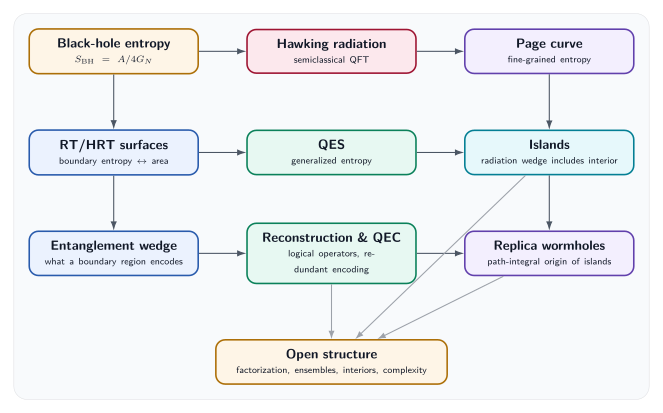
The tension among these statements is the black hole information problem. The modern resolution is not a single slogan such as “information comes out.” It is a web of precise statements about generalized entropy, quantum extremal surfaces, entanglement wedges, replica wormholes, and quantum error correction. The purpose of this section is to make that web navigable.
The conceptual spine is:
The first formula says that geometry carries entropy. The second says that the entropy relevant in semiclassical gravity is not just an area, but an area plus the ordinary entropy of quantum fields. The third says that the surface appearing in a gravitational entropy formula should be chosen by extremizing this generalized entropy. The fourth says that, when computing the fine-grained entropy of Hawking radiation, the relevant bulk region can include an interior island. The last says that the entropy of the radiation can follow the unitary Page curve rather than Hawking’s monotonically growing semiclassical answer.
What is the paradox?
Section titled “What is the paradox?”Start with a pure quantum state that collapses to form a black hole. Semiclassical quantum field theory on the resulting black-hole spacetime predicts Hawking radiation that is approximately thermal. If the black hole evaporates completely and the final state is only thermal radiation, the evolution seems to map
where is pure but is mixed. This is not ordinary unitary quantum mechanics.
One can phrase the problem as an incompatible triad:
- Unitary quantum mechanics: the complete state evolves by a unitary operator.
- Semiclassical effective field theory: outside the horizon, low-energy physics is well described by QFT on a smooth spacetime.
- A smooth horizon: an infalling observer sees no violent drama at the horizon of a sufficiently large black hole.
The modern story does not simply discard one item. Instead, it clarifies the domains of validity of each. The exterior Hawking calculation is a good approximation to many local observables, but it is not the correct calculation of the fine-grained entropy of all the radiation at late times. The subtlety is nonlocal from the viewpoint of semiclassical geometry but natural from the viewpoint of holography.
Coarse-grained entropy versus fine-grained entropy
Section titled “Coarse-grained entropy versus fine-grained entropy”A recurring source of confusion is that several different quantities are called “entropy.” They answer different questions.
The thermodynamic entropy of a black hole is
For a stationary black hole this is a coarse-grained entropy: it counts the number of microscopic states compatible with macroscopic data such as mass, angular momentum, and charge. It is analogous to the entropy of a gas at fixed energy and volume.
The von Neumann entropy of a density matrix is
This is a fine-grained entropy. For the complete state of a closed quantum system, is constant under unitary evolution. For a subsystem, it can change because the subsystem becomes entangled with its complement.
The generalized entropy is
Here is the von Neumann entropy of quantum fields in a bulk region , and the dots denote higher-derivative and counterterm contributions. This is the quantity that gravity asks us to extremize when computing quantum-corrected holographic entropy.
The paradox becomes sharp when Hawking’s calculation is interpreted as a calculation of the fine-grained entropy of the radiation. Semiclassically, the radiation entropy grows as more outgoing modes are produced. But in a unitary evaporation process, the fine-grained entropy of the radiation must eventually decrease, because the final radiation state should be pure.
A schematic unitary Page curve is
This formula should not be read as an exact theorem. It is a useful leading-order cartoon: before the Page time the Hawking saddle dominates, while after the Page time a different entropy saddle dominates.
The holographic viewpoint
Section titled “The holographic viewpoint”AdS/CFT gives a particularly clean setting because the boundary theory is an ordinary nongravitational quantum system. If the CFT evolves unitarily, then any bulk black hole process described by that CFT must also be unitary. The problem is not whether the answer is unitary; the problem is how bulk semiclassical gravity knows this.
The essential holographic lesson is that bulk locality is emergent and redundant. A bulk region is not assigned to a boundary region by naive geometric projection. Instead, a boundary subregion encodes its entanglement wedge , the bulk domain of dependence bounded by and an appropriate extremal surface. In the classical limit this surface is the RT/HRT surface; with quantum corrections it is a quantum extremal surface.
For a boundary region , the quantum-corrected entropy takes the schematic form
where is a codimension-two surface homologous to , and is the bulk region between and . This formula compresses a remarkable amount of physics:
- the area term remembers black-hole thermodynamics;
- the bulk entropy term remembers ordinary quantum entanglement;
- extremization is the gravitational equation that selects the surface;
- minimization chooses the dominant saddle;
- the resulting wedge tells us which bulk operators can be reconstructed from .
When is the radiation system collected outside an evaporating black hole, the same logic leads to the island rule:
The new object is the island , a gravitating region that is included in the entropy calculation even though the radiation system is outside the black hole. After the Page time, the dominant island saddle often places behind the horizon. In entanglement-wedge language, part of the black-hole interior is encoded in the radiation.
How the pages fit together
Section titled “How the pages fit together”This section is organized as a sequence of lecture notes. The early pages are conceptual and thermodynamic; the middle pages develop the holographic entropy and reconstruction machinery; the later pages explain islands, replica wormholes, and open puzzles.
| Order | Page | Main question |
|---|---|---|
| 1 | Overview | What is the conceptual map? |
| 2 | Black Hole Entropy and the Holographic Principle | Why does geometry carry entropy? |
| 3 | Hawking Radiation and the Information Paradox | Why does semiclassical radiation look nonunitary? |
| 4 | Page Curve and Fine-Grained Entropy | What entropy curve does unitarity require? |
| 5 | Holographic Entanglement: RT and HRT | How does boundary entropy become bulk area? |
| 6 | Quantum Extremal Surfaces and the Island Rule | How do quantum corrections produce islands? |
| 7 | Entanglement Wedge, JLMS, and Relative Entropy | Which bulk region is encoded in a boundary region? |
| 8 | Bulk Reconstruction and Quantum Error Correction | Why is bulk information redundantly encoded? |
| 9 | Operator-Algebra QEC, Edge Modes, and the Area Operator | What replaces Hilbert-space factorization in gravity? |
| 10 | Islands in JT Gravity | How does the Page curve appear in a controlled model? |
| 11 | Higher-Dimensional Islands and Double Holography | How do islands appear beyond two dimensions? |
| 12 | Replica Wormholes and the Gravitational Replica Trick | What path-integral saddles justify the island rule? |
| 13 | ER=EPR, Wormholes, and Black Hole Interiors | How are entanglement and geometry related? |
| 14 | Complexity Proposals: Volume, Action, and Beyond | Why might reconstruction be computationally hard? |
| 15 | Factorization Puzzles, Ensembles, and Open Problems | What is still not fully understood? |
A good first reading path is pages 2, 3, 4, 5, 6, 10, and 12. That path takes you from black-hole entropy to the island derivation of the Page curve. A more holographic path is pages 5, 6, 7, 8, and 9. A more speculative but research-facing path is pages 12, 13, 14, and 15.
Notation
Section titled “Notation”The following notation will be used throughout this section.
| Symbol | Meaning |
|---|---|
| Newton’s constant in the relevant bulk dimension. | |
| Planck’s constant. Many formulas later use units with . | |
| A boundary spatial region, or sometimes an area when context is clear. | |
| The complement of the boundary region . | |
| A nongravitating radiation region or radiation Hilbert space. | |
| An island, usually a gravitating region included in the entropy of . | |
| A candidate extremal surface. | |
| The RT/HRT surface anchored to . | |
| The causal information surface associated with . | |
| The entanglement wedge of boundary region . | |
| The reduced density matrix on region . | |
| The modular Hamiltonian of . | |
| The von Neumann entropy . | |
| Relative entropy between states and . | |
| Bekenstein-Hawking entropy, . | |
| Generalized entropy, area term plus bulk entropy. | |
| Entropy of bulk quantum fields in a specified region. | |
| Fine-grained entropy of the collected Hawking radiation. | |
| Time when becomes comparable to the remaining black-hole entropy. | |
| A low-energy bulk code subspace embedded in the CFT Hilbert space. |
Unless stated otherwise, logarithms are natural logarithms. In many holographic formulas the leading area contribution scales like , while ordinary bulk entanglement is . In evaporating black-hole problems, however, large boosts and long times can make the bulk entropy gradients compete with area gradients; this is why quantum extremal surfaces can move in ways invisible to classical RT/HRT reasoning.
Three levels of description
Section titled “Three levels of description”It is useful to separate three descriptions of the same physics.
1. Boundary quantum mechanics
Section titled “1. Boundary quantum mechanics”In AdS/CFT, the boundary theory is a nongravitational quantum system. Its Hilbert space evolves unitarily. Fine-grained entropy is computed by ordinary density matrices. There is no fundamental loss of information in this description.
2. Semiclassical bulk effective theory
Section titled “2. Semiclassical bulk effective theory”The bulk description uses a smooth spacetime plus quantum fields propagating on it. This description is excellent for local, low-energy observables outside the horizon. It also explains why Hawking radiation is approximately thermal. But when asked to compute a global fine-grained entropy at late times, it misses nonperturbative correlations unless one includes the correct gravitational entropy saddles.
3. Gravitational path integral
Section titled “3. Gravitational path integral”The gravitational path integral computes entropy using replicas. It is not restricted to geometries in which the replicas remain disconnected. Replica wormholes are connected saddles linking different replicas. In the limit of the replica trick, these saddles lead to quantum extremal surfaces and islands.
A large part of the subject is the dictionary among these descriptions. The same Page transition can be described as a change of dominant QES, a change of entanglement wedge, a property of quantum error correction, or a replica-wormhole saddle in the gravitational path integral.
What would count as a resolution?
Section titled “What would count as a resolution?”A satisfactory resolution of the information problem should explain at least four things.
First, it should reproduce the Page curve for the fine-grained entropy of radiation:
up to corrections that depend on the model and ensemble.
Second, it should preserve the success of semiclassical QFT for ordinary exterior observations. The point is not that Hawking’s local calculation is useless. The point is that a local calculation of radiation production is not the same as a nonperturbative calculation of the fine-grained entropy of all radiation.
Third, it should explain how interior information is encoded without violating no-cloning. The modern answer uses entanglement wedge reconstruction: an interior operator can have different reconstructions on different boundary systems, but these reconstructions act on a code subspace and are not independent copies of the same operational information.
Fourth, it should clarify what remains unresolved. Islands and replica wormholes teach us how the Page curve can emerge from semiclassical gravity, but they also expose deeper questions about factorization, ensemble averages, gravitational path integrals, and state dependence.
Common pitfalls
Section titled “Common pitfalls”Pitfall 1: “Hawking radiation is thermal, so information is definitely lost.” The radiation is approximately thermal in perturbative semiclassical calculations of local observables. Fine-grained entropy is a more delicate observable. In a unitary theory, exponentially small correlations in the state can matter enormously for entropy.
Pitfall 2: “The island is a physical piece of space that flies into the detector.” The island is not transported to the radiation region. It is a region included in the gravitational entropy prescription for . Operationally, it means that degrees of freedom in the island are encoded in the radiation’s entanglement wedge.
Pitfall 3: “RT/HRT surfaces and QES surfaces are just geometric tricks.” They are geometric, but not merely tricks. They encode deep statements about relative entropy, modular flow, and quantum error correction.
Pitfall 4: “The Page curve solves every black-hole puzzle.” It solves a central entropy puzzle, but not every microscopic question. The detailed unitary map, the exact meaning of the gravitational path integral, and the status of factorization in theories with wormholes remain active research topics.
Minimal prerequisites
Section titled “Minimal prerequisites”The following background is useful.
- General relativity: horizons, surface gravity, Penrose diagrams, and black-hole thermodynamics.
- Quantum field theory: density matrices, entanglement entropy, path integrals, and QFT in curved spacetime.
- AdS/CFT: the basic bulk-boundary dictionary, large , and classical gravity as a limit of the CFT.
- Quantum information: relative entropy, quantum error correction, and the idea of a code subspace.
One can still read the first few pages with only basic GR and QFT. The later pages assume more familiarity with holographic entanglement and quantum information.
Exercises
Section titled “Exercises”Exercise 1: Classifying entropies
Section titled “Exercise 1: Classifying entropies”Classify each entropy below as primarily coarse-grained, fine-grained, or generalized.
- for a stationary Schwarzschild black hole.
- for collected Hawking radiation .
- in the island formula.
- The thermal entropy of a CFT at fixed temperature.
Solution
- is usually interpreted as a coarse-grained entropy of the black hole, although in holography it can also count microscopic states in the dual theory.
- is a fine-grained von Neumann entropy of a subsystem.
- is a generalized entropy.
- The thermal entropy of a CFT is coarse-grained if it is computed from a thermal ensemble, although it can equal the entropy of a subsystem in special fine-grained setups such as tracing out one side of a thermofield double state.
Exercise 2: Why the Page curve must turn over
Section titled “Exercise 2: Why the Page curve must turn over”Suppose an evaporating black hole begins in a pure state and evaporates completely into radiation. Explain why the fine-grained entropy of all emitted radiation must vanish at very early and very late times, assuming unitary evolution and no leftover remnant.
Solution
At very early times, before any radiation has been emitted, the radiation Hilbert space is essentially empty, so its entropy is zero. At very late times, if evaporation is complete and there is no remnant, the radiation is the whole closed system. Since the initial state was pure and time evolution is unitary, the final radiation state is also pure. Therefore its fine-grained entropy again vanishes. The entropy can be large at intermediate times because the radiation subsystem is entangled with the remaining black hole.
Exercise 3: Two competing saddles
Section titled “Exercise 3: Two competing saddles”Assume a simplified model in which the no-island entropy grows as , while the island entropy is approximately , with positive constants , , and . The physical answer is the smaller of the two saddles. Find the Page time in this model.
Solution
The Page transition occurs when the two candidate entropies are equal:
Thus
Before this time the no-island saddle dominates, and after this time the island saddle dominates. This model is only schematic, but it captures the logic of a saddle-point transition in the entropy calculation.
Exercise 4: No-cloning and reconstruction
Section titled “Exercise 4: No-cloning and reconstruction”After the Page time, the radiation’s entanglement wedge can include part of the black-hole interior. Why does this not mean that there are two independent copies of the same interior degree of freedom, one in the black hole and one in the radiation?
Solution
Entanglement wedge reconstruction is a statement about logical operators in a code subspace, not about independent duplication of microscopic degrees of freedom. The same logical bulk operator may have different boundary reconstructions, but these reconstructions are not independent physical copies that can be compared arbitrarily. They are different representations of one encoded operator, valid in specified regimes and code subspaces. This is analogous to quantum error correction, where a logical qubit can be recoverable from different subsets of physical qubits without violating the no-cloning theorem.
Further reading
Section titled “Further reading”These references are not prerequisites for the first read, but they anchor the main ideas historically and technically.
- J. D. Bekenstein, “Black Holes and Entropy”, Phys. Rev. D 7, 2333 (1973).
- S. W. Hawking, “Particle Creation by Black Holes”, Commun. Math. Phys. 43, 199 (1975).
- D. N. Page, “Information in Black Hole Radiation”, Phys. Rev. Lett. 71, 3743 (1993).
- J. Maldacena, “The Large Limit of Superconformal Field Theories and Supergravity”, Adv. Theor. Math. Phys. 2, 231 (1998).
- S. Ryu and T. Takayanagi, “Holographic Derivation of Entanglement Entropy from AdS/CFT”, Phys. Rev. Lett. 96, 181602 (2006).
- V. E. Hubeny, M. Rangamani, and T. Takayanagi, “A Covariant Holographic Entanglement Entropy Proposal”, JHEP 07, 062 (2007).
- N. Engelhardt and A. C. Wall, “Quantum Extremal Surfaces”, JHEP 01, 073 (2015).
- D. L. Jafferis, A. Lewkowycz, J. Maldacena, and S. J. Suh, “Relative Entropy Equals Bulk Relative Entropy”, JHEP 06, 004 (2016).
- A. Almheiri, X. Dong, and D. Harlow, “Bulk Locality and Quantum Error Correction in AdS/CFT”, JHEP 04, 163 (2015).
- G. Penington, “Entanglement Wedge Reconstruction and the Information Paradox”, JHEP 09, 002 (2020).
- A. Almheiri, N. Engelhardt, D. Marolf, and H. Maxfield, “The Entropy of Bulk Quantum Fields and the Entanglement Wedge of an Evaporating Black Hole”, JHEP 12, 063 (2019).
- G. Penington, S. H. Shenker, D. Stanford, and Z. Yang, “Replica Wormholes and the Black Hole Interior”, JHEP 03, 205 (2022).
- A. Almheiri, T. Hartman, J. Maldacena, E. Shaghoulian, and A. Tajdini, “Replica Wormholes and the Entropy of Hawking Radiation”, JHEP 05, 013 (2020).
The next page begins with the thermodynamic foundation: why the entropy of a black hole scales like area rather than volume, and why this observation already points toward holography.